Facts
The dispute concerned agricultural land admeasuring Ac.3.00 in Sy.No.727/1 at Chinnagudur Village, Mahabubabad District, including Ac.1.00 in Sy.No.727/1/A. The petitioners claimed title through succession from Murari Chandraiah, mutation in favour of petitioner No.1, and subsequent registered gift deeds in favour of petitioner Nos.2 and 3, followed by mutation and issuance of pattadar pass books.
Source reference: para. 4Respondent No.6 claimed title under a registered sale deed dated 31.12.2001 executed by the alleged legal heirs of Murari Somaiah and sought cancellation of the petitioners’ mutations and pattadar pass books before the Revenue Divisional Officer.
Source reference: paras. 5–6During the proceedings, the Telangana Rights in Land and Pattadar Pass Books Act, 1971 was repealed and the pending appeal was transferred to the Special Tribunal under Section 16 of the Telangana Rights in Land and Pattadar Pass Books Act, 2020.
Source reference: para. 7Respondent No.6 died on 29.01.2021, before the Special Tribunal passed its orders, but his legal representatives were not brought on record.
Source reference: para. 7Nevertheless, the Tribunal cancelled the petitioners’ mutations and pattadar pass books by order dated 25.06.2021, while directing the parties to approach the civil court for declaration of title.
Source reference: para. 10After the Tribunal’s order, respondent Nos.7 to 9 instituted O.S. No.288 of 2021 seeking declaration of title, recovery of possession, rectification of revenue entries and injunction; the suit remained pending.
Source reference: para. 11During the writ proceedings, the 2020 Act was repealed by the Telangana Bhu Bharati (Record of Rights in Land) Act, 2025, which preserved actions taken under the repealed Act and provided for mutation in accordance with civil-court decrees.
Source reference: paras. 8–9Issues
Whether the writ petition was maintainable despite Section 16(2) of the 2020 Act declaring orders of the Special Tribunal final, and despite respondent No.6 having died before the writ petition was instituted?
Source reference: para. 21(i)Whether the order of the Special Tribunal was void because it was passed after the death of respondent No.6 without bringing his legal representatives on record or affording them an opportunity of hearing?
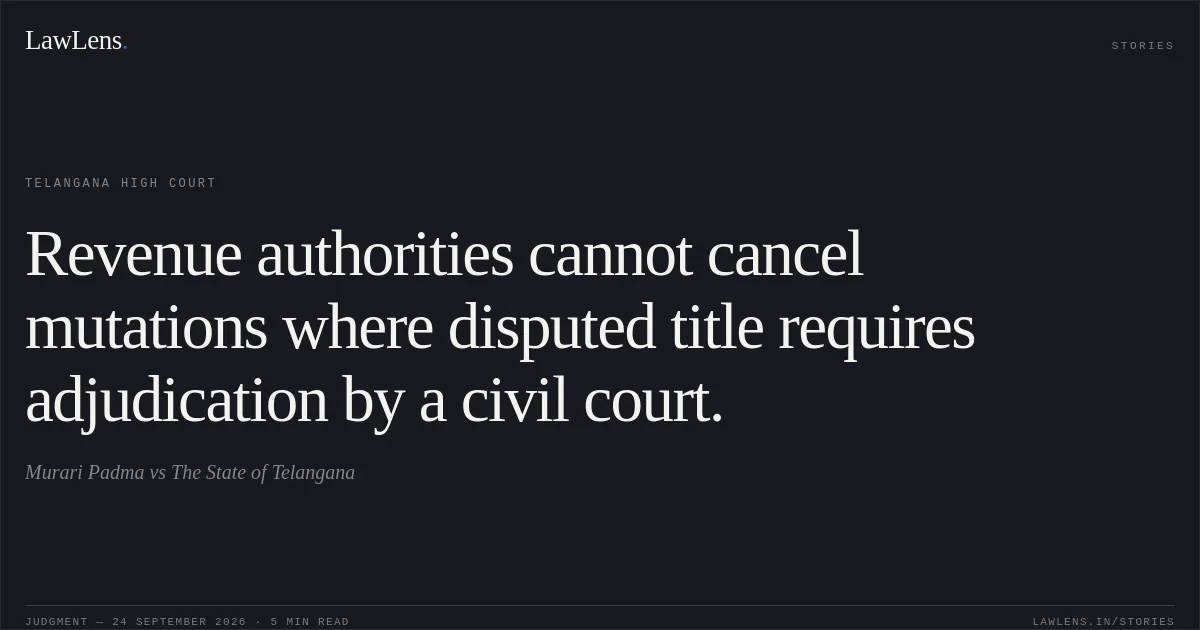
Source reference: para. 21(ii)Whether the Special Tribunal could cancel the petitioners’ mutations and pattadar pass books when the rival claims involved disputed questions of title pending adjudication before the civil court?
Source reference: para. 21(iii)What relief should be granted?
Source reference: para. 21(iv)Law Applied
The Court held that the finality clause in Section 16(2) of the 2020 Act operated only within the statutory hierarchy and could not exclude the High Court’s constitutional judicial-review jurisdiction under Articles 226 and 227, particularly in cases involving jurisdictional error or breach of natural justice.
Source reference: paras. 22–23; L. Chandra Kumar v. Union of India, (1997) 3 SCC 261Under the principles in Karuppaswamy v. C. Ramamurthy, (1993) 4 SCC 41, and Pankajbhai Rameshbhai Zalavadiya v. Jethabhai Kalabhai Zalavadiya, (2017) 9 SCC 700, a bona fide mistake in impleading a dead party may be cured by bringing the legal representatives on record.
Source reference: paras. 25–27However, an order or decree passed for or against a dead person is a nullity, as recognised in Kiran Singh v. Chaman Paswan, AIR 1954 SC 340, and Gurnam Singh v. Gurbachan Kaur, (2017) 13 SCC 414.
Source reference: paras. 30–32Section 13 of the 2020 Act conferred civil-court powers upon authorities conducting enquiries, requiring observance of procedural principles analogous to Order XXII of the Code of Civil Procedure.
Source reference: para. 33The Court further applied the settled rule that revenue mutations neither create nor extinguish title and ordinarily serve fiscal purposes: Sawarni v. Inder Kaur, (1996) 6 SCC 223; Suraj Bhan v. Financial Commissioner, (2007) 6 SCC 186; and Jitendra Singh v. State of Madhya Pradesh, 2021 SCC OnLine SC 802.
Source reference: paras. 40–43Under Sections 5–7 and 11 of the 2020 Act, and Sections 8, 10(5), 11 and 18 of the 2025 Act, revenue authorities may conduct a summary enquiry concerning entries, but disputed title must be determined by a competent civil court, after which the record of rights is to be amended in accordance with the decree.
Source reference: paras. 36–39, 45–50Reasoning
The Court first rejected the maintainability objection. Section 16(2) of the 2020 Act could not bar constitutional judicial review where the challenge alleged nullity, lack of jurisdiction and violation of natural justice.
Source reference: paras. 22–23Although the writ petition initially named the deceased respondent No.6, his legal representatives were subsequently impleaded, participated through counsel and were heard fully; no prejudice was established. Further, they had themselves failed to inform the Special Tribunal of his death or seek substitution.
Source reference: paras. 24–28On the validity of the Tribunal’s order, the Court held that respondent No.6 had died before both the interim and final orders. Since the Tribunal passed the order in favour of a person who no longer had legal existence, without substitution of his legal representatives, the order was a nullity.
Source reference: paras. 29–35Independently, the Tribunal’s order was unsustainable on merits. Having recognised that the controversy involved title and directed the parties to seek a civil-court declaration, the Tribunal could not simultaneously cancel the petitioners’ revenue entries and pattadar pass books. Such cancellation effectively prejudged the title dispute and altered the parties’ position during the pendency of the civil suit.
Source reference: paras. 47–49The pending suit itself sought recovery of possession, indicating that possession was disputed and could not be conclusively determined through summary revenue proceedings.
Source reference: para. 49The statutory scheme required the revenue record to follow, rather than precede, the civil court’s adjudication of title.
Source reference: para. 50Holding
The writ petition was allowed.
The High Court set aside the Special Tribunal’s order dated 25.06.2021 in Tribunal Case No.273 of 2021/ROR Appeal Petition No. E/656/2016/RDO, holding it void because it was passed after the death of respondent No.6 without substitution of his legal representatives and unsustainable because the Tribunal had cancelled revenue entries despite recognising that title had to be decided by the civil court.
Source reference: paras. 51–54The petitioners’ revenue entries and pattadar pass books-cum-title deeds were restored to the position existing before the impugned order, subject to the result of O.S. No.288 of 2021.
Source reference: paras. 51–54The Court expressly refrained from deciding title or possession and directed that the successful party may seek consequential mutation under Section 8 of the 2025 Act after disposal of the civil suit.
Source reference: paras. 51–54No order as to costs was made, and pending miscellaneous applications were closed.
Source reference: paras. 51–54Acts & Sections Cited
10 provisions across 3 statutes referred to in this judgment. Each provision opens on LawLens.
Telangana Rights in Land and Pattadar Pass Books Act, 20207
Telangana General Clauses Act, 1891.2
Limitation Act, 19631
Original Court PDF
Murari PadmavsThe State of Telangana
Click to open original judgment
Original judgment, available to read, download and summarize on LawLens.in