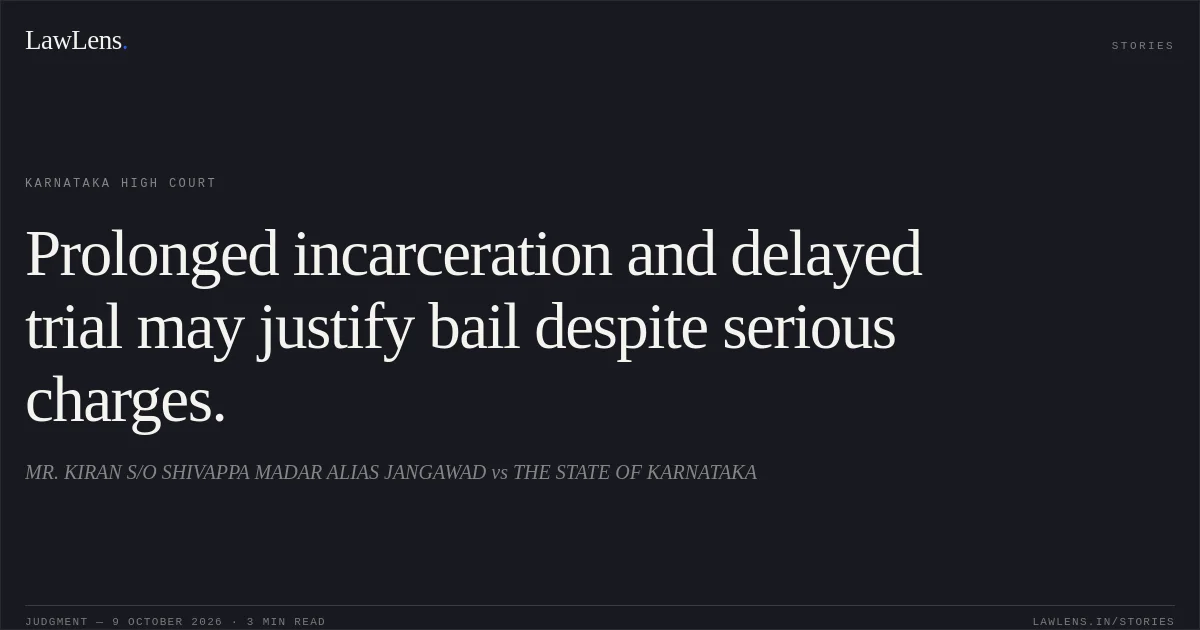
Facts
The petitioners, accused Nos. 7 and 8 in Crime No. 125/2020, sought regular bail in a case alleging offences under Sections 143, 147, 148, 341, 447, 302 and 109 read with Section 34 of the Indian Penal Code.
Source reference: pp. 2–4, paras. 2, 4, 7They had been in judicial custody since 16 September 2020, and the charge sheet had been filed.
Source reference: pp. 2–4, paras. 2, 4, 7The trial had commenced, but two of the three alleged eyewitnesses examined had not supported the prosecution.
Source reference: pp. 3–4, paras. 5–7Proceedings had also not progressed for about a year, reportedly because proceedings against a subsequently impleaded accused had been stayed.
Source reference: pp. 3–4, paras. 5–7The State opposed bail, citing the alleged pre-planned nature of the murder and the risk that the petitioners might not cooperate with the trial or might reoffend.
Source reference: p. 4, paras. 9–10Issues
1. Whether the petitioners should be released on regular bail in light of their prolonged custody, the status and pace of the trial, and the evidence recorded to date.
Source reference: pp. 3–6, paras. 5–7, 12–142. Whether the State’s objections concerning the alleged seriousness and pre-planned nature of the offence warranted refusal of bail despite the circumstances relied on by the petitioners.
Source reference: pp. 4–6, paras. 9–14Law Applied
The petition was considered under Section 439 of the Code of Criminal Procedure, 1973, corresponding to Section 483 of the Bharatiya Nagarik Suraksha Sanhita, 2023, which provides the High Court’s power to grant bail.
Source reference: pp. 1–2, paras. 2, 15The Court considered the petitioners’ period of custody, progress of the trial, the absence of identified criminal antecedents, and the risks of absconding or tampering with evidence in deciding whether bail was appropriate.
Source reference: pp. 5–6, paras. 12–14It also relied on Javed Gulam Nabi Shaikh v. State of Maharashtra and another, (2024) 9 SCC 813, and Vaibhav Singh v. State of Uttar Pradesh, SLP (Crl.) No. 7416/2026, stating that their ratio supported the petitioners; the order does not further specify the propositions drawn from those decisions.
Source reference: p. 5, para. 11; p. 6, para. 14Reasoning
The Court considered that the petitioners had remained in custody for more than five years, the trial was already underway but had not progressed for about a year, and two examined eyewitnesses had not supported the prosecution.
Source reference: pp. 3–6, paras. 5–7, 12It treated the eyewitnesses’ evidence as a mitigating consideration, not as establishing entitlement to acquittal.
Source reference: p. 5, para. 13The Court also noted that no criminal antecedents had been identified to support a conclusion that the petitioners were likely to abscond or tamper with evidence.
Source reference: p. 6, para. 13Balancing these considerations against the State’s objections, the Court held that the competing concerns could be addressed through appropriate bail conditions.
Source reference: pp. 4–6, paras. 9–14Holding
The High Court allowed the petition and directed the release of accused Nos. 7 and 8 on bail, each on a personal bond of ₹2,00,000 with two sureties for the like sum.
The petitioners were required to cooperate with the trial, refrain from tampering with evidence or threatening witnesses, attend the police station on the first and third Saturdays of each month, notify the police before leaving the police-station jurisdiction, provide and update their address and active mobile number, and not commit further offences.
Source reference: pp. 6–7, para. 15(ii)–(vii)The Court stated that breach of the conditions could lead the prosecution to seek cancellation of bail and that its observations were confined to disposal of the petition.
Source reference: p. 7Acts & Sections Cited
10 provisions across 3 statutes referred to in this judgment. Each provision opens on LawLens.
Code of Criminal Procedure, 19731
Bharatiya Nagarik Suraksha Sanhita, 20231
Indian Penal Code, 18608
Original Court PDF
MR. KIRAN S/O SHIVAPPA MADAR ALIAS JANGAWADvsTHE STATE OF KARNATAKA
Click to open original judgment
Original judgment, available to read, download and summarize on LawLens.in
![Authorities must consider employees’ claims under cited precedents, subject to similarity and applicable rules.. Anwar Ul Hassan Chesti vs D/o Health And Medical Education Ut Of Jammu & Kashmir. CAT - ['Srinagar']. LawLens](/stories/thumbnails/authorities-must-consider-employees-claims-under-cited-precedents-subject-to-similarity-an-ea3a30d13510422ca1f750e161753fd2.webp)