Facts
The applicant, Govind Yadav, was arrested on August 27, 2024, after being intercepted while driving a truck.
Source reference: p.1, 4A search of the vehicle's cabin allegedly uncovered 2.810 kilograms of opium (commercial quantity), leading to charges under Sections 8/18 and 29 of the Narcotic Drugs and Psychotropic Substances (NDPS) Act.
Source reference: p.1, 4This was the applicant's third bail application; two previous applications were dismissed as withdrawn with liberty to renew.
Source reference: p.1By the time of this hearing, the applicant had been in judicial custody for approximately one year and seven months.
Source reference: p.5During the trial proceedings, the independent seizure witnesses, Ahsaan Khan (PW-1) and Ravi (PW-2), were examined but did not support the prosecution’s case.
Source reference: p.1, 4Issues
1. Whether the applicant is entitled to grant of bail under Section 483 of the BNSS, 2023, in light of the statutory bar under Section 37(1)(b) of the NDPS Act, given the hostile testimony of seizure witnesses and prolonged incarceration.
Source reference: p.1, 52. Whether the right to life and liberty under Article 21 of the Constitution of India outweighs restrictive statutory provisions regarding bail in cases of delayed trial.
Source reference: p.2, 4-5Law Applied
The Court primarily applied Section 483 of the Bharatiya Nagarik Suraksha Sanhita (BNSS), 2023, and Section 37(1)(b) of the NDPS Act, which restricts bail for commercial quantities of contraband.
Source reference: p.1, 5It relied on the constitutional mandate of Article 21 regarding the right to a speedy trial.
Source reference: p.2The Court followed the principle from Sheikh Javed Iqbal v. State of Uttar Pradesh [2024 INSC 534], which held that constitutional courts may grant bail despite restrictive penal statutes if Article 21 rights are infringed.
Source reference: p.4-5It further applied Ankur Chaudhary v. State of Madhya Pradesh [SLP(Crl.) No.4648/2024], establishing that prolonged incarceration and hostile panch witnesses justify conditional liberty overriding the Section 37 NDPS embargo.
Source reference: p.5Reasoning
The Court balanced the gravity of the offense (seizure of commercial quantity) against the applicant's prolonged custody and the progress of the trial.
Source reference: p.4It noted that the independent seizure witnesses failed to support the prosecution, raising questions regarding the veracity of the recovery.
Source reference: p.4Although the State argued against bail citing the applicant's two criminal antecedents, the Court observed that the applicant had no prior convictions and was the sole breadwinner for his family.
Source reference: p.3-5The Court reasoned that keeping the applicant in jail for over 19 months without the trial reaching a conclusion violated the fundamental right to liberty.
Source reference: p.5Relying on a series of Supreme Court precedents, the Court determined that the "anathema" of prolonged custody justifies the suspension of the statutory bar under Section 37 of the NDPS Act, especially when there is no immediate likelihood of recidivism or fleeing from justice.
Source reference: p.5-6Holding
The Court allowed the application and granted bail to the applicant.
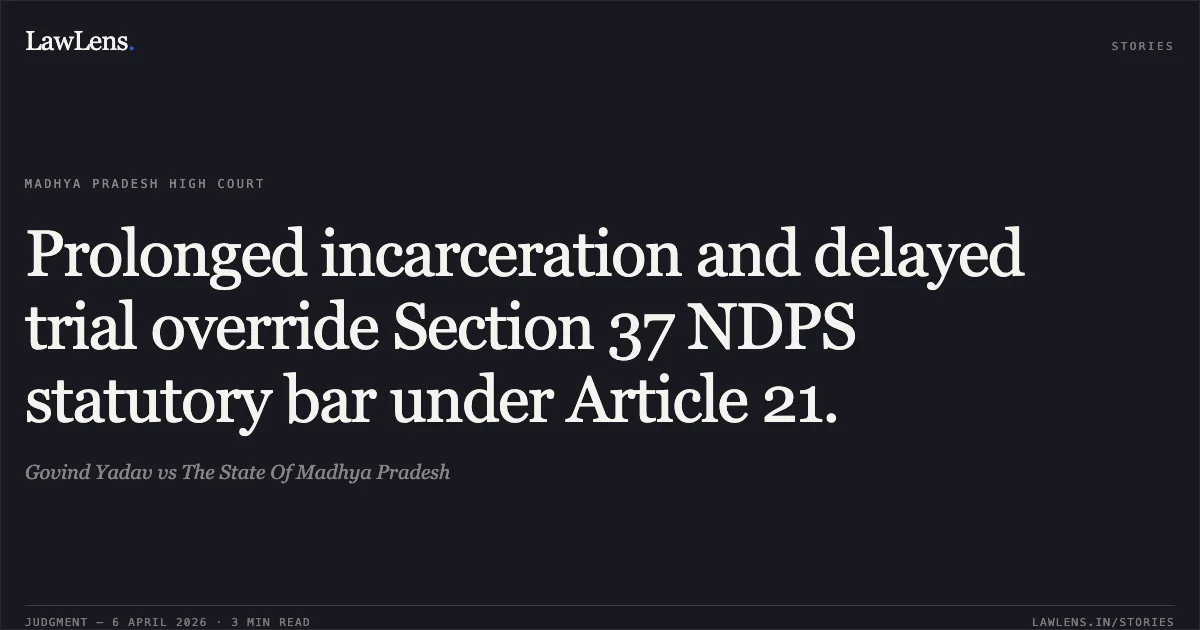
It held that while Section 37 of the NDPS Act creates a high threshold, it cannot override the fundamental right to a speedy trial and liberty under Article 21 when incarceration becomes excessively prolonged.
Source reference: p.5The applicant was ordered to be released on a personal bond of Rs. 1,00,000/- with one solvent surety, subject to strict conditions including regular attendance at trial, non-tampering with evidence, and a prohibition on committing similar offenses.
Source reference: p.6Acts & Sections Cited
8 provisions across 4 statutes referred to in this judgment. Each provision opens on LawLens.
Bharatiya Nagarik Suraksha Sanhita, 20232
Narcotic Drugs and Psychotropic Substances Act, 19854
Unlawful Activities (Prevention) Act, 19671
Code of Criminal Procedure, 19731
Original Court PDF
Govind YadavvsThe State Of Madhya Pradesh
Click to open original judgment
Original judgment, available to read, download and summarize on LawLens.in