Facts
The applicant, Lavish, was arrested on November 15, 2024, in connection with Crime No. 514/2024 for offenses under Sections 8/20 and 29 of the NDPS Act.
Source reference: para. 1According to the prosecution, 21 kgs of cannabis (ganja) were recovered from a bag tied to a motorcycle the applicant was operating.
Source reference: para. 8This was the applicant's third bail application; two previous applications were dismissed as withdrawn on August 4, 2025, and November 7, 2025.
Source reference: para. 2Since the last dismissal, independent seizure witnesses Pawan (PW1) and Anand (PW2) were examined but did not support the prosecution’s case.
Source reference: para. 2, 5The applicant, a 20-year-old laborer with no criminal antecedents, had been in judicial custody for approximately one year and four months at the time of this order.
Source reference: para. 7, 12Issues
1. Whether the applicant is entitled to bail under Section 483 of the Bharatiya Nagarik Suraksha Sanhita (BNSS), 2023, considering the hostile testimony of independent witnesses and the length of his incarceration.
Source reference: para. 1, 52. Whether the statutory embargo under Section 37(1)(b) of the NDPS Act can be overridden by the fundamental right to liberty under Article 21 of the Constitution in cases of prolonged trial.
Source reference: para. 11Law Applied
The Court applied Section 483 of the BNSS, 2023, governing the grant of bail.
Source reference: para. 1Article 21 of the Constitution of India, which guarantees the right to life and personal liberty, including the right to a speedy trial.
Source reference: para. 5, 9Union of India v. K.A. Najeeb (2021) and Sheikh Javed Iqbal v. State of Uttar Pradesh (2024) to establish that constitutional courts may grant bail despite restrictive penal statutes if an accused's fundamental rights are infringed.
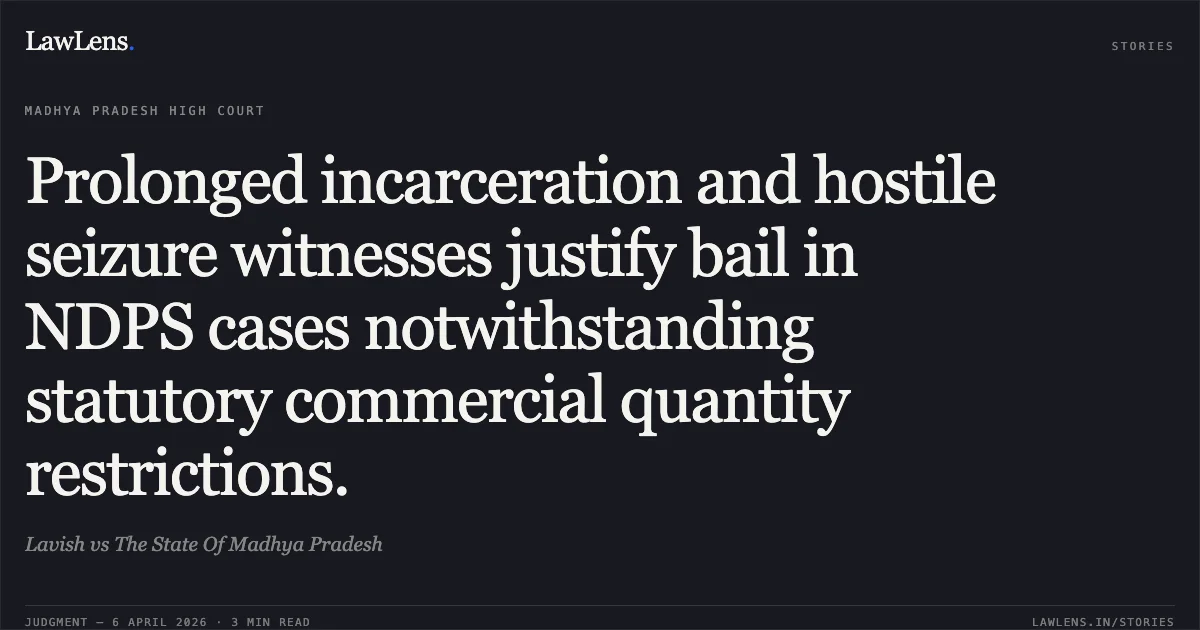
Source reference: para. 9The principle from Ankur Chaudhary v. State of Madhya Pradesh (2024), which states that prolonged incarceration and the failure of panch witnesses to support the prosecution may justify conditional liberty notwithstanding Section 37(1)(b) of the NDPS Act.
Source reference: para. 11Reasoning
The Court noted that while the quantity of contraband seized (21 kgs) was slightly above the commercial threshold, the primary seizure witnesses (PW1 and PW2) failed to support the prosecution’s allegations.
Source reference: para. 5, 8The Court observed that the applicant had been in custody for 16 months and the trial was not progressing at an appropriate pace.
Source reference: para. 12In balancing the statutory restrictions of the NDPS Act against constitutional mandates, the Court reasoned that "prolonged custody is anathema to the fundamental right of life and liberty".
Source reference: para. 5It determined that when a trial is unlikely to conclude soon, the precious fundamental rights under Article 21 must prevail over the statutory embargo of Section 37 of the NDPS Act.
Source reference: para. 11The Court also took into account the applicant’s youth, his lack of criminal history, and his socio-economic background as a laborer, finding no compelling reason to continue his incarceration.
Source reference: para. 7, 12Holding
The Court allowed the application and directed that the applicant be released on bail.
The holding clarified that the veracity of the prosecution’s case is a matter for trial, but the current circumstances justified release.
Source reference: para. 8The applicant was ordered to be released upon furnishing a personal bond of Rs. 1,00,000 with one solvent surety of the same amount, subject to specific conditions including mandatory appearance, prohibition against further offenses, and prohibition against tampering with evidence.
Source reference: para. 14Acts & Sections Cited
8 provisions across 4 statutes referred to in this judgment. Each provision opens on LawLens.
Bharatiya Nagarik Suraksha Sanhita, 20232
Narcotic Drugs and Psychotropic Substances Act, 19854
Unlawful Activities (Prevention) Act, 19671
Code of Criminal Procedure, 19731
Original Court PDF
LavishvsThe State Of Madhya Pradesh
Click to open original judgment
Original judgment, available to read, download and summarize on LawLens.in