Facts
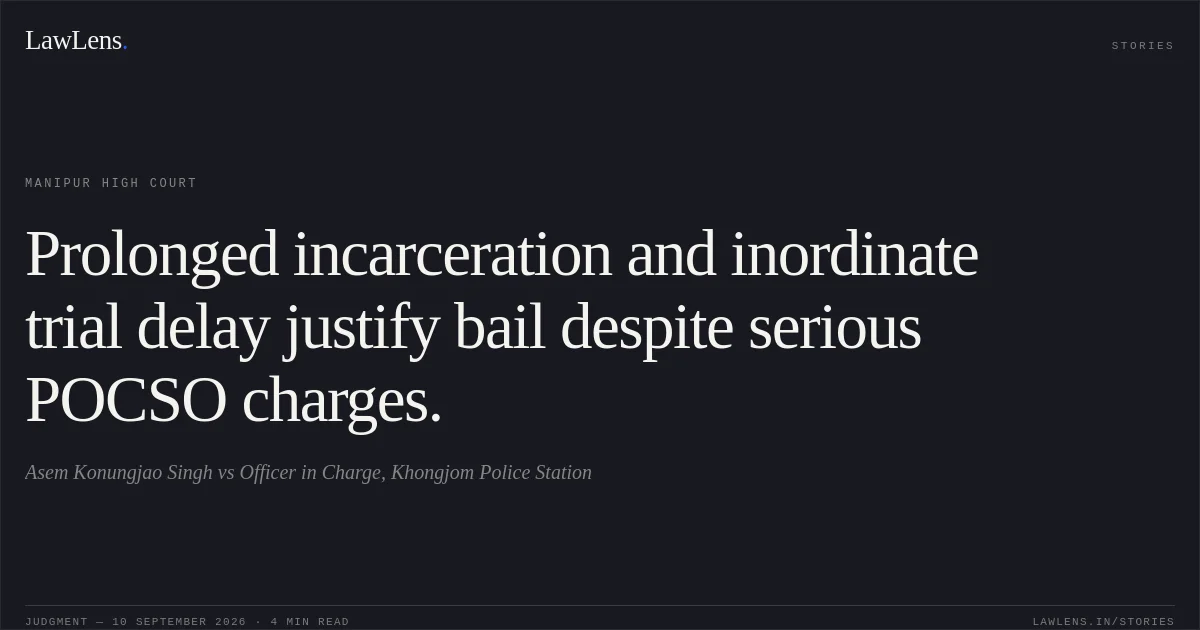
The petitioner was arrested in connection with FIR Case No. 56(12) of 2022, Kongjom Police Station, for alleged offences under Section 6 of the Protection of Children from Sexual Offences Act, 2012 (“POCSO Act”) and Section 506 IPC, on the complaint of the victim’s mother alleging sexual assault upon the victim.
Source reference: p.2, para. 3His earlier bail application before the Special Judge (POCSO), Thoubal, was rejected, and two subsequent applications before the High Court resulted in directions for expeditious consideration of charge and completion of trial within five months.
Source reference: p.2, para. 3Charges were framed on 19.10.2024, but by the time of the present application only four of the ten prosecution witnesses had been examined, despite the expiry of the five-month period fixed by the High Court.
Source reference: p.2, para. 3; p.3, para. 4The petitioner contended that the trial had progressed slowly, that the statutory timeline under Section 35 of the POCSO Act had not been complied with, and that the medical evidence did not establish penetrative sexual assault.
Source reference: p.3, para. 4The State opposed bail on the grounds that the offence was heinous, the victim and accused were neighbours, and release could traumatise or influence the victim.
Source reference: p.3, para. 6At the time of decision, the case had also been transferred to the Special Judge, Fast Track Special Court No. 2, Lamphel Court Complex.
Source reference: p.4, para. 7Issues
Whether the petitioner was entitled to bail on account of prolonged incarceration and the slow progress of the POCSO trial, notwithstanding the seriousness of the alleged offence?
Source reference: p.4, paras. 7–9Whether the failure to complete the trial within the five-month period directed by the High Court rendered the continuation of the trial without jurisdiction or automatically entitled the accused to bail?
Source reference: p.3, para. 4; p.4, para. 8Whether the Court could consider the apparent weakness or limitations of the medical evidence at the stage of deciding the bail application?
Source reference: p.3, para. 4; p.4, para. 8Law Applied
The Court exercised its jurisdiction under Section 439 CrPC, corresponding to Section 483 of the Bharatiya Nagarik Suraksha Sanhita, 2023, in considering release on bail.
Source reference: p.1, para. 2Section 35 of the POCSO Act requires the evidence of the child to be recorded within the prescribed period and the trial to be completed, as far as possible, within one year from the date of cognizance.
Source reference: p.3, para. 4The Court applied the principle that bail is neither punitive nor preventive, as stated in Sanjay Chandra v. CBI, (2012) 1 SCC 40.
Source reference: p.3, para. 5It further relied on Hussain v. Union of India, AIR 2017 SC 1362, for the principle that deprivation of personal liberty without a reasonably speedy trial is inconsistent with Article 21.
Source reference: p.3, para. 5However, failure to comply with a judicially fixed timeline does not efface or invalidate the POCSO trial; rather, an application for extension should ordinarily be made by the prosecution or the Special Court.
Source reference: p.4, para. 8Reasoning
The Court found that the petitioner had remained in custody for more than three and a half years and that, despite the earlier direction to complete the trial within five months, only four prosecution witnesses had been examined.
Source reference: p.4, paras. 7–9The slow progress was therefore attributable to the continuing delay in trial, engaging the Article 21 concern recognised in Hussain.
Source reference: p.3, para. 5Although the Court rejected the argument that expiry of the five-month period automatically deprived the trial court of jurisdiction, it considered the absence of any application for extension and the limited progress of the trial as relevant circumstances supporting bail.
Source reference: p.4, para. 8The Court noted that the medical examination report ruled out penetrative sexual intercourse but expressed the possibility of sexual assault; it expressly declined to assess the evidentiary merits conclusively and referred to the report only for the limited purpose of determining bail.
Source reference: p.4, paras. 8, 11Balancing the petitioner’s prolonged incarceration and the slow trial against the seriousness of the allegations and the risk of contact with the victim, the Court concluded that conditional release was appropriate.
Source reference: p.4, para. 9Holding
The High Court held that the petitioner was entitled to bail principally because of his incarceration exceeding three and a half years and the slow progress of the trial.
It clarified that non-completion of the trial within the five-month period did not invalidate the proceedings or automatically confer a right to bail, but that the prosecution or Special Court ought to seek an extension where necessary.
Source reference: p.4, para. 8The bail application was allowed.
Source reference: p.4, para. 9The petitioner was directed to be released on furnishing a personal bond of ₹50,000 with a surety, preferably a gazetted officer, for the like amount, subject to conditions including regular appearance, non-interference with witnesses or evidence, a prohibition on leaving Manipur without permission, surrender of any passport, and a prohibition on residing within five kilometres of or interacting with the victim.
Source reference: p.4–5, para. 9The Court expressly stated that its observations were confined to the bail application and would not prejudice the trial court’s independent assessment of the merits.
Source reference: p.5–6, para. 11Acts & Sections Cited
5 provisions across 4 statutes referred to in this judgment. Each provision opens on LawLens.
Code of Criminal Procedure, 19731
Bharatiya Nagarik Suraksha Sanhita, 20231
Protection of Children from Sexual Offences Act, 20122
Indian Penal Code, 18601
Original Court PDF
Asem Konungjao SinghvsOfficer in Charge, Khongjom Police Station
Click to open original judgment
Original judgment, available to read, download and summarize on LawLens.in