Facts
The case arises from FIR No. 21 of 2024 involving large-scale rioting, arson, and violence at Malik-ka-Bagicha, Haldwani, on February 8, 2024, during an administrative demolition drive.
Source reference: p. 1-2Rioters allegedly used petrol bombs, fired illegal weapons, and snatched police equipment.
Source reference: p. 2The appellant was arrested on February 11, 2024, after his name surfaced during the investigation through CCTV footage.
Source reference: p. 2He was charged under multiple sections of the IPC, the Unlawful Activities (Prevention) Act (UAPA), the Prevention of Damage to Public Property Act, and the Criminal Law Amendment Act.
Source reference: p. 1The appellant moved the High Court after the Special Judge (U.A.P. Act), Haldwani, rejected his second bail application on November 10, 2025.
Source reference: p. 1-2Issues
1. Whether the appellant is entitled to regular bail under the facts and circumstances of the case, specifically considering the nature of the evidence and the duration of his incarceration.
Source reference: p. 3-4Law Applied
The Court considered the penal provisions of Sections 147, 148, 149, 307, 323, 332, 341, 342, 353, 395, 427, 436, 333, 412, and 120B of the IPC; Section 7 of the Criminal Law Amendment Act, 1932; Sections 3/4 of the Prevention of Damage to Public Property Act, 1984; and Sections 15/16 of the Unlawful Activities (Prevention) Act, 1967.
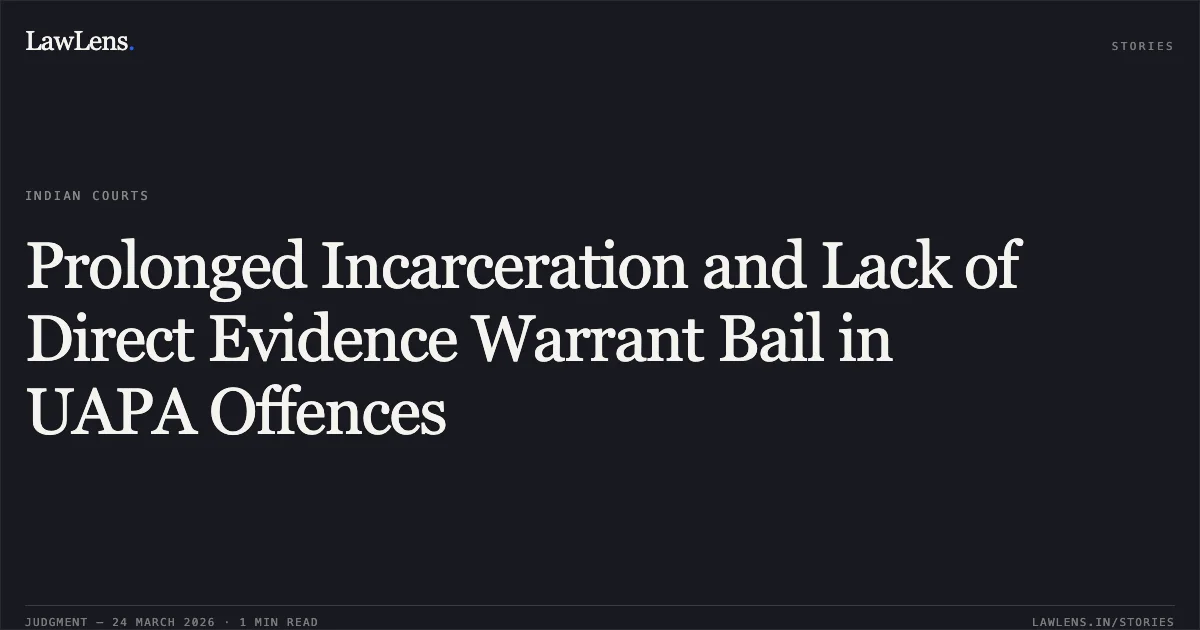
Source reference: p. 1The Court applied the principle that the absence of direct evidence and a prolonged period of pre-trial detention (two years) are significant factors in exercising judicial discretion for granting bail.
Source reference: p. 4-5Reasoning
The Court examined the prosecution's evidence, including statements recorded under Section 161 Cr.P.C. and CCTV footage.
Source reference: p. 3-4While the State argued the appellant was part of a planned conspiracy and spotted inciting a crowd, the Court noted that the role assigned to the appellant was "general in nature," limited to "pushing and shoving" within a crowd.
Source reference: p. 4The Bench observed that there was no direct evidence linking the appellant to specific acts of violence and highlighted that the prosecution failed to clarify who had actually identified the appellant from the CCTV footage.
Source reference: p. 4Furthermore, the Court emphasized that the appellant had no prior criminal antecedents and had already spent two years in custody.
Source reference: p. 4Balancing the severity of the charges against the nature of the involvement and the length of detention, the Court found the appellant eligible for bail.
Source reference: p. 4-5Holding
The High Court allowed the criminal appeal and set aside the order dated November 10, 2025, passed by the Special Judge (U.A.P. Act).
The Court held that the appellant is entitled to be released on regular bail.
Source reference: p. 5It directed the appellant’s immediate release upon the execution of a personal bond and two reliable sureties of the like amount to the satisfaction of the trial court, provided he is not required in any other matter.
Source reference: p. 5Acts & Sections Cited
18 provisions across 3 statutes referred to in this judgment. Each provision opens on LawLens.
Indian Penal Code, 1860
Unlawful Activities (Prevention) Act, 19672
Original Court PDF
ABU TASLEEMvsSTATE OF UTTARAKHAND
Click to open original judgment
Original judgment, available to read, download and summarize on LawLens.in