Facts
The appellant filed an appeal under Section 21(4) of the National Investigation Agency Act, 2008, challenging the rejection of his bail application by the Special Judge-ATS, Ranchi
Source reference: para. 1The prosecution alleged that the appellant is a member of the Aman Sao gang, which operates an extortion racket from jail and utilizes funds for acquiring sophisticated weapons to target government institutions
Source reference: paras. 3-4On July 17, 2023, during an ATS raid to apprehend gang members, the appellant and his associates allegedly fired upon the police party, causing gunshot injuries to a Deputy Superintendent of Police and a Sub-Inspector
Source reference: paras. 4, 62The appellant was charged under Sections 353, 332, 333, 307, 120(B) of the IPC, Section 27 of the Arms Act, and Sections 16, 17, and 20 of the Unlawful Activities (Prevention) Act (UAPA)
Source reference: para. 5The appellant’s previous bail applications were either withdrawn or rejected on merit by the High Court in 2024
Source reference: paras. 2, 7-8Issues
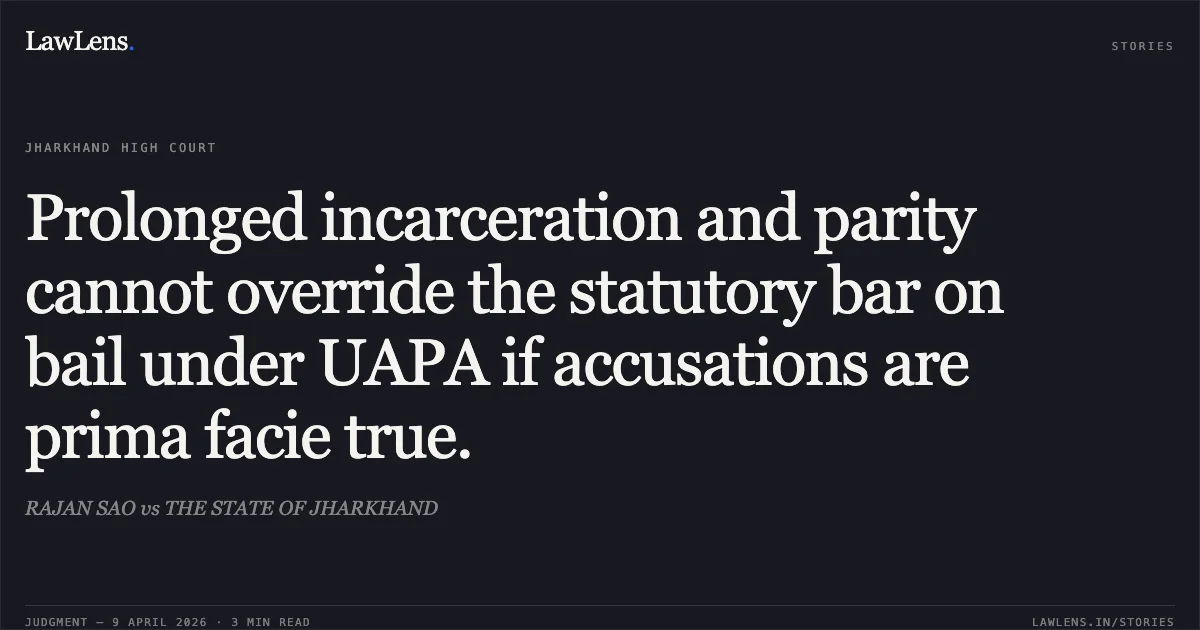
1. Whether there are reasonable grounds for believing that the accusations against the appellant under the UAPA are prima facie true, thereby invoking the statutory bar on bail under Section 43D(5)
Source reference: para. 38, 442. Whether the appellant is entitled to bail on the ground of parity with co-accused persons who were previously enlarged on bail
Source reference: para. 14, 783. Whether prolonged incarceration (approximately 2 years and 7 months) and the likelihood of a delayed trial justify the grant of bail notwithstanding the gravity of the offences
Source reference: para. 19, 52Law Applied
The court primarily applied Section 43D(5) of the UAPA, which mandates that an accused shall not be released on bail if the court, on perusal of the case diary or final report, finds reasonable grounds to believe the accusations are prima facie true
Source reference: para. 38, 44It relied on NIA v. Zahoor Ahmad Shah Watali, establishing that "prima facie true" means the evidence must show complicity on its face without requiring a mini-trial or dissection of evidence
Source reference: paras. 39-42The court further cited Gurwinder Singh v. State of Punjab, which held that under the UAPA, "jail is the rule and bail is the exception," and that mere delay in trial is insufficient for bail in grave offences
Source reference: paras. 44-50, 66Regarding parity, the court applied Ramesh Bhavan Rathod v. Vishanbhai Hirabhai Makwana, emphasizing that parity requires an assessment of the specific role of the accused rather than a simplistic comparison
Source reference: para. 84Finally, it referenced Gulfisha Fatima v. State, noting that in cases affecting national security, delay does not automatically displace statutory restraints
Source reference: para. 67Reasoning
The court observed that the Case Diary (specifically paragraphs 4, 5, 6, 11, 14, and 16) contained material evidence of the appellant’s active involvement in the Aman Sao gang and the specific act of firing at police officers
Source reference: paras. 31-32, 62It determined that the appellant’s role was not peripheral but central to the conspiracy, as he was identified at the scene where two officers sustained serious injuries
Source reference: paras. 62, 86The court rejected the plea of parity, noting that the appellant’s specific role in the shootout distinguished him from the co-accused who received bail
Source reference: paras. 87-89Furthermore, the court found the appellant’s criminal antecedents—comprising three cases of a similar nature—to be a significant factor against his release
Source reference: para. 54Regarding the trial delay, the court noted that the trial was at an advanced stage, with 7 out of 21 witnesses already examined, thus mitigating concerns of unconscionable detention
Source reference: paras. 75, 96Consequently, the court held that the statutory embargo under Section 43D(5) remained attracted as the accusations appeared prima facie true
Source reference: para. 93Holding
The High Court dismissed the appeal and upheld the trial court's order dated July 9, 2025, rejecting the bail prayer
The court held that the appellant failed to demonstrate a material change in circumstances since his last bail rejection on merit and that the principle of parity could not be extended given his distinct role in the armed assault on police
Source reference: paras. 87, 95The court ordered the trial to proceed without being prejudiced by the observations made in the bail proceedings
Source reference: para. 100Acts & Sections Cited
19 provisions across 5 statutes referred to in this judgment. Each provision opens on LawLens.
National Investigation Agency Act, 20081
Indian Penal Code, 18604
Arms Act, 19591
Unlawful Activities (Prevention) Act, 19678
Code of Criminal Procedure, 19735
Original Court PDF
RAJAN SAOvsTHE STATE OF JHARKHAND
Click to open original judgment
Original judgment, available to read, download and summarize on LawLens.in