Facts
The petitioner was arrested on June 6, 2014, in connection with FIR No. 109/2014 under Sections 302 and 201 of the RPC.
Source reference: para. 3, 8Charges were framed on November 10, 2014, before the 2nd Additional Sessions Judge, Jammu.
Source reference: para. 1, 8Over nearly twelve years of incarceration, the prosecution examined only 24 out of 35 witnesses, averaging fewer than two witnesses per year.
Source reference: para. 8, 9Despite a peremptory order dated December 15, 2025, to conclude evidence, the prosecution failed to produce remaining witnesses, citing "VIP duty" as a reason for the absence of a key witness.
Source reference: para. 10The petitioner sought bail from the High Court after his initial application was dismissed by the Trial Court on September 17, 2025.
Source reference: para. 2Issues
1. Whether the petitioner’s fundamental right to a speedy trial under Article 21 of the Constitution was violated by his twelve-year pre-trial incarceration.
Source reference: para. 2, 92. Whether an accused charged with a heinous offense (Section 302 RPC) is entitled to bail solely on the grounds of prolonged delay in the trial.
Source reference: para. 6, 11Law Applied
The court primarily relied on Article 21 of the Constitution of India, which guarantees the right to a speedy trial as a fundamental right.
Source reference: para. 12It applied the principle from Vaibhav Singh v. State of Uttar Pradesh (2026), holding that no matter how grave the crime, an accused cannot be kept in jail indefinitely if the delay is not their fault.
Source reference: para. 12The court also referenced Raman Kumar v. UT of J&K (2025), which established that a trial court’s failure to ensure a timely trial necessitates the grant of bail despite the gravity of the charges or statutory bars in the Cr.P.C.
Source reference: para. 13Reasoning
The Court observed that the prosecution had taken over eleven years to examine only 24 witnesses, describing the pace as "languid".
Source reference: para. 9It noted the Trial Court’s own censure of the prosecution's "casual approach" in evading court appearances under the guise of VIP duties.
Source reference: para. 10, 11The Court reasoned that while Section 302 RPC involves a severe punishment, the "quantum of punishment" and the "gravity of the offense" cannot override the fundamental right to a speedy trial when the incarceration reaches nearly twelve years.
Source reference: para. 11, 12Applying the Vaibhav Singh precedent, the Court found that the prosecution and the Trial Court failed to protect the petitioner's constitutional rights, as there was "no end in sight" for the trial’s conclusion.
Source reference: para. 13Holding
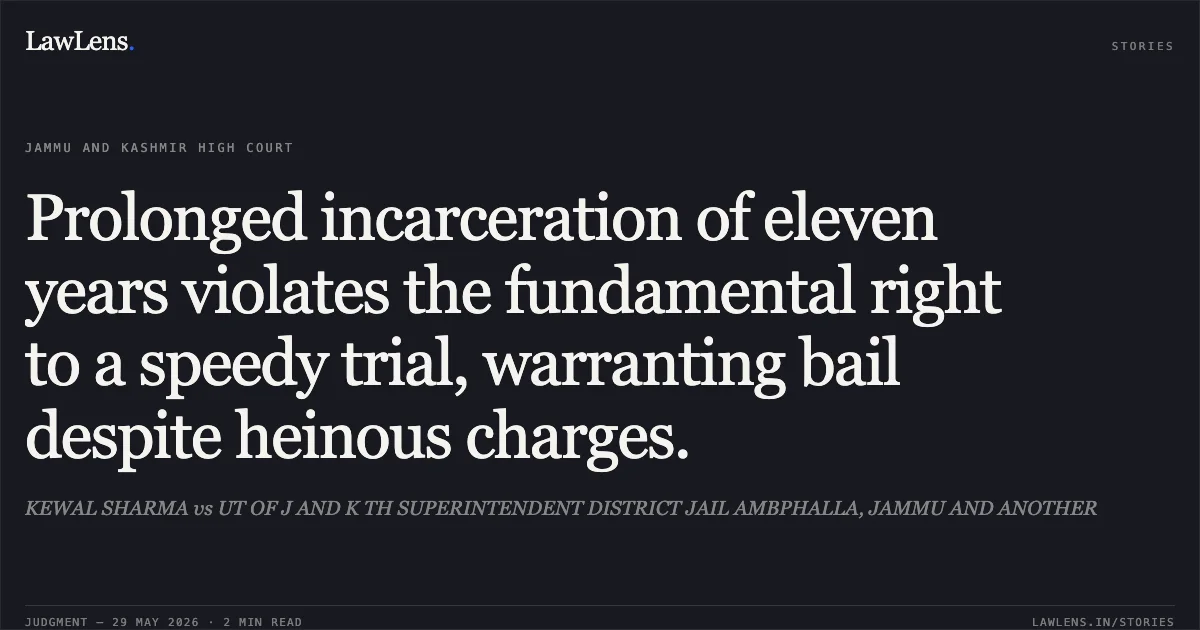
The Court answered in the affirmative, holding that the petitioner’s fundamental right to a speedy trial had suffered an "egregious infringement".
The petition was allowed, and the petitioner was ordered to be enlarged on bail subject to furnishing two solvent sureties of Rs. 50,000 each, personal bonds, and conditions regarding regular attendance and travel restrictions and the Trial Court was further directed to dispose of the case as expeditiously as possible.
Source reference: para. 14, 15Acts & Sections Cited
5 provisions across 3 statutes referred to in this judgment. Each provision opens on LawLens.
Indian Penal Code, 18602
Code of Criminal Procedure, 19732
Bharatiya Nagarik Suraksha Sanhita, 20231
Original Court PDF
KEWAL SHARMAvsUT OF J AND K TH SUPERINTENDENT DISTRICT JAIL AMBPHALLA, JAMMU AND ANOTHER
Click to open original judgment
Original judgment, available to read, download and summarize on LawLens.in