Facts
The petitioners, Deepak Ramnani and Pradeep Ramdanee, are brothers accused in a multi-crore extortion racket allegedly led by Sukesh Chandra Shekhar.
Source reference: para. 5It is alleged that between 2020 and 2021, while Sukesh was in jail, the petitioners assisted in extorting approximately ₹217 crores from the complainant, Aditi Singh, by impersonating high-ranking government officials.
Source reference: para. 5Pradeep was arrested in a trap while receiving funds, and Deepak was arrested shortly thereafter.
Source reference: para. 5(E)The State invoked the Maharashtra Control of Organised Crime Act (MCOCA).
Source reference: para. 1(a)Subsequent money laundering proceedings under the PMLA were initiated by the Enforcement Directorate (ED).
Source reference: para. 1(b)The petitioners sought regular bail citing nearly five years of pre-trial incarceration and the unlikely completion of the trial in the near future.
Source reference: para. 8(a)Issues
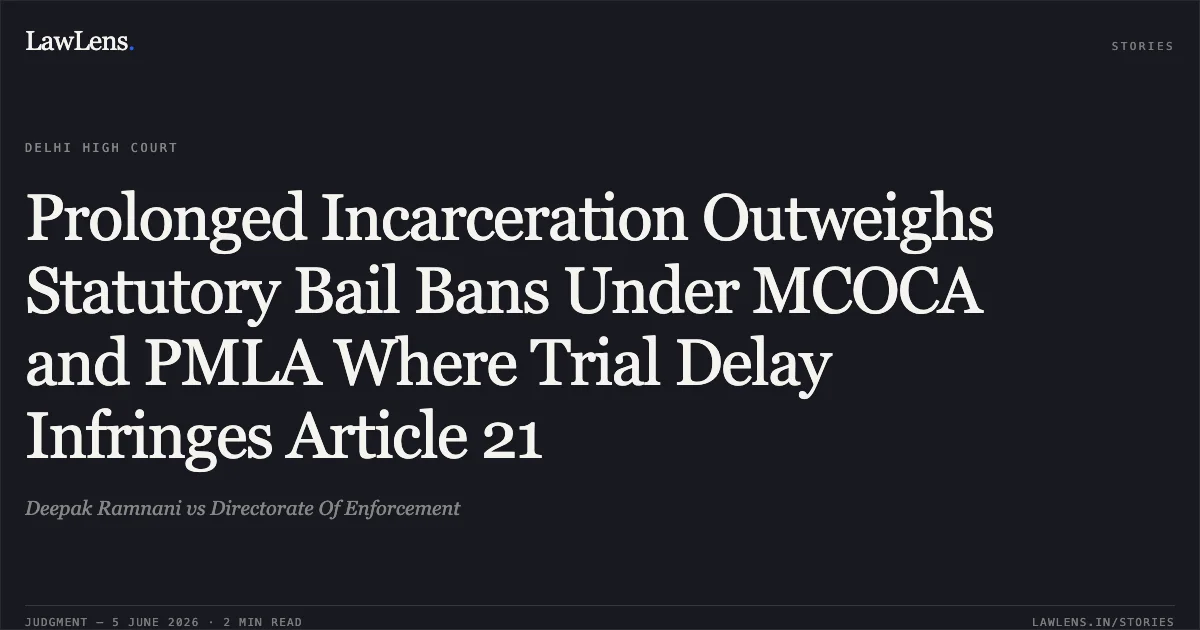
Whether the petitioners are entitled to bail on the grounds of prolonged pre-trial incarceration under Article 21, notwithstanding the stringent statutory restrictions in Section 21(4) of MCOCA and Section 45 of the PMLA.
Source reference: para. 14Whether the specific roles attributed to the petitioners (logistical/financial facilitation) justify further detention when compared to "strategic commanders" of the syndicate.
Source reference: para. 28(G)-(J)Law Applied
Supreme Court’s three-judge bench ruling in Union of India v. K.A. Najeeb, which held that statutory rigors for bail "melt down" where there is no likelihood of a timely trial and incarceration is prolonged.
Source reference: para. 31The court noted the divergent views in Gulfisha Fatima v. State (emphasizing a factual analysis of roles) and Syed Iftikhar Andrabi v. NIA (warning against hollowing out Article 21 protections), as discussed in the recent reference in Tasleem Ahmed v. State.
Source reference: paras. 17-21Section 479 of the BNSS (formerly Section 436A CrPC), which mandates release if an accused has undergone half of the maximum prescribed sentence.
Source reference: para. 30The principle of parity in Vijay Madanlal Chaudhary v. Union of India.
Source reference: para. 30Reasoning
The Court observed that despite the gravity of the offences, the petitioners had spent approximately 4 years and 10 months in custody—a period nearing the minimum five-year sentence for MCOCA.
Source reference: para. 28(A)While the trial was delayed due to the complexity of 23 accused and 403 witnesses, the Court found the petitioners' roles to be "logistical facilitation" and "financial facilitation" rather than strategic command.
Source reference: para. 28(H)-(J)Applying the Gulfisha Fatima framework, the Court distinguished between "strategic architects" and "operational conduits," noting that the petitioners acted strictly on Sukesh's instructions without autonomous decision-making power.
Source reference: para. 28(F), (I)In the PMLA case, the Court held that Deepak had served a substantial part of the maximum seven-year sentence and noted that 13 out of 18 co-accused had already been granted bail, making a strong case for parity.
Source reference: para. 29, 31, 34Holding
The Court allowed the applications, holding that continued pre-trial detention would assume a punitive character violating Article 21.
The petitioners were granted bail in the MCOCA/IPC case (FIR 208/2021) and Deepak was granted bail in the PMLA case (ECIR/54/DLZO-II/2021), subject to a personal bond of ₹2,50,000 each with two sureties.
Source reference: para. 36The Court clarified that the findings were limited to the bail adjudication and would not influence the trial.
Source reference: para. 38Acts & Sections Cited
10 provisions across 4 statutes referred to in this judgment. Each provision opens on LawLens.
Maharashtra Control of Organised Crime Act, 19997
Prevention of Money-Laundering Act, 20021
Bharatiya Nagarik Suraksha Sanhita, 20231
Code of Criminal Procedure, 19731
Original Court PDF
Deepak RamnanivsDirectorate Of Enforcement
Click to open original judgment
Original judgment, available to read, download and summarize on LawLens.in