01Facts
The petitioner, Ayub, is accused No.1 in S.C. No. 662/2024, pending before the LVII Additional City Civil and Sessions Judge (CCH-58), Bengaluru, arising out of Crime No. 556/2023 of Mahadevapura Police Station. He is charged under Sections 302, 120B and 34 IPC.
¶ 1The FIR, based on the complaint of the deceased's wife, alleges that the petitioner and others assaulted the deceased with weapons on 16.09.2023, and the deceased died at CMH Hospital.
¶ 3 · ¶ 4The petitioner was arrested on 16.10.2023 and has remained in judicial custody since then.
¶ 3 · ¶ 6The trial court rejected his bail.
¶ 3In Crl.P. No. 10714/2024 the petition was dismissed as not pressed, with liberty to refile after CW16 and CW17, the alleged eyewitnesses, were examined.
¶ 3In Crl.P. No. 5149/2026, the court disposed of the petition on the prosecution's assurance that the witnesses would be examined within two months, with liberty to renew if examination was not completed within four months.
¶ 3 · ¶ 6CW16 and CW17 were examined as PW4 and PW5. They were partly treated as hostile and cross-examined, but they have since failed to appear for further cross-examination, and non-bailable warrants and proclamation have been ordered against them.
¶ 6Of 51 charge-sheet witnesses, only 3 have been fully examined and 2 partially.
¶ 802Issues
i.1. Whether the petitioner is entitled to regular bail in a successive application on the ground of prolonged pre-trial incarceration and delay in trial, where the eyewitnesses have been examined but are partly hostile and have not completed cross-examination.
¶ 3 · ¶ 5 · ¶ 6 · ¶ 8ii.2. Whether the seriousness of the alleged offence under Section 302 read with Sections 34 and 120B IPC can justify denial of bail where the State has not ensured a speedy trial as guaranteed under Article 21 of the Constitution.
¶ 7 · ¶ 903Law Applied
The court exercised its bail jurisdiction under Section 439 CrPC, as applied through Section 483 BNSS, 2023.
¶ 1The offences invoked are murder under Section 302 IPC, read with Section 34 (common intention) and Section 120B (criminal conspiracy) of the IPC.
¶ 1 · ¶ 3The court relied on the Supreme Court's decision in Javed Gulam Nabi Shaikh v. State of Maharashtra (2024) 9 SCC 813, which holds that where the State or the court cannot secure an accused's fundamental right to a speedy trial under Article 21, the prosecution should not oppose bail merely because the crime is serious, since Article 21 applies irrespective of the nature of the offence.
¶ 7The court treated the earlier orders reserving liberty to renew bail after examination of CW16 and CW17 as the procedural basis for entertaining the successive application.
¶ 3 · ¶ 5Provisions in the judgment · 4 · Linked ones open on LawLens
Code of Criminal Procedure, 1973 Section 439
Bharatiya Nagarik Suraksha Sanhita, 2023 Section 483
Indian Penal Code, 1860 Section 34Section 302
04Reasoning
The court first considered the procedural history and found that the liberty granted in earlier orders was properly invoked, since the witnesses had been examined before the trial court as PW4 and PW5.
¶ 3 · ¶ 6It then assessed the progress of the trial. Because PW4 and PW5 were partly hostile and have not returned for further cross-examination, coercive process has been ordered against them.
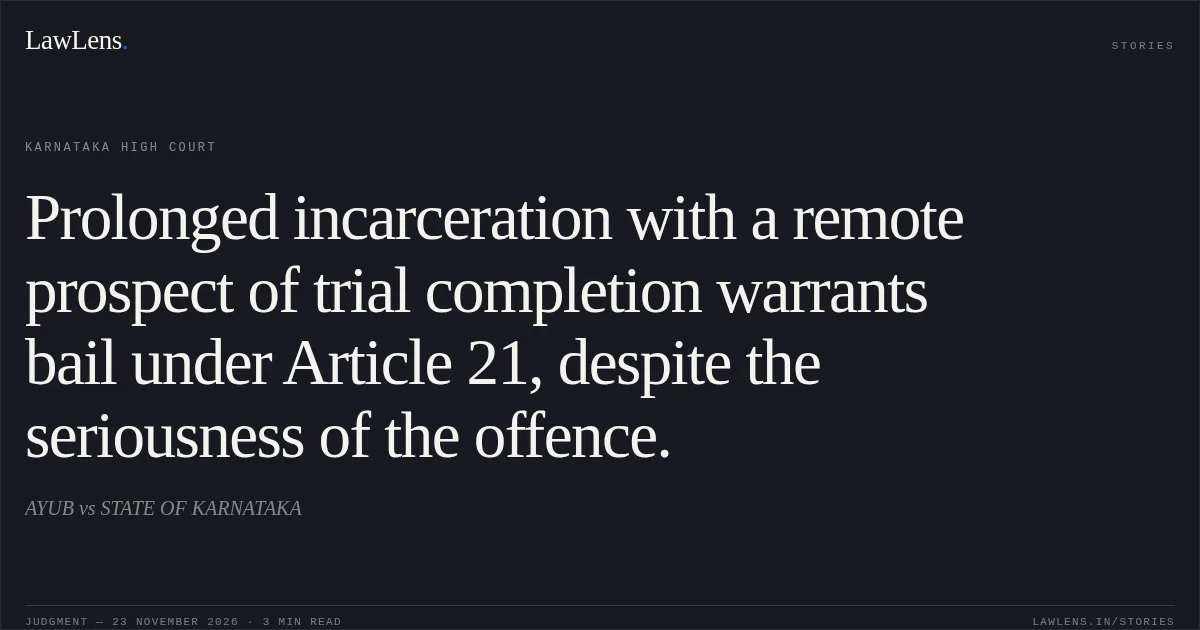
¶ 6Applying Javed Gulam Nabi Shaikh, the court held that the petitioner's incarceration of more than three years, together with the slow progress of the trial (only 3 of 51 witnesses fully examined and 2 partly examined), made early conclusion of trial on merits remote.
¶ 8On that basis, the court held that Article 21 considerations outweighed the seriousness of the charge. It expressly declined to comment on the merits or demerits of the case, so its decision rests solely on the period of incarceration and the state of the trial.
¶ 905Holding
The court held that, without expressing any view on the merits, the petitioner's prayer for regular bail must be granted solely in view of his prolonged incarceration and the remote prospect of early trial completion.
¶ 8 · ¶ 9The criminal petition is allowed, and the petitioner is to be enlarged on bail in S.C. No. 662/2024 subject to the following conditions: (a) a personal bond of Rs. 1,00,000 with two sureties of the like sum, to the satisfaction of the jurisdictional court; (b) regular appearance on all hearing dates unless exempted by the trial court for valid reasons; (c) no direct or indirect threats to or tampering with prosecution witnesses; (d) no involvement in similar offences in future; and (e) no leaving of the trial court's jurisdiction without permission until the case is disposed of.
¶ 9(i)–(ii) · ¶ 9(ii)(a)–(e)Original Court PDF
AYUBvsSTATE OF KARNATAKA
Click to open original judgment
Original judgment, available to read, download and summarize on LawLens.in