Facts
The applicant was arrested on 13 February 2024 in connection with Crime No. 53/2024 registered at Police Station Lailunga, District Raigarh, for offences under Sections 302 and 34 of the Indian Penal Code.
Source reference: paras. 2–4The prosecution alleged that the deceased, Sanjay Nagwanshi, and the wife of co-accused Sulechand Nagwanshi were found dead near Sulechand’s house.
Source reference: paras. 2–4According to Sulechand’s memorandum statement, he discovered his wife and Sanjay in a compromising position and committed their murders, with the applicant allegedly assisting him.
Source reference: paras. 2–4The charge-sheet was filed in 2024 and charges were framed on 3 September 2024. However, despite the applicant remaining in custody since 13 February 2024, no prosecution witness had been examined by the date of the bail order.
Source reference: paras. 4, 7The applicant therefore sought regular bail under Section 483 of the Bharatiya Nagarik Suraksha Sanhita, 2023, principally relying on his prolonged incarceration and denial of a speedy trial.
Source reference: paras. 1, 4Issues
Whether the applicant was entitled to regular bail under Section 483 of the Bharatiya Nagarik Suraksha Sanhita, 2023, in view of the allegations under Sections 302/34 of the IPC and the material available in the case diary?
Source reference: paras. 1, 6, 9Whether the applicant’s prolonged pre-trial incarceration, despite framing of charges and examination of no prosecution witness, violated his fundamental right to a speedy trial under Article 21 of the Constitution?
Source reference: paras. 4, 7–9Law Applied
The Court applied Section 483 of the Bharatiya Nagarik Suraksha Sanhita, 2023, governing the High Court’s power to grant regular bail, in the context of offences punishable under Sections 302 and 34 of the Indian Penal Code.
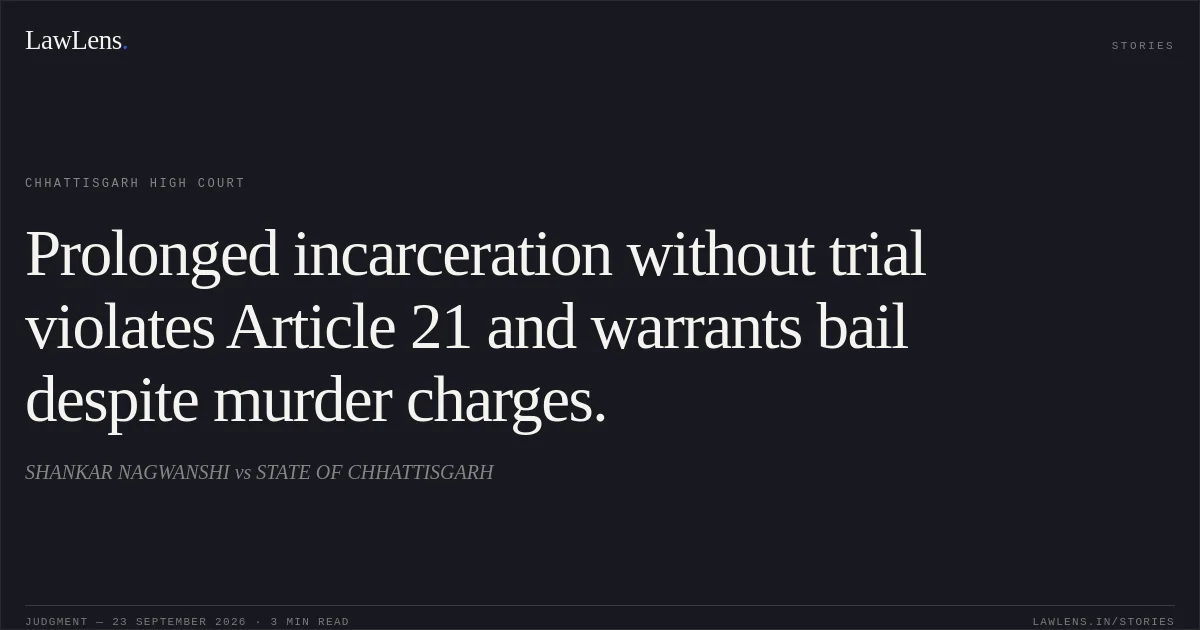
Source reference: para. 1It relied on the constitutional guarantee of a speedy trial under Article 21, holding that prolonged incarceration without meaningful progress in the trial may justify release on bail, even where the accused is charged with murder.
Source reference: para. 8The Court followed Sahil Manoj Machare v. State of Maharashtra, 2026 SCC OnLine SC 810, which held that prolonged incarceration without examination of witnesses infringes the right to speedy trial, and Pardeep Kumar Banu v. State of Punjab, 2026 LiveLaw (SC) 3024, which recognized that incarceration without trial amounts to punishment in appropriate circumstances.
Source reference: paras. 7–8Reasoning
The Court considered the allegations, the case diary, and the applicant’s period of custody.
Source reference: paras. 7, 9Although the prosecution alleged that the applicant had assisted the co-accused in committing the murders, the Court emphasized that the applicant had remained in custody since 13 February 2024, charges had been framed on 3 September 2024, and not a single prosecution witness had been examined by the date of consideration of the application.
Source reference: paras. 7, 9Applying the Article 21 principle recognized in Sahil Manoj Machare and Pardeep Kumar Banu, the Court held that the absence of progress in the trial was a significant factor favouring bail.
Source reference: paras. 7–9The Court also took into account that the applicant had no previous criminal antecedents.
Source reference: para. 9Holding
The High Court allowed the applicant’s first bail application and directed that he be released on bail upon execution of a personal bond of Rs. 50,000 to the satisfaction of the trial Court.
Bail was made subject to conditions that the applicant would appear for police interrogation when required, would not influence or threaten witnesses, and would not act in a manner prejudicial to a fair and expeditious trial.
Source reference: para. 10The Court clarified that its observations were confined to the determination of the bail application and would not affect the merits of the criminal trial.
Source reference: para. 10Acts & Sections Cited
3 provisions across 2 statutes referred to in this judgment. Each provision opens on LawLens.
Bharatiya Nagarik Suraksha Sanhita, 20231
Indian Penal Code, 18602
Original Court PDF
SHANKAR NAGWANSHIvsSTATE OF CHHATTISGARH
Click to open original judgment
Original judgment, available to read, download and summarize on LawLens.in