Facts
The plaintiff filed a partition suit claiming that Schedule ‘B’ property was ancestral and available for partition. Defendant No. 1 disputed that claim, asserting that the property had fallen to his share in an earlier partition and that he had obtained an order regularising it.
Source reference: paras. 2–3The Trial Court rejected the plaintiff’s application for temporary injunction under Order XXXIX Rules 1 and 2 CPC. The Appellate Court reversed that decision and granted an injunction, reasoning that the plaintiff’s specific pleadings concerning Schedule ‘B’ property had not been seriously challenged.
Source reference: para. 4Defendant No. 1 challenged the appellate order under Article 227. The injunction had remained in force since 12 June 2018, and no interim stay had been sought in the writ petition.
Source reference: paras. 5–6Issues
1. Whether the High Court should examine the correctness of the Appellate Court’s interlocutory injunction order after it had remained in operation for several years without a stay, while the partition suit remained pending.
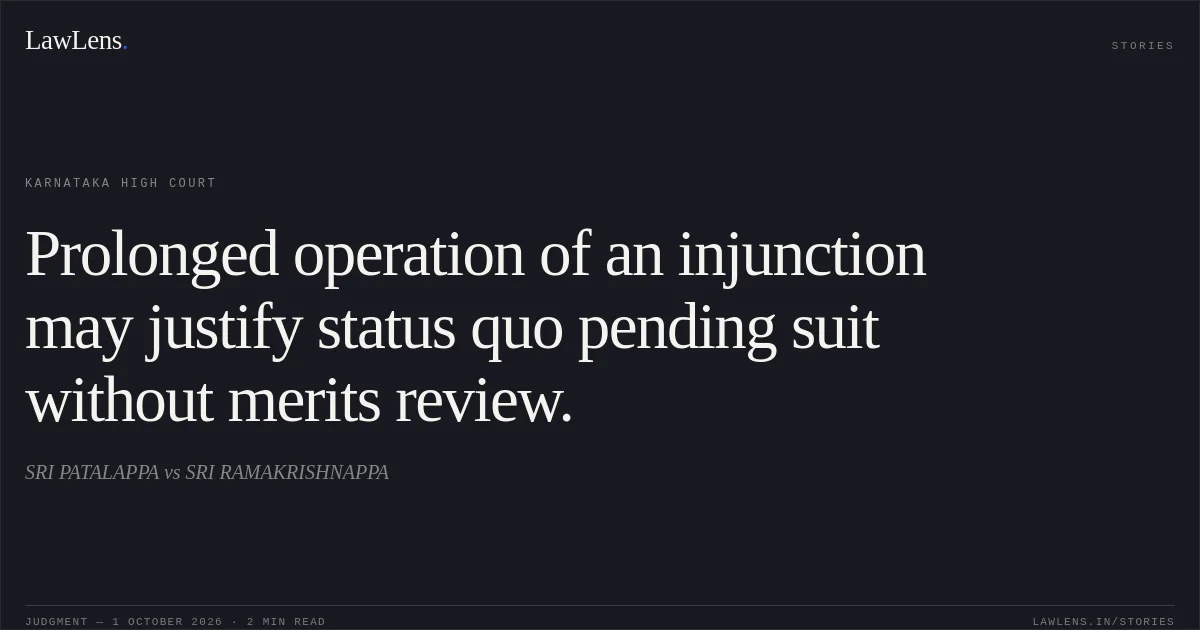
Source reference: paras. 5–62. Whether, in the circumstances, the parties should be directed to maintain status quo in respect of the suit schedule property pending disposal of the partition suit.
Source reference: paras. 8–9Law Applied
The petition invoked the High Court’s supervisory jurisdiction under Article 227 of the Constitution of India. The underlying interim-injunction application was made under Order XXXIX Rules 1 and 2 of the Code of Civil Procedure, 1908.
Source reference: no citationThe Court applied its discretionary jurisdiction in light of the prolonged operation of the injunction, the absence of any stay, the pending adjudication of the parties’ substantive rights, and the need to preserve the property pending suit.
Source reference: paras. 5–8No precedent was cited, and the Court did not determine the substantive legal test for the competing claims to Schedule ‘B’ property.
Source reference: no citationReasoning
The Court declined to assess the correctness of the Appellate Court’s injunction because the order had operated continuously since 2018, the petitioner had not sought a stay, and the parties’ rights in Schedule ‘B’ property were still to be determined in the partition suit.
Source reference: paras. 5–6The injunction principally restrained the petitioner from felling standing trees; some trees had already been felled, and the petitioner stated that the resulting wood had decayed and was no longer marketable.
Source reference: paras. 6–7Without expressing any view on the merits of the rival claims or the appellate findings, the Court considered that justice would be served by maintaining the property’s status quo until the suit was decided.
Source reference: para. 8Holding
The writ petition was disposed of with a direction that the parties maintain status quo in respect of the suit schedule property pending disposal of O.S. No. 429/2012.
The parties were directed to cooperate in the expeditious disposal of the suit and avoid unnecessary adjournments; the Trial Court was directed to make every endeavour to decide it expeditiously and in accordance with law, uninfluenced by the High Court’s observations.
Source reference: paras. 9–10Original Court PDF
SRI PATALAPPAvsSRI RAMAKRISHNAPPA
Click to open original judgment
Original judgment, available to read, download and summarize on LawLens.in