01Facts
The appellant challenged, under Section 14-A of the Scheduled Castes and Scheduled Tribes (Prevention of Atrocities) Act, 1989, the order dated 18 October 2025 by which the 4th Additional Sessions Judge, Rajkot rejected his application for regular bail under Section 483 of the Bharatiya Nagarik Suraksha Sanhita, 2023.
p. 1 · ¶ 2The case arose from FIR C.R. No. 11208045240928 of 2024 registered at Malviyanagar Police Station, Rajkot City, for offences under Sections 103(1), 117(2), 118(1) and 54 of the Bharatiya Nyaya Sanhita, 2023, Section 3(2)(va) of the SC/ST Act and Section 135(1) of the Gujarat Police Act.
p. 1 · ¶ 2The appellant had been arrested on 8 November 2024.
p. 2 · ¶ 3Although the investigation was complete and the chargesheet had been filed, charges had not been framed, no witness had been examined, and the prosecution had cited 47 witnesses.
p. 2 · ¶ 3, 5.1–5.2The trial had not progressed principally because co-accused Ashish @ Pungo Bharatbhai was absconding.
p. 2 · ¶ 5.1–5.202Issues
i.Whether the appellant was entitled to regular bail under Section 483 of the BNSS despite the serious offences alleged against him and the prosecution’s objections concerning flight risk and possible tampering with evidence?
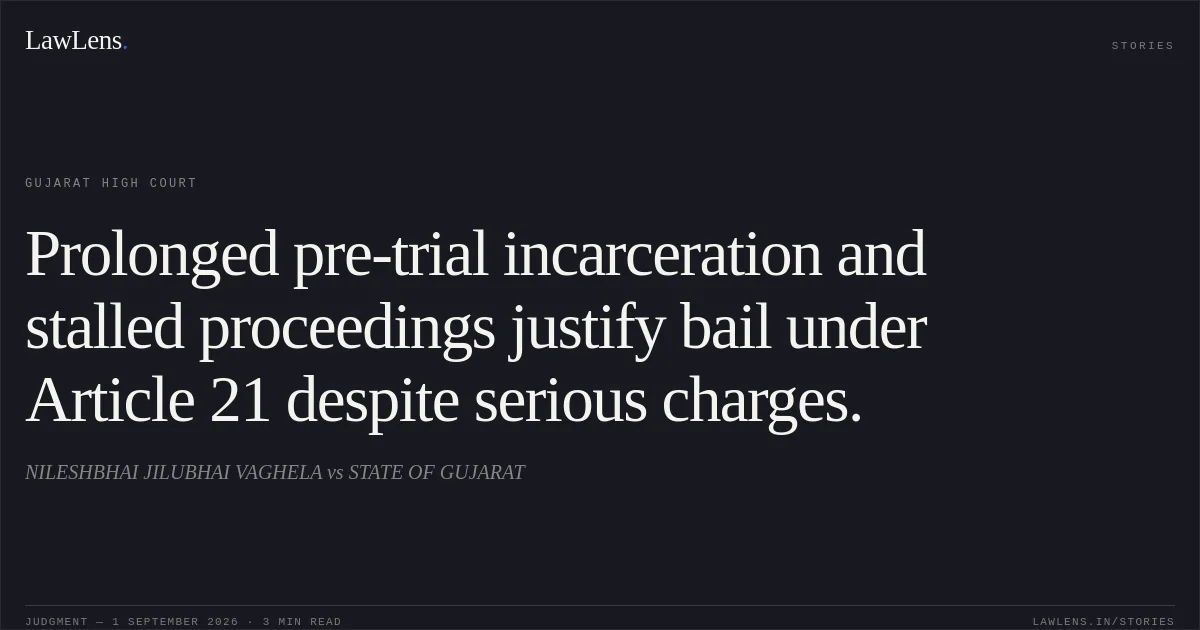
p. 2 · ¶ 3–5ii.Whether the appellant’s prolonged incarceration, in circumstances where charges had not been framed and the trial had not commenced, violated the right to speedy trial and personal liberty under Article 21 of the Constitution?
p. 2 · ¶ 5.1–5.203Law Applied
The Court applied Section 14-A of the SC/ST Act, which provides the appellate remedy against specified orders of the Special or Sessions Court, and Section 483 of the BNSS governing regular bail.
It relied on Article 21 of the Constitution, under which an accused cannot be detained indefinitely without a reasonably expeditious trial.
The Court referred to Union of India v. K.A. Najeeb, (2021) 3 SCC 713, and Mohd. Muslim alias Hussain v. State (NCT of Delhi), 2023 SCC OnLine SC 352, for the principle that prolonged incarceration and likely delay in trial may justify bail notwithstanding the seriousness of the offence.
p. 2 · ¶ 5.2It also relied on Pradeep Kumar @ Banu v. State of Punjab, SLP (Cri.) No. 18775/2025, and Sanjay Chandra v. CBI, (2012) 1 SCC 40, recognising that pre-trial detention is not punitive and that personal liberty and the right to speedy trial must be protected.
p. 2 · ¶ 5.2The Court further observed that the prosecution and the trial court possess remedies under the BNSS to proceed against or otherwise address the abscondence of a co-accused.
p. 2 · ¶ 5.1–5.2Provisions in the judgment · 7 · Linked ones open on LawLens
Scheduled Castes and the Scheduled Tribes (Prevention of Atrocities) Act, 1989 Section 3
Bharatiya Nagarik Suraksha Sanhita, 2023 Section 483
Bharatiya Nyaya Sanhita, 2023 Section 103Section 117Section 118Section 54
Gujarat Police Act, 1951. Section 135
04Reasoning
The Court accepted that the allegations were serious but gave decisive weight to the prolonged and unexplained stagnation of the proceedings.
The appellant had remained in custody since 8 November 2024; nevertheless, charges had not been framed, no witness had been examined, and 47 witnesses remained to be examined.
p. 2 · ¶ 5.1–5.2The Court held that the abscondence of a co-accused could not justify keeping the appellant in custody indefinitely, particularly when the prosecution could adopt appropriate procedural measures under the BNSS and the trial court could proceed in accordance with law.
p. 2 · ¶ 5.1Applying Article 21 and the principles in K.A. Najeeb, Mohd. Muslim, Pradeep Kumar and Sanjay Chandra, the Court concluded that the continuing detention was disproportionate to the pace of the trial and that the prosecution could not oppose bail merely while failing to ensure expeditious progress of the case.
p. 2 · ¶ 5.2The Court addressed the prosecution’s concerns regarding misuse of liberty and interference with the trial by imposing reporting, travel, residence, passport and non-tampering conditions.
p. 3 · ¶ 605Holding
The appeal was allowed.
pp. 3–4 · ¶ 6–7The order dated 18 October 2025 rejecting bail was quashed and set aside, and the appellant was ordered to be released on regular bail upon executing a personal bond of ₹15,000 with one surety of the like amount, subject to conditions including surrender of passport, restriction on leaving India, monthly police-station attendance for six months, disclosure and maintenance of his address, non-interference with the prosecution, and refraining from unnecessary adjournments.
pp. 3–4 · ¶ 6–7Release was made subject to the appellant not being required in any other offence, and the trial court was authorised to take appropriate action in case of breach of conditions.
p. 4 · ¶ 7The Trial Court was directed not to be influenced by the prima facie observations made in the bail order.
p. 4 · ¶ 8Original Court PDF
NILESHBHAI JILUBHAI VAGHELAvsSTATE OF GUJARAT
Click to open original judgment
Original judgment, available to read, download and summarize on LawLens.in