Facts
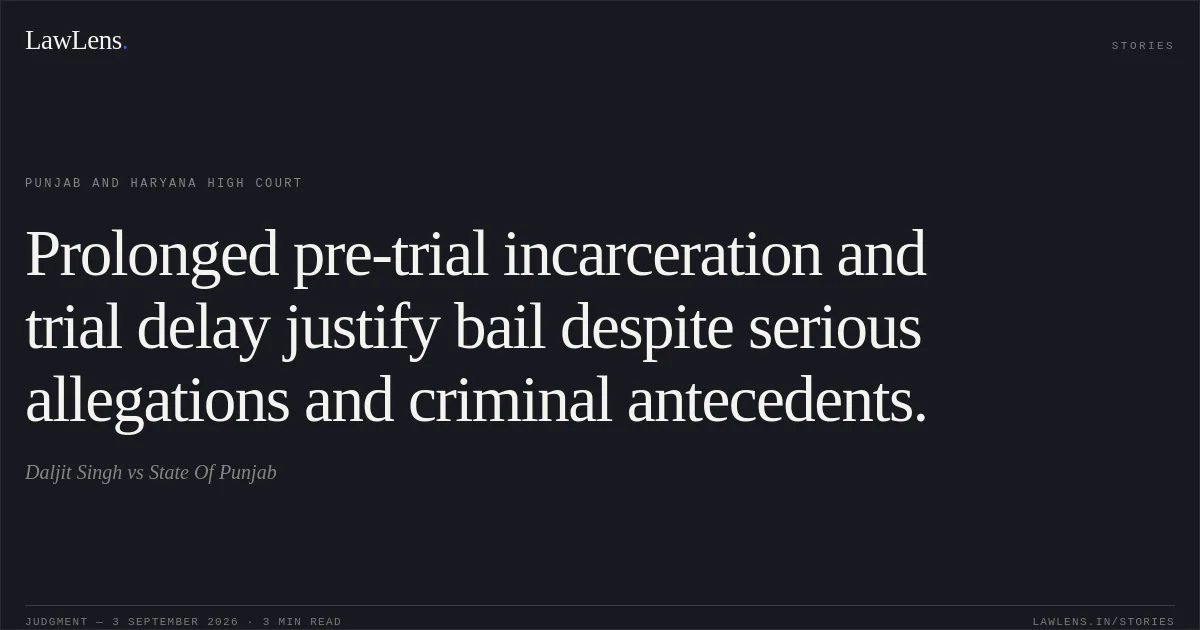
The petitioner sought first regular bail under Section 483 of the Bharatiya Nagarik Suraksha Sanhita, 2023, in FIR No. 256 dated 10 June 2023, registered at Police Station City Barnala, District Barnala, for offences under Sections 201, 307, 323 and 325 read with Section 34 IPC, corresponding to Sections 238, 109, 115(2) and 117 read with Section 3(5) of the Bharatiya Nyaya Sanhita, 2023, and Section 52 of the Prisons Act, 1894.
Source reference: para. 1The petitioner claimed false implication, absence of any specific overt act or injury attributable to him, and contended that the injury was not declared dangerous to life. He had remained in custody since 10 June 2023, for more than three years and two months, and relied on the fact that the main accused had already been granted bail by the High Court.
Source reference: para. 2The State opposed bail on the ground that the allegations were serious and that eleven other FIRs had been registered against the petitioner, making him a habitual offender.
Source reference: para. 3At the time of consideration, the prosecution had not examined even a single witness.
Source reference: para. 9Issues
Whether the petitioner was entitled to regular bail despite the seriousness of the allegations and his criminal antecedents, in view of his prolonged pre-trial incarceration?
Source reference: paras. 2–4, 9Whether continued detention of the petitioner, when the trial had substantially progressed neither and no witness had been examined, violated the constitutional guarantee of speedy trial under Article 21?
Source reference: paras. 5, 9Whether bail could be granted subject to conditions intended to secure the petitioner’s presence at trial and prevent interference with the administration of justice?
Source reference: paras. 8, 10Law Applied
The Court applied Section 483 of the Bharatiya Nagarik Suraksha Sanhita, 2023, governing the High Court’s power to grant regular bail.
Source reference: para. 1It relied on the constitutional right to speedy trial under Article 21, holding that such right begins from arrest and continues through investigation, inquiry and trial; in assessing delay, the Court must consider the length of delay, its justification, the accused’s assertion of the right, and prejudice caused by the delay, as stated in Ranjan Dwivedi v. CBI, relying on Kartar Singh v. State of Punjab and Hussainara Khatoon v. State of Bihar.
Source reference: para. 5The Court further applied the principle that bail is neither punitive nor preventive and that pre-trial detention is justified principally to secure the accused’s attendance at trial or prevent witness tampering, as recognised in Gudikanti Narasimhulu v. Public Prosecutor.
Source reference: para. 6Relying on Gurbaksh Singh Sibbia v. State of Punjab, the Court reiterated that grant or refusal of bail depends on the cumulative effect of the circumstances and that no single circumstance is conclusive.
Source reference: para. 7Reasoning
Although the Court acknowledged the seriousness of the allegations and the petitioner’s involvement in other criminal cases, it held that these factors could not justify indefinite pre-trial incarceration.
Source reference: para. 9The petitioner had remained in custody for over three years and two months, while the prosecution had not examined even one witness, demonstrating unreasonable delay in the trial.
Source reference: para. 9Applying the Article 21 speedy-trial principles and the rule that bail is not a form of punishment, the Court treated prolonged custody and the absence of meaningful trial progress as decisive considerations.
Source reference: paras. 5, 6, 9The petitioner’s criminal antecedents were considered but did not outweigh the constitutional and procedural consequences of continued detention, particularly where the bail order could impose safeguards against absconding, witness influence and further criminal activity.
Source reference: paras. 8–10Holding
The High Court allowed the bail application without commenting on the merits of the prosecution case.
The petitioner was directed to be released on regular bail upon furnishing bail and surety bonds to the satisfaction of the trial Court, Duty Magistrate or Chief Judicial Magistrate concerned.
Source reference: para. 10The release was made subject to conditions including non-interference with witnesses, regular appearance before the trial Court, prior permission for absence, surrender of passport or filing of an affidavit, disclosure and updating of residence and mobile-phone details, and the possibility of cancellation of bail if the petitioner engaged in further criminal activity.
Source reference: para. 10(i)–(vi)The Court also permitted the trial Court to require two heavy local sureties and imposed a condition requiring the petitioner to report on the first Monday of every English calendar month before the concerned Station House Officer until conclusion of the trial.
Source reference: para. 10(vii)–(viii)Acts & Sections Cited
15 provisions across 5 statutes referred to in this judgment. Each provision opens on LawLens.
Bharatiya Nagarik Suraksha Sanhita, 20231
Indian Penal Code, 18605
Bharatiya Nyaya Sanhita, 20235
Prisons Act, 18941
Code of Criminal Procedure, 19733
Original Court PDF
Daljit SinghvsState Of Punjab
Click to open original judgment
Original judgment, available to read, download and summarize on LawLens.in