Facts
The applicant was arrested on December 19, 2023, in connection with Crime No. 862 of 2023 for alleged possession of 2 kg 800 grams of opium, 62 kg of Dodachura, 140 grams of MD narcotic drug, and unauthorized firearms
Source reference: para. 2, 9The prosecution charged the applicant under Sections 8/15, 18, 22, and 29 of the NDPS Act, Sections 25 and 27 of the Arms Act, and Sections 14 and 15 of the M.P. Rajya Surakshya Adhiniyam
Source reference: para. 2This was the applicant’s sixth bail application; prior applications resulted in three grants of temporary bail, one withdrawal, and one dismissal in default
Source reference: para. 3Procedurally, only two out of twenty-three prosecution witnesses had been examined, and the trial court estimated the trial would take another two to three years to conclude
Source reference: para. 1, 9Issues
1. Whether prolonged pre-trial incarceration and the slow pace of trial proceedings entitle the applicant to bail despite the statutory rigors of Section 37 of the NDPS Act
Source reference: para. 6, 122. Whether the hostility of independent seizure witnesses and the applicant's criminal history impact the entitlement to bail under Section 483 of BNSS, 2023
Source reference: para. 6, 9, 14Law Applied
The court primarily applied Section 483 of the Bharatiya Nagarik Suraksha Sanhita (BNSS), 2023 (corresponding to Section 439 CrPC) regarding the High Court's power to grant bail
Source reference: para. 2It navigated the statutory bar under Section 37(1)(b) of the NDPS Act by invoking Article 21 of the Constitution of India, which guarantees the right to a fair and speedy trial
Source reference: para. 6, 10The court relied on the Supreme Court’s rulings in Union of India v. K.A. Najeeb (2021) and Sheikh Javed Iqbal @ Ashfaq Ansari @ Javed Ansari v. State of Uttar Pradesh (2024), which establish that constitutional courts may grant bail despite restrictive penal statutes if an accused’s fundamental rights are infringed by prolonged incarceration
Source reference: para. 10It further cited Ankur Chaudhary v. State of Madhya Pradesh (2024) to emphasize that conditional liberty may override statutory embargoes when a trial is not concluded within a reasonable time
Source reference: para. 12Reasoning
The court balanced the gravity of the alleged offense involving commercial quantities of narcotics against the applicant’s fundamental right to liberty
Source reference: para. 10, 13It noted that the applicant had been in custody for approximately two years and three months, while the trial showed negligible progress with only two witnesses examined
Source reference: para. 9, 13The court observed that the independent seizure witnesses, Shokat Noori (PW1) and Jafar (PW2), did not support the prosecution's case, weakening the immediate veracity of the seizure
Source reference: para. 6, 9Regarding the State’s objection concerning twelve criminal antecedents, the court considered the applicant's rebuttal that many of those cases resulted in acquittals, quashing of FIRs, or grants of bail
Source reference: para. 7, 8The court reasoned that since the trial was not progressing at an appropriate pace and there was no immediate possibility of fleeing justice, continued incarceration would be punitive rather than preventive
Source reference: para. 13Holding
The Court allowed the application and directed the release of the applicant on bail upon furnishing a personal bond of Rs. 1,00,000/- with one surety
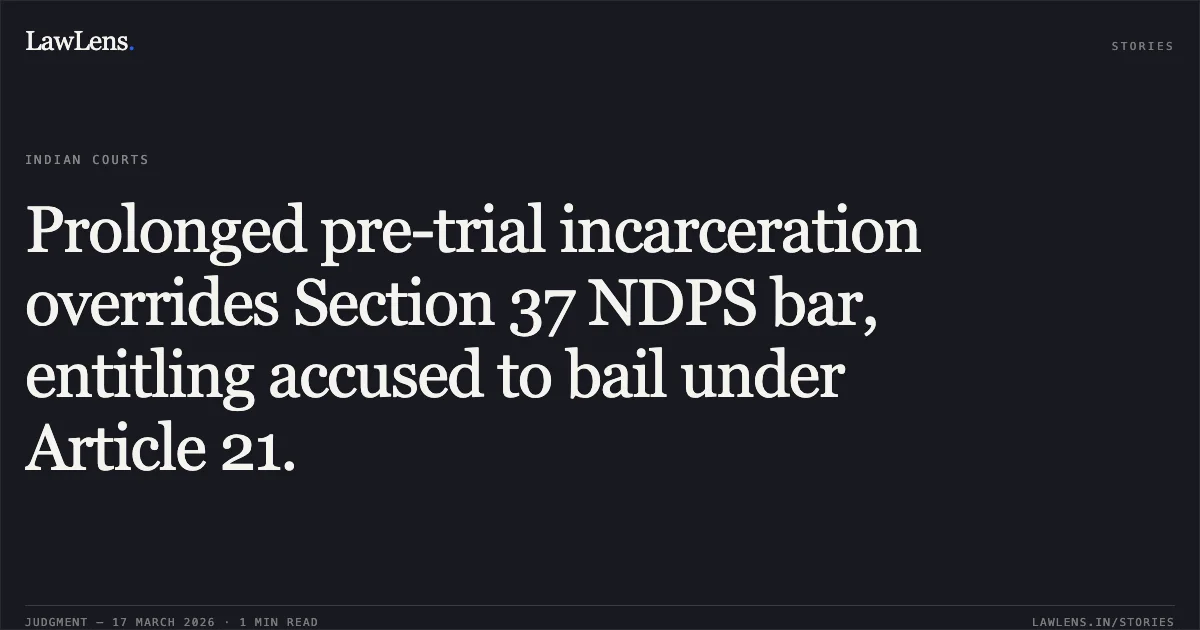
The Court held that while Section 37 of the NDPS Act creates a high threshold, it cannot act as an absolute bar when pre-trial detention violates Article 21
Source reference: para. 10, 12Specific conditions were imposed, including a requirement for the applicant to mark his presence at the Industrial Area Police Station, Jaora, every Saturday until the trial concludes, and a prohibition against committing further offenses
Source reference: para. 15The court clarified that these observations were limited to the bail application and would not affect the merits of the trial
Source reference: para. 13, 16Acts & Sections Cited
12 provisions across 5 statutes referred to in this judgment. Each provision opens on LawLens.
Bharatiya Nagarik Suraksha Sanhita, 20232
Narcotic Drugs and Psychotropic Substances Act, 19856
Arms Act, 19592
Unlawful Activities (Prevention) Act, 19671
Code of Criminal Procedure, 19731
Original Court PDF
Ali Hussain @ FajluvsThe State Of Madhya Pradesh
Click to open original judgment
Original judgment, available to read, download and summarize on LawLens.in