Facts
The appellant was prosecuted for an incident dated 31 March 2007, during which he allegedly abused the complainant’s husband over payment for labour work and struck him with an iron rod on the head, shoulder and legs, causing injuries and unconsciousness.
Source reference: no citationAfter investigation, a charge-sheet was filed; charges were initially framed under Sections 452 and 308 of the Indian Penal Code.
Source reference: no citationFollowing trial, the Additional Sessions Judge, Ganjbasoda, Vidisha, convicted the appellant under Section 325 IPC and sentenced him to one year’s rigorous imprisonment with a fine of ₹1,500 and, in default, two months’ rigorous imprisonment, with sentences to run concurrently.
Source reference: p.1The appellant filed the present appeal under Section 374(2) Cr.P.C., but expressly confined the challenge to the quantum of sentence and did not dispute his conviction.
Source reference: p.1He submitted that he had remained in custody for approximately 30 days, had faced criminal proceedings for nearly 19 years, had deposited the fine, and had not misused the liberty granted during the pendency of the appeal.
Source reference: p.2Issues
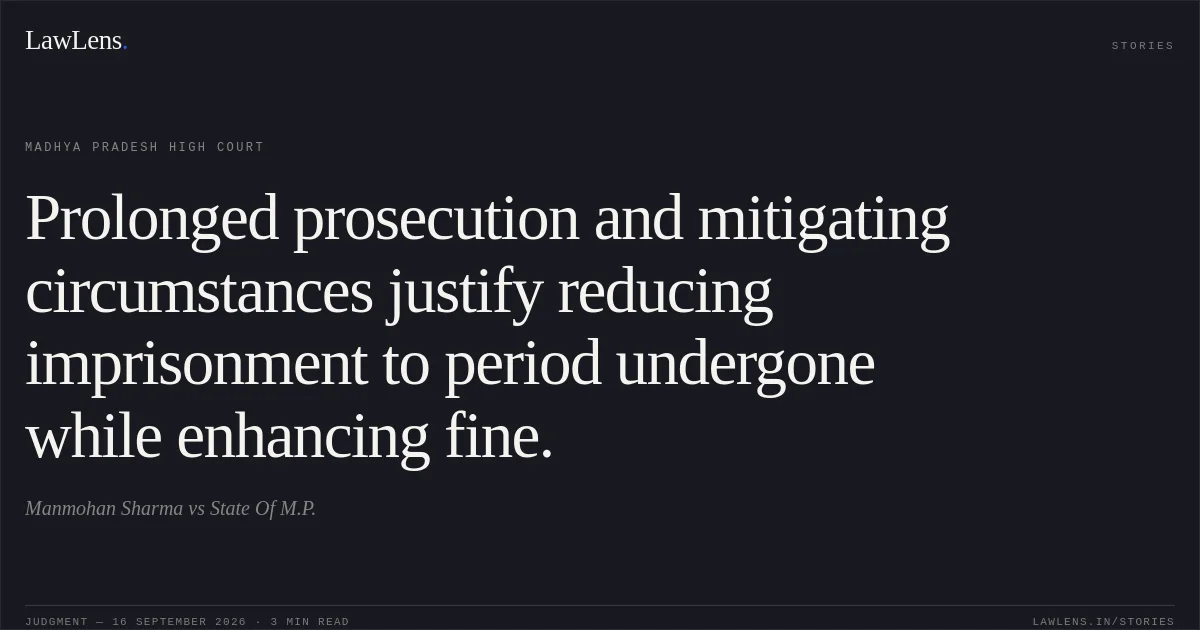
Whether, while maintaining the appellant’s conviction under Section 325 IPC, the substantive sentence of imprisonment should be reduced to the period already undergone in view of the prolonged pendency of the case, the custody already suffered, and the appellant’s circumstances.
Source reference: p.2–3Whether the fine imposed by the trial court should be enhanced as a condition for reducing the substantive sentence.
Source reference: p.3Law Applied
The Court applied Section 374(2) of the Code of Criminal Procedure, which permits an appeal against a conviction and sentence imposed by a Sessions Court; Section 325 IPC, concerning voluntarily causing grievous hurt, under which the conviction was recorded; and Section 357 Cr.P.C., authorising payment of fine as compensation to the victim.
Source reference: no citationIn determining sentence, the Court considered proportionality, the period already undergone, the age and antecedents of the offender, the time elapsed since the offence, conduct during incarceration, and the overall circumstances of the case.
Source reference: no citationNo judicial precedent was cited in the order.
Source reference: no citationReasoning
The appellant did not challenge the finding of guilt, so the Court confined its consideration to sentencing.
Source reference: p.1It noted that the offence occurred in 2007 and that the appellant had faced the criminal process for nearly 19 years, while having already undergone approximately 30 days in custody.
Source reference: p.2The Court further considered that he was middle-aged, had no criminal antecedents shown on record, was stated to be a first-time offender, had maintained satisfactory conduct during incarceration, and had not misused the liberty granted to him.
Source reference: p.3Balancing these mitigating circumstances against the nature of the offence, the Court concluded that continued substantive imprisonment was unnecessary, but that an enhanced fine was appropriate to preserve the punitive element of the sentence and compensate the complainant.
Source reference: p.3Holding
The appeal was allowed in part.
The conviction under Section 325 IPC was maintained, but the substantive sentence of imprisonment was reduced to the period already undergone.
Source reference: p.3The fine was enhanced from ₹1,500 to ₹3,000, to be deposited within two months.
Source reference: p.3Upon deposit, the enhanced fine was directed to be paid to the complainant as compensation under Section 357 Cr.P.C.
Source reference: p.3In default of depositing the enhanced fine, the appellant would be liable to undergo the sentence imposed by the trial court.
Source reference: p.3–4The appeal was accordingly disposed of with this modification in the sentence.
Source reference: p.3–4Acts & Sections Cited
5 provisions across 2 statutes referred to in this judgment. Each provision opens on LawLens.
Code of Criminal Procedure, 19732
Indian Penal Code, 18603
Original Court PDF
Manmohan SharmavsState Of M.P.
Click to open original judgment
Original judgment, available to read, download and summarize on LawLens.in