Facts
The parties married according to Hindu rites on 13 May 2002 and had no child from the marriage.
Source reference: p.2, para. 2The husband alleged that, after approximately two years of marriage, the wife insisted that he separate from his parents and brother, used abusive language, left the matrimonial home without informing him, and occasionally remained away for several days.
Source reference: p.2, para. 2He further alleged that she left the matrimonial home on 7 December 2014 with her father and brother and thereafter resided at her parental home.
Source reference: pp.2–3, paras. 2–3The wife denied cruelty and alleged dowry harassment, physical assault, loss of pregnancy, and forcible ouster from the matrimonial home on 14 December 2014.
Source reference: p.3, para. 4She instituted a criminal case under Sections 498-A, 323 and 379 of the IPC and claimed that she was willing to resume cohabitation with the husband.
Source reference: p.3, para. 5The Principal Judge, Family Court, Sheohar, by judgment and decree dated 30 June 2022 in Matrimonial Case No. 19 of 2015, dissolved the marriage under Section 13(1)(ia) of the Hindu Marriage Act, 1955, on the ground of cruelty.
Source reference: p.1, para. 1The wife preferred the present appeal under Section 19 of the Family Courts Act, 1984 read with Section 28 of the Hindu Marriage Act.
Source reference: p.1, para. 1Issues
Whether the wife’s alleged conduct, including her insistence that the husband live separately from his parents, alleged abusive behaviour, and the parties’ prolonged separation, constituted mental cruelty under Section 13(1)(ia) of the Hindu Marriage Act, 1955?
Source reference: pp.10–16, paras. 19–25Whether the Family Court’s decree of divorce suffered from perversity, legal error, or inadequate appreciation of the evidence so as to warrant appellate interference?
Source reference: pp.9–10, paras. 16–18; p.18, para. 29What permanent alimony and maintenance, if any, should be awarded to the wife under Section 25 of the Hindu Marriage Act?
Source reference: pp.18–25, paras. 30–36Law Applied
The Court applied Section 13(1)(ia) of the Hindu Marriage Act, 1955, under which a marriage may be dissolved where one spouse has treated the other with cruelty.
Source reference: p.1, para. 1Mental cruelty is assessed from the cumulative effect of the parties’ conduct, the entire matrimonial relationship, and the circumstances of separation, rather than from isolated incidents.
Source reference: p.11, para. 20The Court relied on Naveen Kohli v. Neelu Kohli, (2006) 4 SCC 558, and Vinita Saxena v. Pankaj Pandit, (2006) 3 SCC 778, for the principle that cruelty depends on human conduct and the totality of the facts.
Source reference: p.11, para. 20It relied on Samar Ghosh v. Jaya Ghosh, (2007) 4 SCC 511, which recognises that sustained abusive, humiliating, unjustifiable, or intolerable conduct may amount to mental cruelty, while ordinary wear and tear, trivial quarrels, or isolated disagreements do not.
Source reference: pp.11–15, paras. 21–22Narendra v. K. Meena, (2016) 9 SCC 455, was considered regarding persistent insistence by a spouse that the other separate from his parents, in the context of familial and social obligations.
Source reference: pp.7–8, para. 14For financial relief, the Court applied Section 25 of the Hindu Marriage Act, which permits a gross or periodical award having regard to the parties’ income, property, conduct, and other circumstances, along with the financial-disclosure principles in Rajnesh v. Neha, (2021) 2 SCC 324.
Source reference: pp.18–20, paras. 30–32Reasoning
The High Court held that the evidence had to be assessed cumulatively.
Source reference: pp.15–16, paras. 23–24Although the respondent’s witnesses contained discrepancies concerning chronology and the precise duration of separation, the core allegation of sustained matrimonial discord was supported by the evidence of P.Ws.1 to 3 and the husband’s testimony.
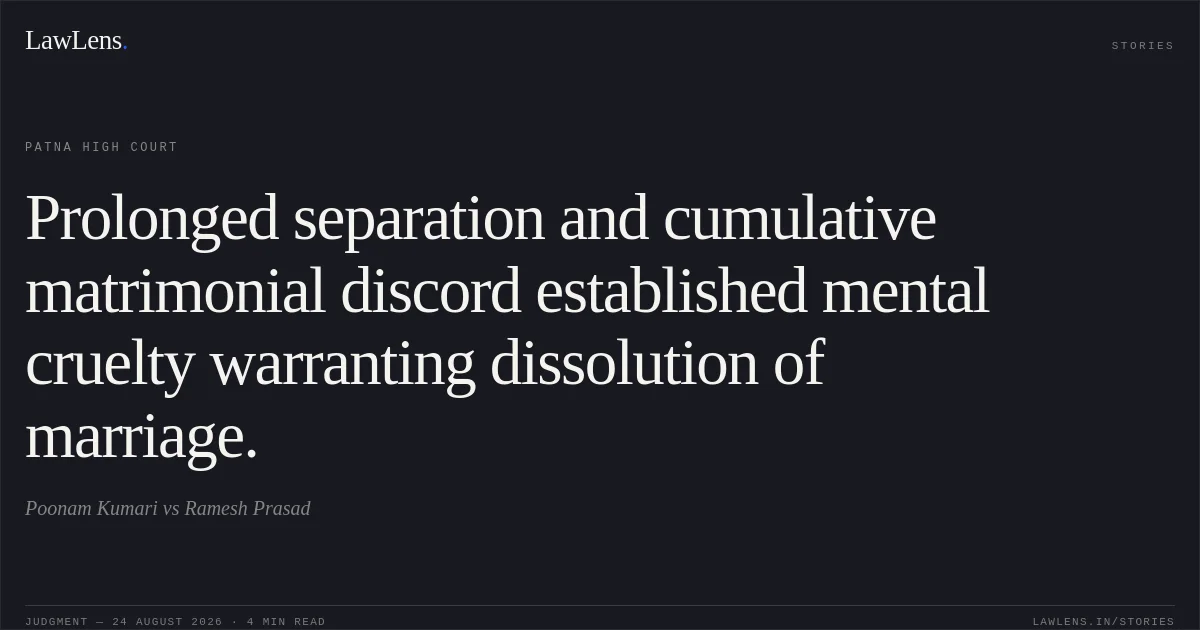
Source reference: pp.15–16, paras. 23–24The wife’s insistence upon separate residence, the alleged continuation of discord even after the husband separated from his parents and brother, the parties’ admitted failure to resume cohabitation since December 2014, and the overall deterioration of the relationship demonstrated that the matrimonial bond had become practically unworkable.
Source reference: p.16, paras. 24–25Her stated willingness to resume cohabitation did not, by itself, erase the prior conduct or restore a relationship that had deteriorated beyond reasonable repair.
Source reference: p.16, para. 25The criminal cases filed by the parties were not treated as conclusive proof of cruelty, but were considered as part of the broader pattern of continuing matrimonial discord.
Source reference: pp.16–17, para. 26The Court excluded reliance on the unsubstantiated allegation that the wife was earning Rs.10,000 per month, but found that this did not undermine the remaining evidence establishing cruelty.
Source reference: p.17, para. 27For alimony, the Court found no established independent income of the wife and considered the husband’s agricultural property, business activity, vehicle, and disclosed liabilities.
Source reference: pp.19–25, paras. 32–36Balancing the wife’s need for support against the husband’s proved financial capacity, it awarded one katha of transferable agricultural land and monthly alimony of Rs.10,000.
Source reference: pp.19–25, paras. 32–36The existing maintenance of Rs.5,000 per month was directed to be adjusted to prevent double recovery.
Source reference: pp.24–26, paras. 36, 39Holding
The appeal was dismissed, and the Family Court’s decree dissolving the marriage on the ground of cruelty under Section 13(1)(ia) of the Hindu Marriage Act was affirmed.
Subject to that affirmation, the decree was modified to grant the wife one katha of land from the husband’s legally owned, transferable, and unencumbered agricultural property, with transfer to be completed within three months.
Source reference: pp.26–27, paras. 39–40The husband was further directed to pay the wife Rs.10,000 per month as permanent alimony under Section 25, with the existing Rs.5,000 monthly maintenance being adjusted against that amount.
Source reference: p.26, paras. 39–40The parties were permitted to seek variation or rescission under Section 25(2) upon a material change in circumstances.
Source reference: p.27, para. 41Acts & Sections Cited
7 provisions across 3 statutes referred to in this judgment. Linked provisions open on LawLens.
Family Courts Act, 19841
Hindu Marriage Act, 19553
Indian Penal Code, 18603
Original Court PDF
Poonam KumarivsRamesh Prasad
Click to open original judgment
Original judgment, available to read, download and summarize on LawLens.in