Facts
The parties married on 3 December 2007. The husband alleged that the wife left the matrimonial home in March 2008 and that the parties thereafter lived separately; the wife denied the allegations of cruelty and desertion and maintained that she had been ousted from the matrimonial home.
Source reference: paras. 4(i)–(iii), pp. 3–5The husband’s earlier divorce suit, filed on grounds of cruelty and desertion, was dismissed in 2010, and his appeal was dismissed in 2011. In the present matrimonial case, initially dismissed and later remanded for decision on the evidence, the Family Court granted the husband a decree of divorce on 7 June 2022. The wife appealed against that decree.
Source reference: paras. 1, 3, pp. 1–3Issues
Whether the evidence and the parties’ prolonged separation established grounds for dissolution of marriage, such that the Family Court’s decree of divorce should be upheld.
Source reference: para. 5, p. 7Whether the appellate court should interfere with the Family Court’s decree.
Source reference: para. 5, p. 7Law Applied
The judgment’s reasoning rests on the Hindu Marriage Act grounds of cruelty and desertion, corresponding to Sections 13(1)(ia) and 13(1)(ib), although the court did not expressly cite those provisions. It treated desertion for more than two years immediately preceding presentation of the divorce petition as a basis for dissolution, and prolonged separation and denial of conjugal relations as cruelty in the circumstances of this case.
Source reference: para. 5, p. 7The court expressly referred to Section 25 of the Hindu Marriage Act as the provision under which the wife could seek permanent alimony. No precedent was cited.
Source reference: paras. 8–9, pp. 7–8Reasoning
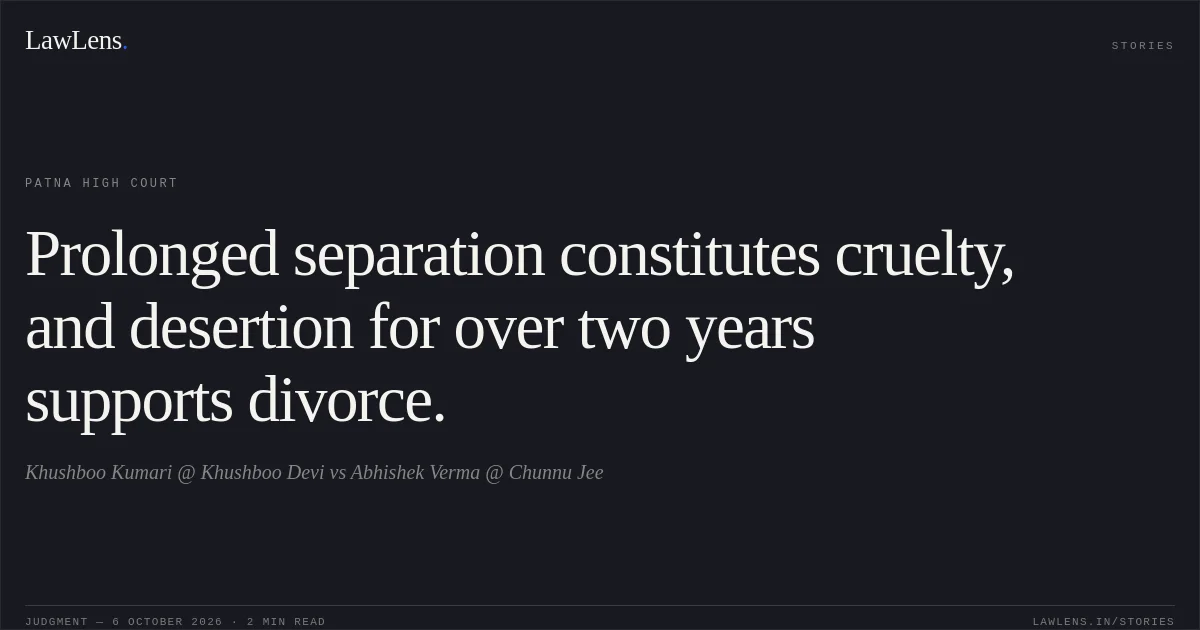
The court noted that the wife did not dispute that the parties had lived separately for approximately 18 years. It considered that prolonged separation and denial of conjugal relations amounted to cruelty, and found that the wife had been in desertion for more than two years immediately before the husband filed the matrimonial case.
Source reference: para. 5, p. 7On that basis, it concluded that the Family Court had rightly granted divorce and found no reason to interfere. As the wife had not sought permanent alimony before the Family Court, the court preserved her liberty to apply under Section 25.
Source reference: paras. 5, 8–9, pp. 7–8Holding
The appeal was dismissed, and the Family Court’s judgment and decree dissolving the marriage were affirmed.
The wife was granted liberty to apply for permanent alimony under Section 25 of the Hindu Marriage Act; if she does so, the Family Court was directed to decide the application in accordance with law, preferably within four months of filing.
Source reference: para. 9, p. 8Acts & Sections Cited
1 provisions across 1 statute referred to in this judgment. Each provision opens on LawLens.
Hindu Marriage Act, 19551
Original Court PDF
Khushboo Kumari @ Khushboo DevivsAbhishek Verma @ Chunnu Jee
Click to open original judgment
Original judgment, available to read, download and summarize on LawLens.in