Facts
The petitioner sought to quash C.C. No. 3807 of 2010, arising from Crime No. 614 of 2010, in which he and others were alleged to have obstructed police officers attempting to arrest Seeman, used force and abusive language, threatened the police, and damaged a police van by pelting stones.
Source reference: p.1–2The final report charged the petitioner under IPC Sections 188, 143, 147, 294(b), 341, 353, 336 and 506(i), and Section 3 of the Prevention of Damage to Public Property Act.
Source reference: p.1–2The petitioner denied involvement in an unlawful assembly or restraining anyone; the prosecution opposed quashing, submitting that Section 195 CrPC did not prevent police from registering an FIR or investigating an offence under Section 188 IPC.
Source reference: p.2–3Issues
Whether the police could register a case and lay a final report for an offence under Section 188 IPC without a written complaint by the public servant concerned, as required by Section 195(1)(a)(i) CrPC.
Source reference: p.3, p.6Whether the allegations disclosed the ingredients of unlawful assembly or the other offences charged, such that the prosecution could proceed.
Source reference: p.5–6Law Applied
Section 195(1)(a)(i) CrPC bars a court from taking cognizance of an offence under IPC Sections 172–188, including Section 188, except upon a written complaint by the public servant concerned or a public servant to whom that person is administratively subordinate.
Source reference: p.3The Court relied on the guidelines in Jeevanandham and others v. State, including that a police officer cannot register an FIR for an offence under Sections 172–188 IPC and that a final report may be acted upon for other offences only where those offences are independently disclosed.
Source reference: p.4–5Under IPC Section 141, an assembly of five or more persons is unlawful only if it shares one of the specified common objects, including resisting execution of law or committing an offence.
Source reference: p.5–6Reasoning
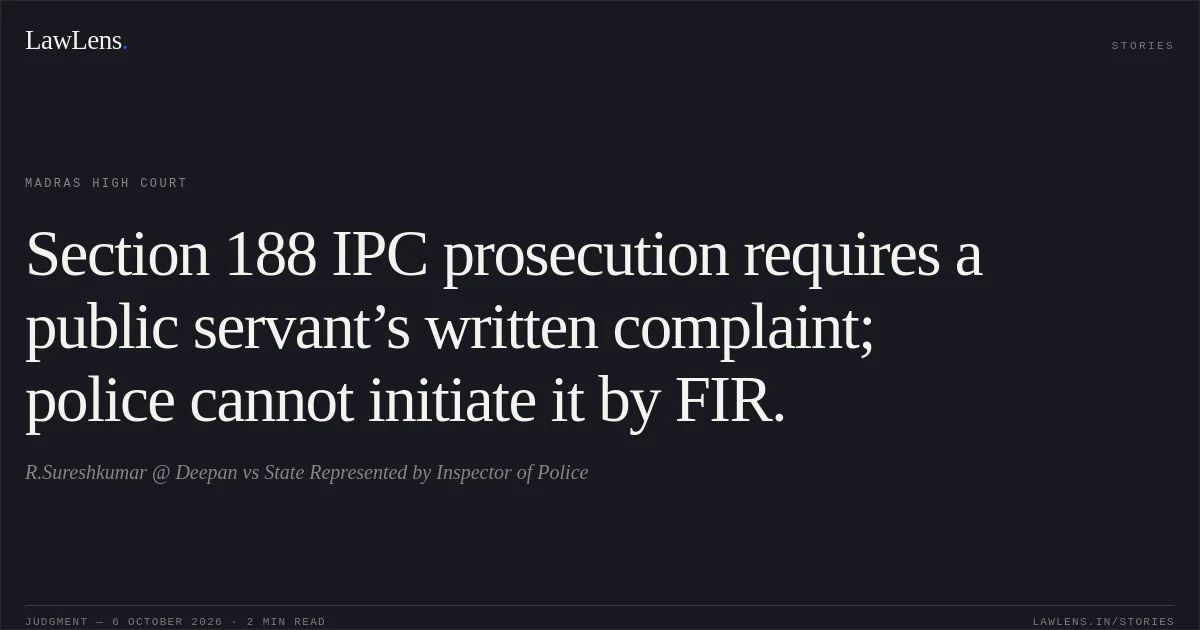
The Court held that the police were not competent to register an FIR for the Section 188 offence and that, absent the written complaint required by Section 195(1)(a)(i) CrPC, the FIR or final report could not sustain that charge.
Source reference: p.3, p.6It also found that the materials did not disclose the ingredients of unlawful assembly: the accused had not shown criminal force to commit mischief or another offence, or to take possession of property or a right.
Source reference: p.6Concluding that the other charged offences likewise lacked supporting ingredients, the Court held that the final report could not be sustained.
Source reference: p.6Holding
The High Court allowed the petition and quashed the entire proceeding in C.C. No. 3807 of 2010 before the Chief Metropolitan Magistrate, Egmore, Chennai.
It directed the petitioner to pay ₹10,000 to the Chief Justice Relief Fund, Madras High Court, and file proof of payment with the Registry; the connected miscellaneous petitions were closed.
Source reference: p.7Acts & Sections Cited
29 provisions across 4 statutes referred to in this judgment. Each provision opens on LawLens.
Indian Penal Code, 1860
Code of Criminal Procedure, 19732
Prevention of Damage to Public Property Act, 19841
Police Act, 18611
Original Court PDF
R.Sureshkumar @ DeepanvsState Represented by Inspector of Police
Click to open original judgment
Original judgment, available to read, download and summarize on LawLens.in
![Ayurveda faculty recruitment conditions must conform to governing statutory regulations.. Dr Vikram Vir Bhushan vs HEALTH AND MEDICAL EDUCATION DEPARTMENT. CAT - ['Jammu']. LawLens](/stories/thumbnails/ayurveda-faculty-recruitment-conditions-must-conform-to-governing-statutory-regulations-e9e5bd2503b94c5b80cb9b5dd3d3eac9.webp)
![Recovery of pecuniary loss requires a reasoned finding of each employee’s individual contribution.. Rakesh Kumar vs D/o Jal Shakti Ut Of Jammu & Kashmir. CAT - ['Jammu']. LawLens](/stories/thumbnails/recovery-of-pecuniary-loss-requires-a-reasoned-finding-of-each-employees-individual-contri-e9a45adab31641c4bb0112f2acbf02d0.webp)