Facts
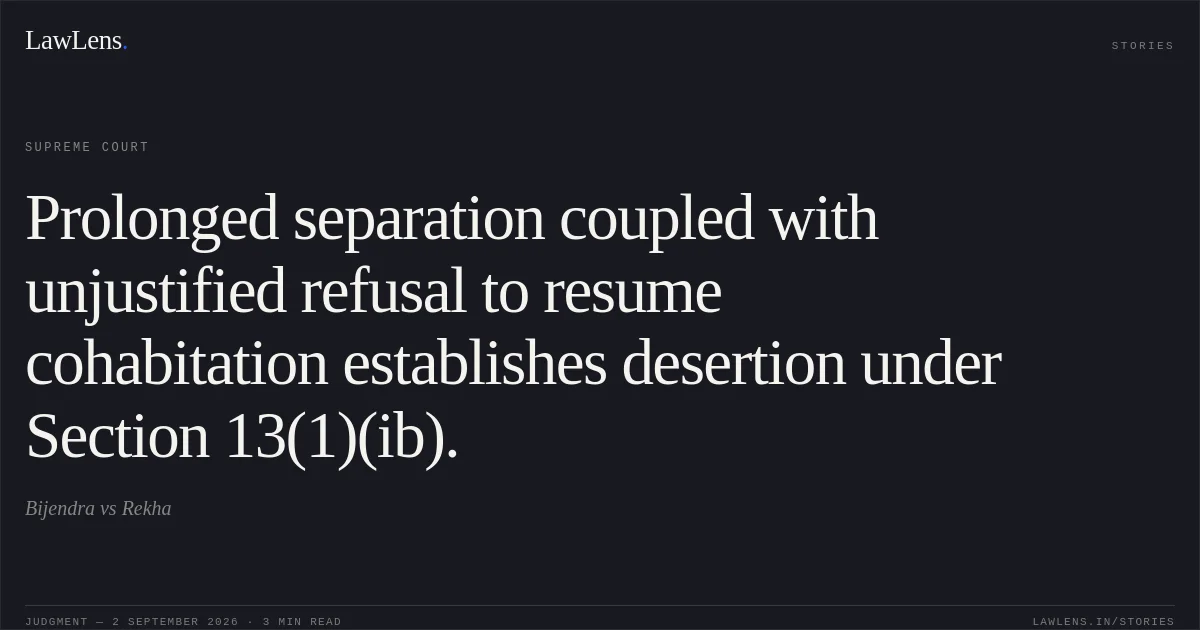
The parties married on 23 June 2003 and had no children. The appellant-husband alleged cruelty, including denial of matrimonial relations and insulting conduct, and stated that the respondent-wife left for her parental home on 30 November 2005 and refused to return when he went to bring her back on 15 December 2005. The parties thereafter lived separately without resuming cohabitation.
Source reference: pp.1–2; paras 1–3The appellant filed a divorce petition under Section 13 of the Hindu Marriage Act, 1955 (“HMA”) on the grounds of cruelty and desertion.
Source reference: p.2; para 3The Trial Court found the allegations of cruelty unproved but held that the respondent had deserted the appellant from 15 December 2005, while nevertheless dismissing the divorce petition.
Source reference: p.2; para 4; p.5; para 15The High Court dismissed the appellant’s appeal, holding that physical separation alone did not establish desertion and that animus deserendi had not been proved.
Source reference: pp.2–3; para 6Issues
Whether the respondent-wife had deserted the appellant-husband within the meaning of Section 13(1)(ib) of the HMA by living separately and refusing to resume cohabitation from 15 December 2005.
Source reference: p.4; para 14Whether the appellant was entitled to dissolution of marriage despite the concurrent findings that cruelty had not been proved.
Source reference: pp.8–9; paras 19–23What consequential relief, including permanent alimony, should be granted upon dissolution of the marriage?
Source reference: pp.9–10; paras 20, 24–25Law Applied
The Court applied Section 13(1)(ib) of the HMA, under which desertion constitutes a ground for divorce where one spouse has deserted the other for a continuous period of not less than two years immediately preceding the presentation of the petition.
Source reference: pp.6–8; paras 17–18Desertion requires both the factum of separation and the intention permanently to bring cohabitation to an end (animus deserendi), together with absence of the deserted spouse’s consent and absence of reasonable cause for the separation, as explained in Lachman Utamchand Kirpalani v. Meena and Savitri Pandey v. Prem Chandra Pandey.
Source reference: pp.6–8; paras 17–18Desertion is not synonymous with mere physical separation; it is a withdrawal from matrimonial obligations and may be established by inference from the parties’ conduct and surrounding circumstances.
Source reference: pp.7–8; para 18The Court also relied on Naveen Kohli v. Neelu Kohli for the principle that prolonged separation may demonstrate that a marriage has broken down beyond repair, and on Shilpa Sailesh v. Varun Sreenivasan as instructive on the significance of prolonged separation, although the decree was not granted under Article 142 of the Constitution.
Source reference: pp.6–7, 9; paras 17, 21–22Reasoning
The fact of separation was undisputed: the parties had lived apart since 15 December 2005 and had never resumed cohabitation.
Source reference: p.4; para 14Although the respondent stated that she remained willing to discharge her marital obligations, the Court held that this assertion could not prevail over her conduct. The appellant, accompanied by Ram Prakash, had gone to bring her back to the matrimonial home, but she refused to return without establishing any reasonable cause for doing so.
Source reference: pp.5, 8; paras 15, 19This conduct, viewed alongside the continuous separation and failure of all reconciliation efforts, established both the factum of separation and the requisite intention to terminate matrimonial cohabitation.
Source reference: p.8; para 19The High Court therefore erred in treating the respondent’s verbal assertion as sufficient to negate animus deserendi.
Source reference: p.8; para 19The Court did not disturb the findings that cruelty had not been proved, but held that desertion independently entitled the appellant to divorce.
Source reference: p.9; para 23Given the parties’ prolonged separation, absence of children, and failed attempts at reconciliation, continuation of the legal marital tie would not serve the ends of justice.
Source reference: p.9; para 20Holding
The appeal was partly allowed. The Supreme Court set aside the High Court’s finding that desertion had not been proved and held that the respondent-wife had deserted the appellant under Section 13(1)(ib) of the HMA.
The marriage solemnized on 23 June 2003 was dissolved by a decree of divorce on the ground of desertion; the findings rejecting cruelty were left undisturbed.
Source reference: p.10; para 25(ii)The appellant was directed to pay the respondent ₹7,00,000 as permanent alimony by depositing the amount before the Trial Court within three months, failing which it would carry interest at 9% per annum and be recoverable through execution.
Source reference: p.10; para 25(iii)No order as to costs was made.
Source reference: p.10; para 25(iv)Acts & Sections Cited
2 provisions across 1 statute referred to in this judgment. Each provision opens on LawLens.
Hindu Marriage Act, 19552
Original Court PDF
BijendravsRekha
Click to open original judgment
Original judgment, available to read, download and summarize on LawLens.in