Facts
The petitioner, an Assistant Teacher appointed on 9 September 1964 and subsequently functioning as Headmaster of Primary School, Sarkhand Khera, District Mathura, was placed under suspension by the District Basic Education Officer, Mathura, on 10 February 1992 on allegations including insubordination, absence from duty, locking the school premises, failure to hand over charge, and retention of official records, including the cash book, passbook and cheque book.
Source reference: paras. 4–5, 19–21Criminal proceedings under Section 409 IPC were instituted against him. He was convicted by the Chief Judicial Magistrate, Mathura, on 3 June 1997; his criminal appeal was dismissed, and his criminal revision before the High Court was dismissed on 31 March 2018.
Source reference: paras. 6–8, 21–23The petitioner superannuated on 30 June 2000 while remaining under suspension and claimed salary, subsistence allowance, pension, arrears of pension and other retiral benefits.
Source reference: para. 24The department considered his representations and, by order dated 1 July 2020, rejected his claims on the ground that he had been convicted, had not reported for duty during suspension, and was therefore not entitled to suspension allowance or pensionary benefits as claimed.
Source reference: para. 25The record indicated that his GPF and Group Insurance benefits had already been paid.
Source reference: para. 26Issues
Whether the petitioner was entitled to quashing of the suspension order dated 10 February 1992 merely because the suspension continued for a prolonged period and survived his superannuation?
Source reference: paras. 10, 15, 28, 34–35Whether the petitioner was entitled to full salary or back wages for the period during which he remained under suspension despite not performing duties?
Source reference: paras. 28–33, 46–47, 53–55Whether the petitioner was entitled to subsistence allowance and other monetary benefits on the basis of the alleged termination or outcome of the criminal proceedings?
Source reference: paras. 30–32, 44–45, 51Whether the departmental decision dated 1 July 2020 refusing further monetary and retiral benefits was arbitrary, perverse, or contrary to law so as to warrant interference under Article 226 of the Constitution?
Source reference: paras. 37, 50, 55–56Law Applied
The Court applied Article 226 of the Constitution, under which interference is warranted only where the petitioner establishes a legally enforceable right and the impugned decision suffers from illegality, perversity, jurisdictional error, or violation of law.
Source reference: paras. 39, 55–56It held that suspension is ordinarily not a punishment and that a suspended employee is entitled only to subsistence allowance admissible under the applicable service rules; full salary is not an automatic consequence of prolonged suspension.
Source reference: paras. 31–32The principle of “no work, no pay” was held relevant where the employee did not perform duties and failed to show that such non-performance resulted exclusively from an unlawful act of the employer.
Source reference: paras. 33, 46, 53The Court relied on State of Maharashtra v. Chandrabhan Tale, (1983) 3 SCC 387, recognising the importance of subsistence allowance but not an indefeasible right to full salary during suspension.
Source reference: para. 32It also relied on J.K. Synthetics Ltd. v. K.P. Agrawal, (2007) 2 SCC 433, for the rule that reinstatement or restoration of service does not automatically confer entitlement to back wages.
Source reference: para. 47It also relied on Union of India v. T.P. Gopinath, 2003 Supreme (Ker) 226; (2003) 2 ILR (Ker) 593, for the distinction between acquittal in criminal proceedings and complete exoneration for service purposes.
Source reference: para. 48Prolonged suspension is undesirable and disciplinary proceedings should ordinarily be concluded expeditiously, but duration alone does not create an automatic right to full salary or other benefits.
Source reference: para. 34Reasoning
The Court held that the petitioner had not established complete exoneration or an honourable acquittal.
Source reference: paras. 23, 30, 36, 40On the contrary, the criminal revision was dismissed and the revisional court’s observations supported the finding that he had retained institutional records despite directions to return them.
Source reference: paras. 23, 30, 36, 40The petitioner also failed to show that he had reported at the place where he was directed to join or cooperated with the departmental proceedings; therefore, he could not rely on the prolonged duration of the proceedings to claim full salary or contend that the delay was attributable exclusively to the department.
Source reference: paras. 29, 35, 42–43, 52The Court distinguished subsistence allowance from salary and held that entitlement to such allowance remained subject to the applicable rules and compliance with the conditions of suspension.
Source reference: paras. 44–45The petitioner did not establish that any legally admissible amount remained unpaid, while the department had already considered his claim and released the GPF and Group Insurance benefits payable to him.
Source reference: paras. 44–45, 50, 54Retirement did not retrospectively convert the suspension period into a period of duty or create a right to salary or additional retiral benefits.
Source reference: para. 49Since the petitioner failed to demonstrate any jurisdictional error, perversity, or statutory violation in the order dated 1 July 2020, no interference under Article 226 was warranted.
Source reference: paras. 37, 39, 55–56Holding
The Court answered the issues against the petitioner.
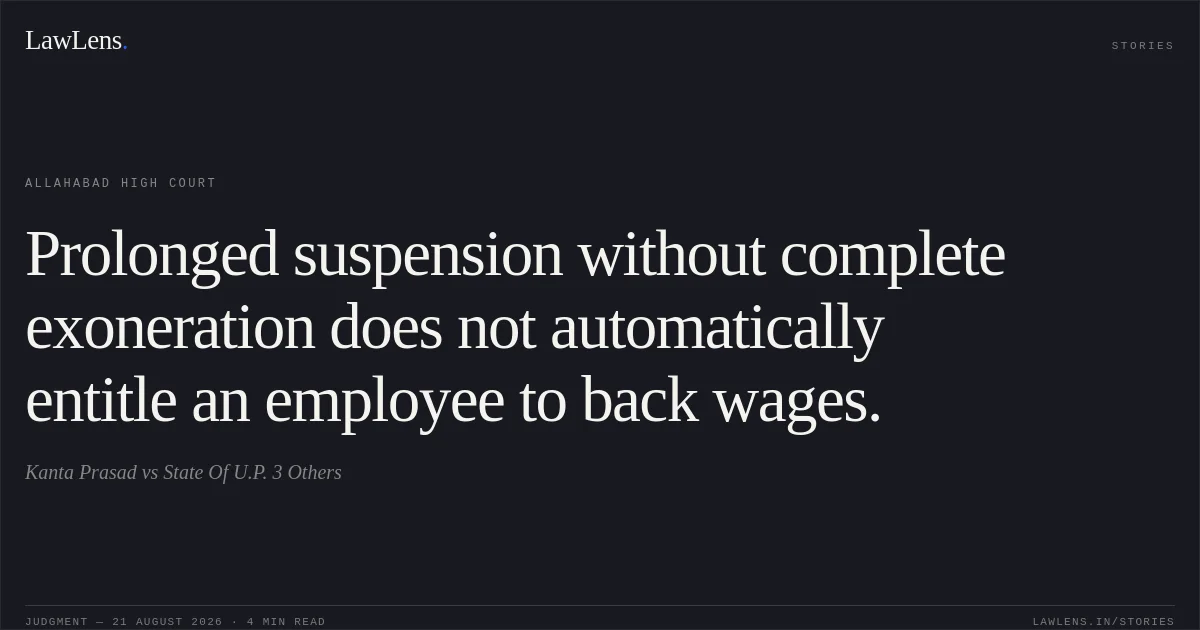
Prolonged suspension, superannuation, or the subsequent criminal revision did not automatically entitle him to quashing of the suspension order, full salary, back wages, additional subsistence allowance, pension arrears, or other retiral benefits.
Source reference: paras. 38, 45–46, 51, 54The petitioner had not proved complete exoneration, had not performed duties during the relevant period, and had not shown that any legally admissible dues remained unpaid.
Source reference: paras. 38, 45–46, 51, 54The writ petition was dismissed, the challenge to the departmental decision dated 1 July 2020 was rejected, and all consequential reliefs were denied.
Source reference: paras. 55–57There was no order as to costs.
Source reference: paras. 55–57Acts & Sections Cited
1 provisions across 1 statute referred to in this judgment. Each provision opens on LawLens.
Indian Penal Code, 18601
Original Court PDF
Kanta PrasadvsState Of U.P. 3 Others
Click to open original judgment
Original judgment, available to read, download and summarize on LawLens.in