01Facts
The employees (Petitioners in cross-petitions) were engaged as Class IV daily-wage workers at Dr. Vaishampayan Memorial Government Medical College, Solapur, for over 15 years
p. 41, 52Despite the existence of 383 sanctioned posts and 145–153 vacancies, and a Government Resolution dated 17 May 2019 mandating recruitment for 100% of these posts, the State continued their service on a daily-wage basis
pp. 42-44The Industrial Court, Solapur, found that the employees had completed continuous service (exceeding 240 days annually) and that the State engaged in unfair labour practices under Items 6, 9, and 10 of Schedule IV of the MRTU & PULP Act, 1971
pp. 42-43However, the Industrial Court only directed the State to "forward proposals for administrative approval" rather than granting direct regularisation
p. 43Both the employees (seeking regularisation) and the State (challenging any relief) filed Writ Petitions
p. 4102Issues
i.1. Whether the Industrial Court was justified in restricting relief to a mere proposal for approval despite finding that the employees were victims of unfair labour practices
p. 48, para 18(i)ii.2. Whether the State can initiate a fresh recruitment process for the same posts during the pendency of proceedings to defeat the employees' claims
p. 48, para 18(ii)iii.3. Whether the State’s continued engagement of workers on a temporary basis for over a decade against perennial needs constitutes an unfair labour practice warranting judicial regularisation
p. 49, para 18(iii)03Law Applied
Items 6, 9, and 10 of Schedule IV of the Maharashtra Recognition of Trade Unions and Prevention of Unfair Labour Practices Act, 1971, which prohibit continuing employees as temporaries/badlis to deprive them of permanent status
p. 42, 45"Model Employer" doctrine under Article 14 of the Constitution, requiring the State to act with fairness and social responsibility
pp. 50-51Principles in Bhola Nath v. State of Jharkhand [2026 INSC 99] regarding the legitimate expectation of permanence after long service
p. 50The Court distinguished and limited the restrictive application of Secretary, State of Karnataka v. Umadevi [(2006) 4 SCC 1] as per the recent cautions in Shripad and Vinod Kumar, holding that Umadevi cannot shield exploitative adhocism
pp. 55-5604Reasoning
The court reasoned that since the employees had rendered over 15 years of uninterrupted service against available sanctioned posts, their continued daily-wage status was an "exploitative approach" that violated Article 14
pp. 51-53It found that the Industrial Court erred in granting only a "conditional direction" to forward names for approval, as this relegated the employees to the mercy of the State despite established legal rights
pp. 55-56The High Court criticized the State's attempt to fill the very same 153 posts via a new advertisement in October 2025 as an attempt to "weaponize recruitment powers" to defeat adjudicated rights
p. 54, 56It held that the State’s claim of procedural irregularity in the original appointments (i.e., "back-door entry") could not override the decade-and-a-half-long service where the State failed to conduct regular recruitment despite perennial institutional needs
p. 5505Holding
The High Court allowed the employees' petitions and dismissed the State's petitions, holding that the Industrial Court’s limited relief was an error of law
p. 57the court modified the order to direct the State to regularise the services of the employees against available sanctioned posts with all consequential benefits
pp. 56-57The State’s communication dated 10 April 2026 denying regularisation was declared unsustainable and the State was directed to implement these orders within eight weeks
p. 57, para (iv)Original Court PDF
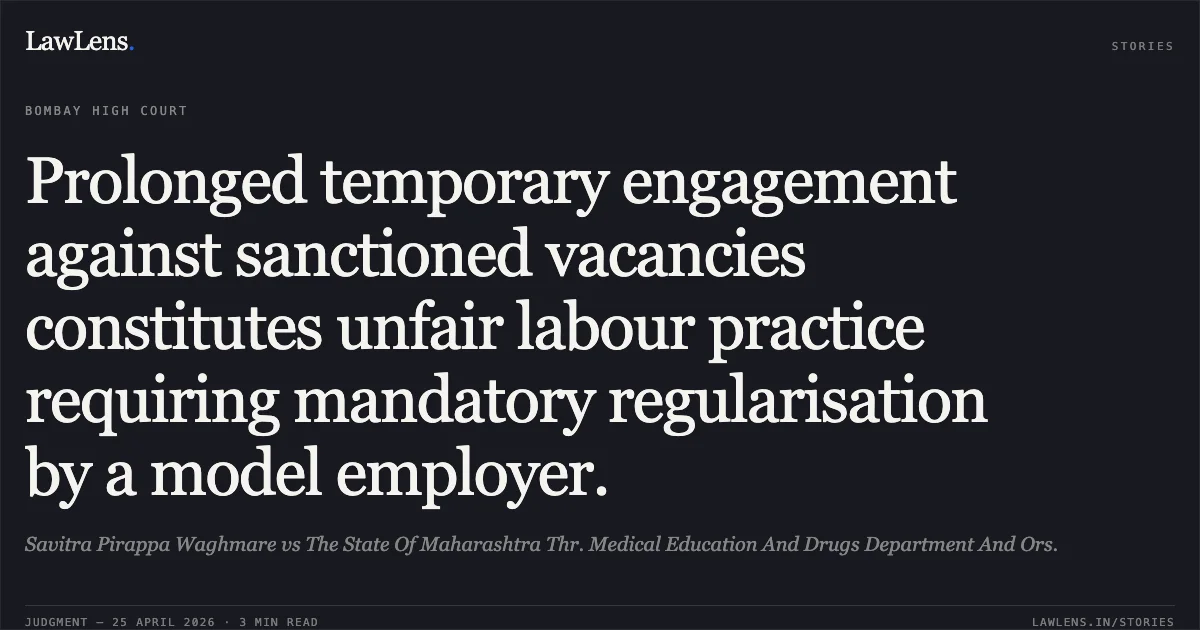
Savitra Pirappa WaghmarevsThe State Of Maharashtra Thr. Medical Education And Drugs Department And Ors.
Click to open original judgment
Original judgment, available to read, download and summarize on LawLens.in