Facts
Approximately 120 employees were engaged as Class IV daily-wage workers at Dr. Vaishampayan Memorial Government Medical College and Shri Chhatrapati Shivaji Maharaj Sarvopachar Rugnalay, Solapur, for over 15 years.
Source reference: p. 41, 49Despite the existence of 383 sanctioned posts and 145 vacancies, the State continued them on daily wages below statutory minimums.
Source reference: p. 42, 49The employees filed complaints under the MRTU & PULP Act, 1971, alleging unfair labour practices.
Source reference: p. 42The Industrial Court, Solapur, found they had completed continuous service for over a decade but only directed the State to "forward proposals for administrative approval".
Source reference: p. 43Both the employees (seeking full regularisation) and the State (challenging any relief) filed cross-writ petitions.
Source reference: p. 41Issues
1. Whether the Industrial Court was justified in restricting relief to a direction to "forward a proposal for approval" instead of granting full regularisation after finding a decade of continuous service against sanctioned vacancies.
Source reference: p. 48 / para. 18(i)2. Whether the State can defeat the claims of employees found to be victims of unfair labour practices by initiating a fresh recruitment process for the same posts during the pendency of litigation.
Source reference: p. 48 / para. 18(ii)3. Whether the findings of unfair labour practices and entitlement to permanency suffered from perversity.
Source reference: p. 49 / para. 18(iii)Law Applied
Items 5, 6, 9, and 10 of Schedule IV of the Maharashtra Recognition of Trade Unions and Prevention of Unfair Labour Practices (MRTU & PULP) Act, 1971, regarding the deprivation of permanent status for temporary workers.
Source reference: p. 42Article 14 of the Constitution of India, emphasizing the State's duty as a "Model Employer" to act with fairness and probity.
Source reference: p. 51The court distinguished Secretary, State of Karnataka v. Umadevi (2006) 4 SCC 1, noting it cannot shield exploitative adhocism.
Source reference: p. 55Principles from Bhola Nath v. State of Jharkhand (2026 INSC 99), asserting that prolonged temporary service creates a "legitimate expectation" of permanence that cannot be waived by contractual terms.
Source reference: p. 50-51Reasoning
The Court held that the State’s conduct in keeping essential healthcare workers on daily wages for 15 years was unconscionable and a "culture of adhocism".
Source reference: p. 52The court reasoned that once a positive finding of fact was recorded—specifically, continuous service exceeding 240 days per year and the availability of sanctioned vacant posts—the Industrial Court’s failure to grant regularisation was an error of law.
Source reference: p. 56By issuing a fresh recruitment advertisement in October 2025 for the same posts while litigation was pending, the State acted with "impunity" to defeat adjudicated rights.
Source reference: p. 54The Court determined that the Doctrine of Legitimate Expectation applied because the workers were essential to hospital efficiency and patient safety, and the State could not rely on procedural irregularities to deny regularisation when it had failed to conduct regular recruitment for decades.
Source reference: p. 52, 55Holding
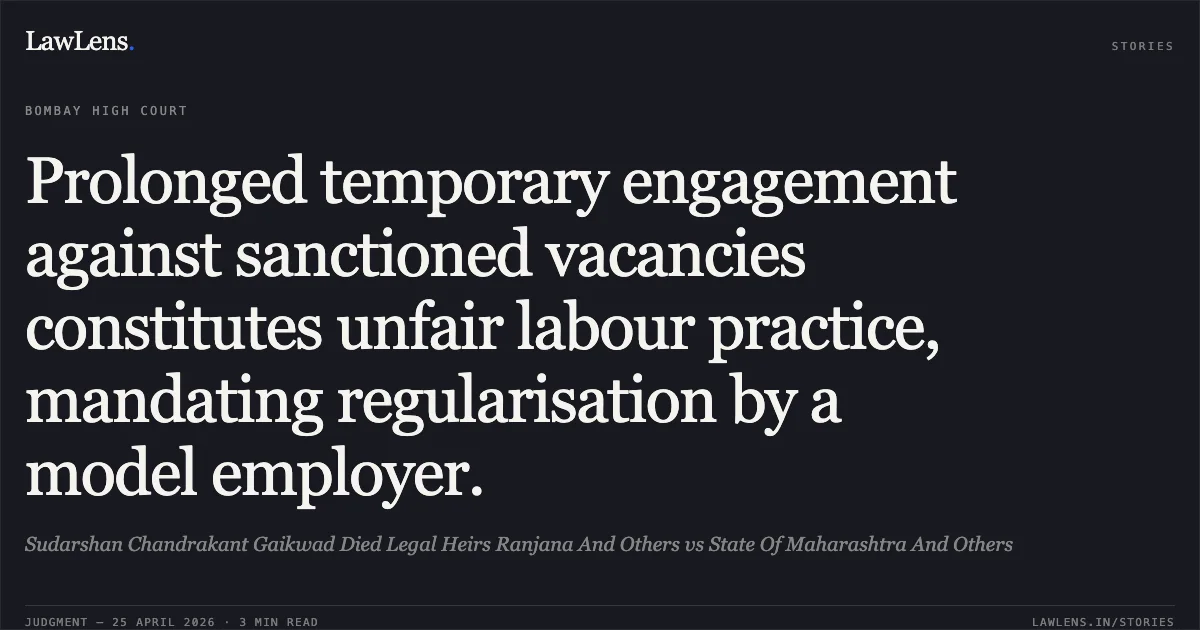
The High Court answered that the Industrial Court was not justified in limiting relief to a mere "proposal" and held that the State is prohibited from weaponizing recruitment powers to displace long-serving employees whose entitlement to permanency is judicially recognized.
The High Court allowed the employees' petitions, dismissed the State’s petitions, modified the Industrial Court's orders, and directed the State to regularise the employees in service against available sanctioned posts with all consequential benefits within eight weeks, quashing the State's communication dated 10/04/2026.
Source reference: p. 57Original Court PDF
Sudarshan Chandrakant Gaikwad Died Legal Heirs Ranjana And OthersvsState Of Maharashtra And Others
Click to open original judgment
Original judgment, available to read, download and summarize on LawLens.in


