Facts
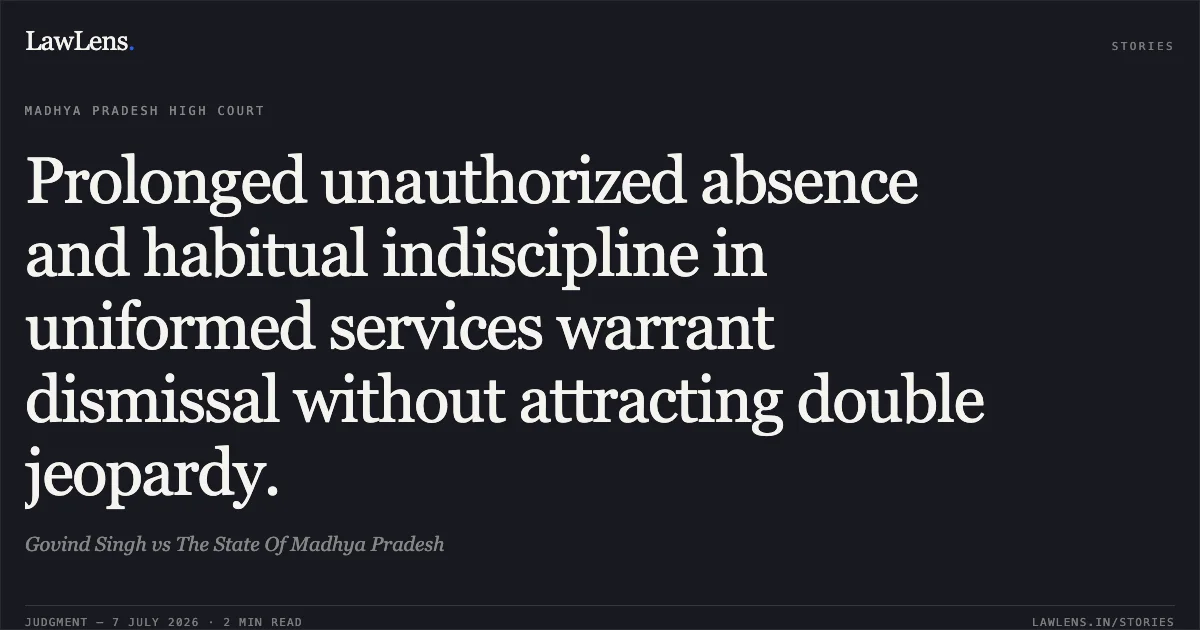
The appellant, a police constable, was dismissed from service on March 29, 2004, following a departmental inquiry that found him guilty of unauthorized absence for 197 days.
Source reference: para. 1, 2The appellant claimed his absence was due to illness following a physical assault in 2000.
Source reference: para. 2He further contended that an earlier communication by the Superintendent of Police dated November 2, 2002, allowing him to resume duties with a reference to "censure/admonition," precluded further disciplinary action.
Source reference: para. 2, 3After his departmental appeal and mercy petition were rejected, he challenged the dismissal in a writ petition, which was dismissed by a Single Judge on June 18, 2025.
Source reference: para. 1, 2The present matter is an intra-court appeal against that dismissal.
Source reference: para. 1, 2Issues
1. Whether the communication dated November 2, 2002, constituted a formal punishment, thereby rendering the subsequent dismissal order a violation of the principle of double jeopardy.
Source reference: para. 3, 72. Whether the punishment of dismissal was shockingly disproportionate given the appellant's medical history and length of service.
Source reference: para. 4, 10Law Applied
The Court applied the principles of judicial review under Article 226 of the Constitution of India, noting that High Courts should not act as appellate authorities over departmental findings unless they are perverse or lack evidence.
Source reference: para. 8The Court relied on Union of India v. P. Gunasekaran and Union of India v. Subrata Nath to define the limited scope of interference in disciplinary matters.
Source reference: para. 5Regarding the conduct of uniformed forces, the Court emphasized that maintenance of discipline and regular attendance are foundational requirements, as established in Central Industrial Security Force v. Abrar Ali.
Source reference: para. 5, 10Reasoning
The Court determined that the communication dated November 2, 2002, was merely administrative permission to rejoin duty and not a disciplinary order, as it was not preceded by a charge-sheet or inquiry; thus, double jeopardy did not apply.
Source reference: para. 7On the merits, the Court found that the appellant had a chronic history of indiscipline, including 19 prior instances of leave without pay and a previous absence of 338 days.
Source reference: para. 8It reasoned that the production of medical documents did not excuse a consistent pattern of unauthorized absence.
Source reference: para. 9The Court concluded that since the appellant was a member of a disciplined force, the penalty of dismissal was justified by his repeated misconduct and overall service record.
Source reference: para. 10Holding
The Court answered both issues in the negative, holding that there was no procedural illegality or disproportionate sentencing in the disciplinary action.
The Division Bench affirmed the Single Judge's order and dismissed the writ appeal, maintaining the appellant's dismissal from service.
Source reference: para. 12Acts & Sections Cited
1 provisions across 1 statute referred to in this judgment. Linked provisions open on LawLens.
M.P. Uchcha Nyayalaya (Khand Nyayapeeth Ko Appeal) Adhiniyam, 20051
Original Court PDF
Govind SinghvsThe State Of Madhya Pradesh
Click to open original judgment
Original judgment, available to read, download and summarize on LawLens.in