Facts
The applicant, a former employee of the Madhya Pradesh Transport Department, was prosecuted in connection with allegations of possessing assets disproportionate to his known sources of income.
Source reference: p.1The Lokayukt FIR constituted the scheduled offence, pursuant to which the Directorate of Enforcement registered ECIR No. ECIR/BHZO/19/2024 for offences under Sections 3 and 4 of the Prevention of Money Laundering Act, 2002 (“PMLA”).
Source reference: p.1The prosecution alleged that the applicant generated proceeds of crime through abuse of official position and invested them in properties, businesses and companies held in the names of family members and associates.
Source reference: pp.1–2Cash, gold jewellery and other valuables were allegedly recovered during searches.
Source reference: pp.1–2The applicant was arrested by the Enforcement Directorate on 10 February 2025 and remained in custody thereafter.
Source reference: p.3His earlier regular bail application had been rejected on merits by the High Court on 27 September 2025.
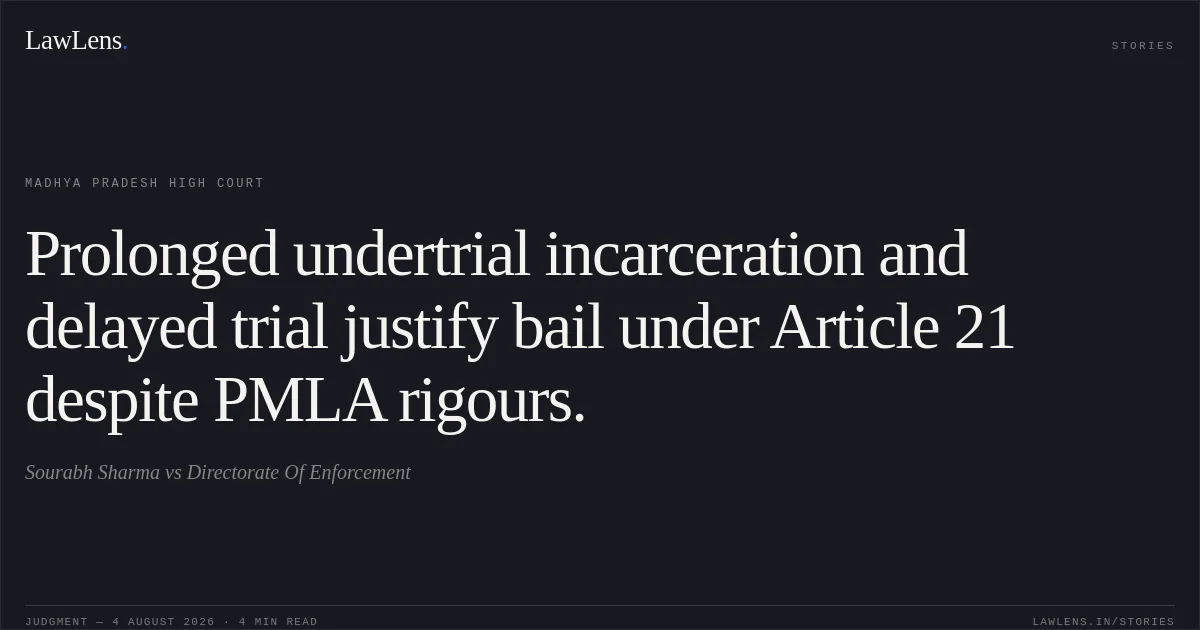
Source reference: pp.3–7In the present third bail application under Section 483 of the Bharatiya Nagarik Suraksha Sanhita, 2023, he relied on subsequent developments: completion of investigation, filing of the prosecution complaint, framing of charges on 10 April 2026, prolonged incarceration exceeding sixteen months, and the absence of meaningful progress in the trial.
Source reference: pp.3–7The prosecution opposed bail on the basis of the seriousness of the alleged money-laundering offence, the material collected under Section 50 of the PMLA, the statutory restrictions under Section 45, and the apprehension of witness tampering, interference with evidence and disposal of proceeds-related properties.
Source reference: pp.12–14Issues
Whether the applicant’s third application for regular bail was maintainable on account of material subsequent changes in circumstances after rejection of his earlier bail application.
Source reference: pp.3–7Whether, despite the rigours of Section 45 of the PMLA and the gravity of the allegations, the applicant was entitled to bail in view of completed investigation, framing of charges, prolonged custody and the likelihood of delay in conclusion of trial.
Source reference: pp.7–15Whether continued detention of the applicant would be unjustified where the prosecution case was substantially documentary and further custodial interrogation was unnecessary.
Source reference: pp.9–12Law Applied
The Court exercised its jurisdiction under Section 483 of the Bharatiya Nagarik Suraksha Sanhita, 2023, while considering offences under Sections 3 and 4 of the PMLA and the twin conditions under Section 45 of that Act.
Source reference: pp.1, 12–13The Court applied the constitutional principles of personal liberty, presumption of innocence and speedy trial under Article 21 of the Constitution.
Source reference: pp.8–10It relied on Vijay Madanlal Choudhary v. Union of India, 2022 SCC OnLine SC 929, regarding the applicability and validity of Section 45.
Source reference: pp.8–10It relied on Manish Sisodia v. Directorate of Enforcement, (2024) 12 SCC 660, and Prem Prakash v. Union of India, 2024 SCC OnLine SC 2270, for the principle that prolonged incarceration and the absence of a reasonable prospect of an early trial are relevant grounds for bail.
Source reference: pp.8–10It relied on Sanjay Chandra v. CBI, (2012) 1 SCC 40, for the proposition that the gravity of an economic offence alone does not justify indefinite pre-trial detention.
Source reference: pp.8–10The Court also considered the prosecution’s reliance on Y.S. Jagan Mohan Reddy v. CBI, (2013) 7 SCC 439, and Directorate of Enforcement v. Aditya Tripathi, (2024) 20 SCC 545, concerning the seriousness of economic offences and risks of interference with the proceedings.
Source reference: pp.13–14Reasoning
The Court found that the present application was based on circumstances materially different from those existing when the earlier bail application was rejected.
Source reference: para. 7; pp.3, 15Investigation had concluded, the prosecution complaint had been filed, charges had been framed and the applicant had remained in custody since 10 February 2025.
Source reference: para. 7; pp.3, 15The prosecution case involved voluminous documentary evidence, and the trial was not likely to conclude in the near future.
Source reference: para. 7Since the investigative process had ended and the evidence had already been collected, continued custody was no longer necessary for investigation or preservation of evidence.
Source reference: para. 7Balancing the seriousness of the allegations and the statutory restrictions under the PMLA against the applicant’s prolonged pre-trial incarceration and Article 21 interests, the Court held that further detention would not serve any useful purpose.
Source reference: para. 7The Court expressly refrained from expressing any opinion on the merits of the prosecution case.
Source reference: para. 8Holding
The High Court allowed the third regular bail application without commenting on the merits of the case.
The applicant was directed to be released on furnishing a personal bond of ₹10,00,000 with one solvent local surety in the like amount to the satisfaction of the trial court.
Source reference: para. 9Bail was subject to conditions that he would not influence witnesses or tamper with evidence, would not leave India without prior permission, would not commit any future offence, would regularly appear before the trial court, and would not seek unnecessary adjournments.
Source reference: para. 9He was also directed to comply with Section 480(3) of the BNSS.
Source reference: para. 9Acts & Sections Cited
7 provisions across 2 statutes referred to in this judgment. Each provision opens on LawLens.
Bharatiya Nagarik Suraksha Sanhita, 20232
Prevention of Money-Laundering Act, 20025
Original Court PDF
Sourabh SharmavsDirectorate Of Enforcement
Click to open original judgment
Original judgment, available to read, download and summarize on LawLens.in