01Facts
The High Court referred disputes concerning a partnership firm to a sole arbitrator via orders dated 17 September 2014 and 17 March 2015.
¶ 2-3The 2014 order directed the arbitrator to "endeavour" to pass an award within nine months.
¶ 16Arbitration commenced, pleadings were filed, and evidence was submitted, but the last meeting occurred on 25 July 2017.
¶ 4For nearly nine years thereafter, no meetings were held; the Applicants claimed settlement talks were ongoing, though no evidence of such meetings was provided.
¶ 4, 31In January 2026, a legal heir of a deceased respondent (not a party to the proceedings) emailed the arbitrator to resume proceedings.
¶ 6, 33Receiving no response and learning of the arbitrator's advanced age, the Applicants filed this application under Section 11 r/w Section 14 to terminate the current mandate and appoint a substitute arbitrator.
¶ 7, 902Issues
i.1. Whether the mandate of the arbitral proceedings stood automatically terminated due to the nine-month "endeavour" period stipulated in the 2014 recruitment order.
¶ 15ii.2. Whether the arbitral proceedings were abandoned by the parties through their conduct, leading to termination under Section 32(2)(c) of the Act.
¶ 15iii.3. Whether the Court can appoint a substitute arbitrator under Sections 11 and 14 if the proceedings themselves have terminated.
¶ 1503Law Applied
The Court applied Section 14 and 15 of the Arbitration and Conciliation Act, 1996 regarding the termination of an arbitrator's mandate and substitution.
¶ 23The Court maintained the distinction between Section 14/15 and Section 32, which governs the termination of the arbitral proceedings themselves.
¶ 24Board of Control for Cricket in India v. Kochi Cricket Private Limited: Section 29A (time limits) applies prospectively and does not govern arbitrations commenced before 23 October 2015.
¶ 17Tata Sons Pvt. Ltd. v. Siva Industries and Holdings Ltd.: The word "endeavour" in time-limit clauses is directory, not mandatory.
¶ 19Dani Wooltex Corporation v. Sheil Properties Pvt. Ltd.: Abandonment is a ground for termination under Section 32(2)(c) but must be clinching and lead to an inevitable inference.
¶ 29Provisions in the judgment · 12 · Linked ones open on LawLens
Arbitration and Conciliation Act, 1996 12 provisions
Section 9Section 11Section 12Section 13Section 14Section 15Section 21Section 23Section 25Section 32Section 33Section 3404Reasoning
The Court first clarified that the nine-month "endeavour" period in the original order was directory and did not automatically extinguish the mandate, especially since parties continued meetings past that date.
¶ 19, 21The Court observed a nine-year hiatus (2017–2026) with zero progress and scrutinized the Applicants' claim of "settlement talks," finding it "incomprehensible" that such talks would last nine years without a single communication to the arbitrator or documented meeting.
¶ 22, 31The Court reasoned that while Sections 14 and 15 allow substitution when a vacancy occurs in a subsisting reference, they cannot be invoked if the proceedings are terminated under Section 32.
¶ 25-26The "clinching" conduct of the parties over nearly a decade led to the sole conclusion of abandonment, distinguishing this case from others where specific reasons for delays existed.
¶ 32, 3405Holding
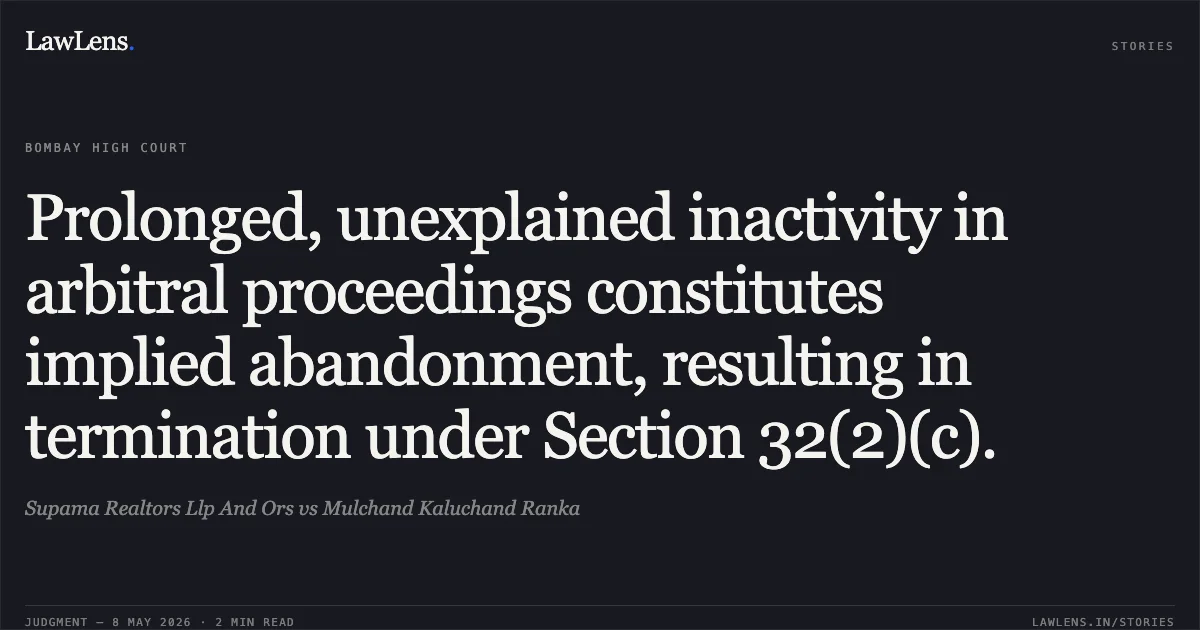
The Court held that the arbitral proceedings were abandoned by the Applicants and therefore stood terminated under Section 32(2)(c) of the Arbitration Act.
¶ 34The Court ruled it had no power to substitute the arbitrator under Section 11 or Section 14 because the proceedings were no longer alive; the application was dismissed.
¶ 35Original Court PDF
Supama Realtors Llp And OrsvsMulchand Kaluchand Ranka
Click to open original judgment
Original judgment, available to read, download and summarize on LawLens.in