Facts
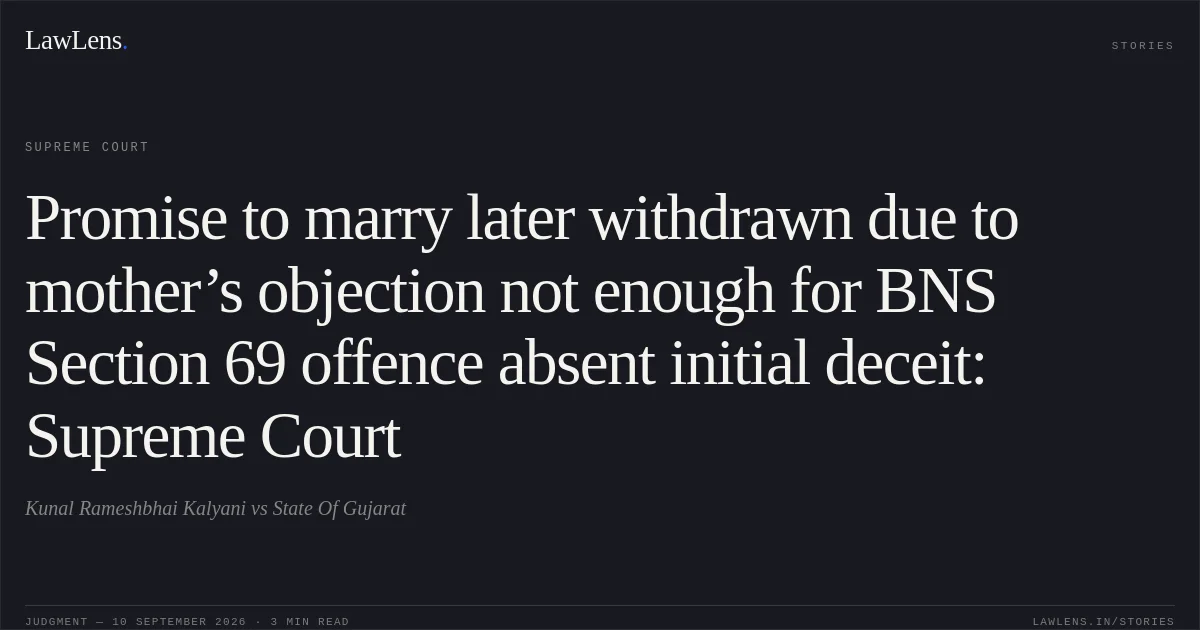
The appellant was accused under Section 69 of the Bharatiya Nyaya Sanhita, 2023 (BNS). The complainant alleged that the appellant developed a relationship with her through a digital platform, promised to marry her, and established physical relations with her, but subsequently refused to marry her because his mother was opposed to the marriage.
Source reference: p.1, paras. 2, 5–6The alleged physical relations occurred in February and April 2024, including a two-day hotel stay. An FIR, being No. 11196030250292 dated 20 May 2025, was registered at Sayajiganh Police Station, Vadodara City, Gujarat. The Gujarat High Court declined to quash the FIR, relying principally on Deepak Gulati v. State of Haryana [(2013) 7 SCC 675]. The appellant challenged that decision before the Supreme Court.
Source reference: p.1–2, paras. 2–3; p.3–4, para. 5Issues
Whether the allegations in the FIR disclosed the deceitful conduct required to constitute an offence under Section 69 of the BNS, particularly a promise to marry made without any intention of fulfilling it.
Source reference: p.2–3, paras. 3–4Whether the continuation of criminal proceedings was justified where the allegations indicated a consensual relationship and the refusal to marry was subsequently attributed to the appellant’s mother’s opposition.
Source reference: p.3–4, paras. 5–7Law Applied
The Court applied Section 69 of the BNS, which criminalises sexual intercourse obtained through deceitful means or through a promise to marry made without any intention of fulfilling it.
Source reference: p.2–3, para. 4The Court held that the provision requires the promise to have been made with the intention, from the outset, never to fulfil it; a later failure to marry due to genuine or unavoidable circumstances does not, by itself, establish the offence.
Source reference: p.2–3, paras. 3–4The Court relied on Deepak Gulati v. State of Haryana, which held that criminal liability requires adequate material showing that the accused had no intention to marry at the time the promise was made, and that a subsequent inability or refusal to fulfil a bona fide promise does not necessarily amount to a misconception of fact under Section 90 of the IPC.
Source reference: p.2, para. 3The Court also distinguished the earlier IPC framework, under which a false promise to marry was examined in the context of rape under Section 375 read with Section 90 IPC, from the distinct offence created by Section 69 BNS.
Source reference: p.2–3, para. 4Reasoning
The Court examined the FIR as a whole and found that it described a relationship that began through a digital platform, developed into a friendship and love affair, and involved repeated physical relations.
Source reference: p.3–4, para. 5The complaint stated that the appellant expressed his desire to marry the complainant at their first physical meeting, but it did not specifically allege that the complainant permitted intercourse solely because of a promise to marry. Instead, the FIR indicated that she “succumbed to his entreaties,” which, in the Court’s view, supported the existence of a consensual relationship rather than inducement through deceit.
Source reference: p.3–4, para. 5Further, the allegation that the appellant later refused marriage because his mother did not approve suggested that the promise, if made, was not shown to have been dishonest from the beginning.
Source reference: p.4, para. 6Mere communication of an intention or desire to marry, without evidence of an initial intention never to fulfil that promise, did not satisfy Section 69 BNS.
Source reference: p.4, paras. 5–6Holding
The Supreme Court held that the FIR did not disclose the deceitful conduct or the initial fraudulent intention required under Section 69 BNS. The allegations reflected a consensual relationship and did not establish that the appellant had induced the complainant through a promise to marry that he never intended to fulfil.
The appeal was allowed, and FIR No. 11196030250292 dated 20 May 2025, registered at Sayajiganh Police Station, Vadodara City, Gujarat, was quashed. Pending applications, if any, were rejected.
Source reference: p.4–5, paras. 7–8Acts & Sections Cited
3 provisions across 2 statutes referred to in this judgment. Each provision opens on LawLens.
Bharatiya Nyaya Sanhita, 20231
Indian Penal Code, 18602
Original Court PDF
Kunal Rameshbhai KalyanivsState Of Gujarat
Click to open original judgment
Original judgment, available to read, download and summarize on LawLens.in