Facts
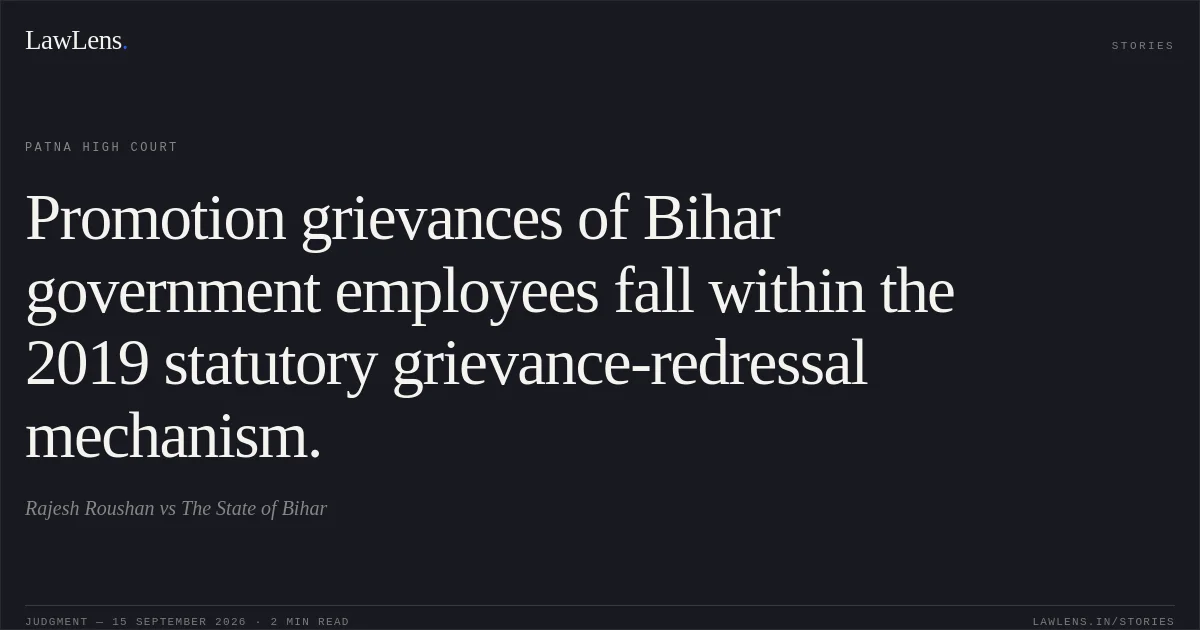
The petitioner sought quashing of the order dated 30 July 2014, by which his representation seeking promotion to a Class III post was rejected, and consequential directions for promotion with benefits.
Source reference: p.2, para. 2He had earlier approached the High Court in CWJC No. 19199 of 2013, which was disposed of with liberty to submit a representation; that representation was subsequently rejected by the competent authority through Memo No. 2088 dated 30 July 2014.
Source reference: p.2, para. 3The petitioner contended that promotions granted to similarly situated employees in 2023, particularly through Memo No. 3441 dated 11 December 2023, gave rise to a fresh cause of action.
Source reference: p.2–3, para. 3The State raised a preliminary objection that the grievance concerned service benefits and was cognisable under the Bihar Government Servant Grievance Redressal Rules, 2019 (“Rules of 2019”).
Source reference: p.3, para. 4Issues
Whether the petitioner’s grievance regarding promotion to a Class III post falls within the statutory complaint mechanism under the Rules of 2019?
Source reference: p.3–4, paras. 4–5Whether the writ petition should be disposed of by granting the petitioner liberty to invoke the remedy under the Rules of 2019 rather than adjudicating the promotion claim on merits?
Source reference: p.4–5, paras. 5–7Law Applied
The Court applied Rule 2(c) of the Bihar Government Servant Grievance Redressal Rules, 2019, which defines “complaint” to include matters relating to government service benefits, including promotion, ACP and MACP; the definition excludes matters already pending before a court and certain disciplinary, departmental, transfer, posting, deputation and RTI matters.
Source reference: p.3–4, para. 5Rule 3(a) permits serving or retired Bihar Government employees to file online complaints concerning service matters or retirement benefits, while Rule 3(b) requires separate applications for separate subjects.
Source reference: p.4, para. 5The Court also permitted the petitioner to raise contentions available under Clause 4C of the Bihar State Litigation Policy, 2011.
Source reference: p.4–5, para. 6Reasoning
The petitioner’s claim was fundamentally a service grievance concerning promotion, a subject expressly covered by Rule 2(c)(4) of the Rules of 2019.
Source reference: p.3–4, para. 5Since the grievance did not fall within the stated exclusions, the Court accepted the State’s objection that the statutory complaint mechanism was available.
Source reference: p.3–4, para. 5Although the petitioner relied on the subsequent promotion of similarly situated employees as creating a fresh cause of action, the Court did not examine the legality of the 2014 rejection or the merits of the promotion claim.
Source reference: p.2–5, paras. 3–6Instead, it directed the petitioner to pursue the specialised statutory mechanism, while preserving his right to raise all legally available contentions.
Source reference: p.2–5, paras. 3–6Holding
The Court did not grant promotion or quash the rejection order.
It granted the petitioner liberty to file a complaint under the Rules of 2019 within 30 days from the date of judgment.
Source reference: p.4–5, para. 6Upon filing, the concerned authority was directed to decide the complaint within the time prescribed by those Rules, with liberty to the petitioner to raise all permissible contentions, including those under Clause 4C of the Bihar State Litigation Policy, 2011.
Source reference: p.4–5, para. 6The writ petition was accordingly disposed of.
Source reference: p.5, para. 7Original Court PDF
Rajesh RoushanvsThe State of Bihar
Click to open original judgment
Original judgment, available to read, download and summarize on LawLens.in