Facts
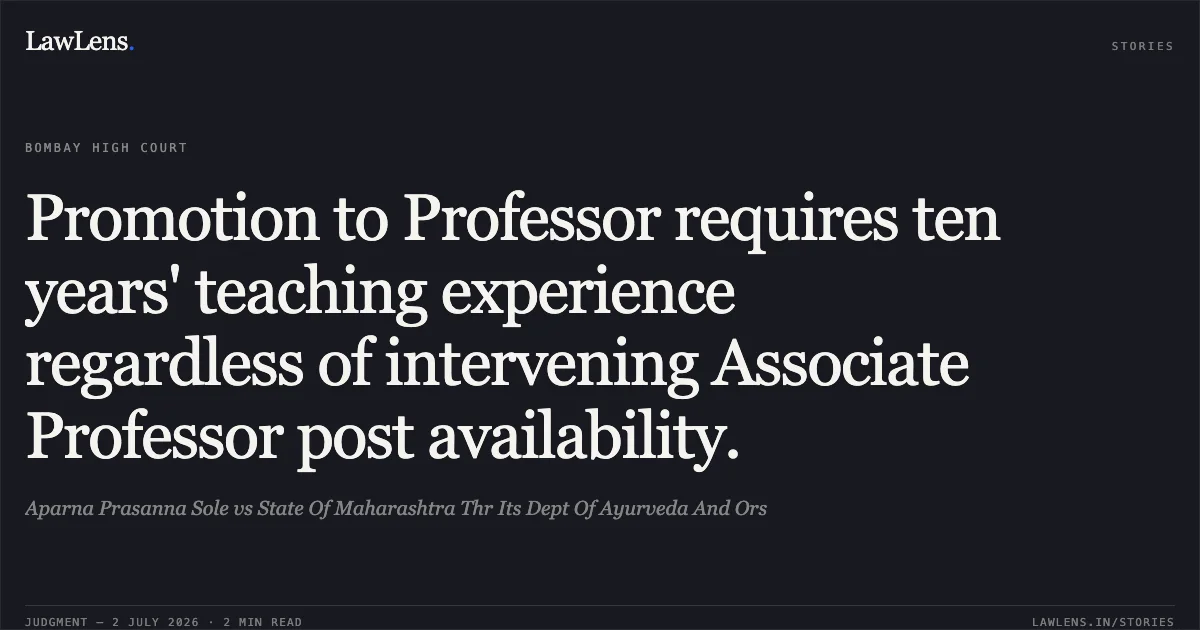
The Petitioners, Assistant Professors in aided Ayurvedic Colleges in Pune, sought promotion to the post of Professor in their respective subjects ('Balrog' and 'Kayachikitsa')
Source reference: p. 2Despite completing over 10 years of service, the Respondent-State denied their promotions via a communication dated June 6, 2024
Source reference: p. 11-12The State’s initial rejection was based on a technicality: since the subject departments lacked a sanctioned post of "Associate Professor," the Petitioners could not be promoted to "Professor," as the State interpreted existing recruitment rules to require service as an Associate Professor as a prerequisite
Source reference: p. 13, 15-16The Petitioners challenged this, citing National Commission for Indian System of Medicine (NCISM) Regulations which allow promotion based on ten years of teaching experience in the concerned subject
Source reference: p. 7, 14Issues
1. Whether the Respondent-State can deny promotion to the post of Professor to an Assistant Professor who possesses 10 years of teaching experience solely because a post of Associate Professor (Reader) is not sanctioned in that specific department.
Source reference: p. 3, 172. Whether the NCISM Regulations 2022 and MUHS Promotion Rules 2007 mandate promotion over direct recruitment for single vacant posts.
Source reference: p. 4, 14Law Applied
Regulation 17(b)(i) of the NCISM (Minimum Standard of Undergraduate Ayurveda Education) Regulations, 2022, which stipulates that the eligibility for the post of Professor is ten years of teaching experience as a regular teacher in the concerned subject or five years as an Associate Professor
Source reference: p. 7, 17MUHS Promotion Rules 2007, which state that if a post is a single post, it must be filled by promotion first before resorting to direct recruitment
Source reference: p. 4Section 44 of the NCISM Act, 2020, which empowers the Central Government/NCISM to issue binding directions to State Governments regarding teacher qualifications and experience
Source reference: p. 11Reasoning
The court reasoned that the State’s rejection was arbitrary and in direct contravention of the apex body's (NCISM) regulations
Source reference: p. 14The court observed that the NCISM Regulations 2022 explicitly provide two paths to becoming a Professor: either 5 years as an Associate Professor OR 10 years as a regular teacher (Assistant Professor) in the subject
Source reference: p. 7, 10During the proceedings, the State filed an affidavit dated January 30, 2025, conceding that it had "decided to allow the promotion" to overcome the technical challenge where Assistant Professors had no career progression due to the absence of a sanctioned Associate Professor post
Source reference: p. 17The court matched this concession with the MUHS 2007 rules, concluding that since the Petitioners satisfied the 10-year experience criteria and the posts were single/vacant, there was no legal basis for the State to withhold promotion
Source reference: p. 18Holding
The court quashed and set aside the impugned rejection communication dated June 6, 2024
It held that the Petitioners are eligible for promotion based on their 10+ years of teaching experience under NCISM norms
Source reference: p. 18The Respondents were directed to promote the Petitioners from Assistant Professor to Professor within two weeks and grant them all consequential benefits in accordance with NCISM and MUHS regulations
Source reference: p. 19Acts & Sections Cited
3 provisions across 1 statute referred to in this judgment. Each provision opens on LawLens.
National Commission for Indian System of Medicine Act, 20203
Original Court PDF
Aparna Prasanna SolevsState Of Maharashtra Thr Its Dept Of Ayurveda And Ors
Click to open original judgment
Original judgment, available to read, download and summarize on LawLens.in