Facts
The Appellants and Respondents are employees of the Andaman & Nicobar Police Department
Source reference: p. 1Originally, promotion from Head Constable to Assistant Sub-Inspector (ASI) was governed by the 1963 Police Manual and 1999 Standing Orders, emphasizing seniority-cum-fitness
Source reference: p. 2-3In 2008 and 2010, the Administration introduced new Recruitment Rules requiring a matriculation (10th pass) qualification and a competitive selection test for 66-2/3% of the posts
Source reference: p. 3Non-matriculate Head Constables (the Appellants) challenged these rules via O.A. No. 351/2014, arguing that the rules were unreasonable and lacked UPSC consultation
Source reference: p. 4-5During litigation, the Administration issued the 2016 Rules, which abolished the selection test and restored the 100% seniority-cum-fitness model
Source reference: p. 4, 8The Tribunal dismissed the O.A. as infructuous, stating the 2016 Rules would govern future promotions
Source reference: p. 8However, the High Court set this aside, directing that vacancies must be filled based on the rules prevailing when each vacancy accrued (the 2010 Rules)
Source reference: p. 9The Appellants approached the Supreme Court
Source reference: p. 10Issues
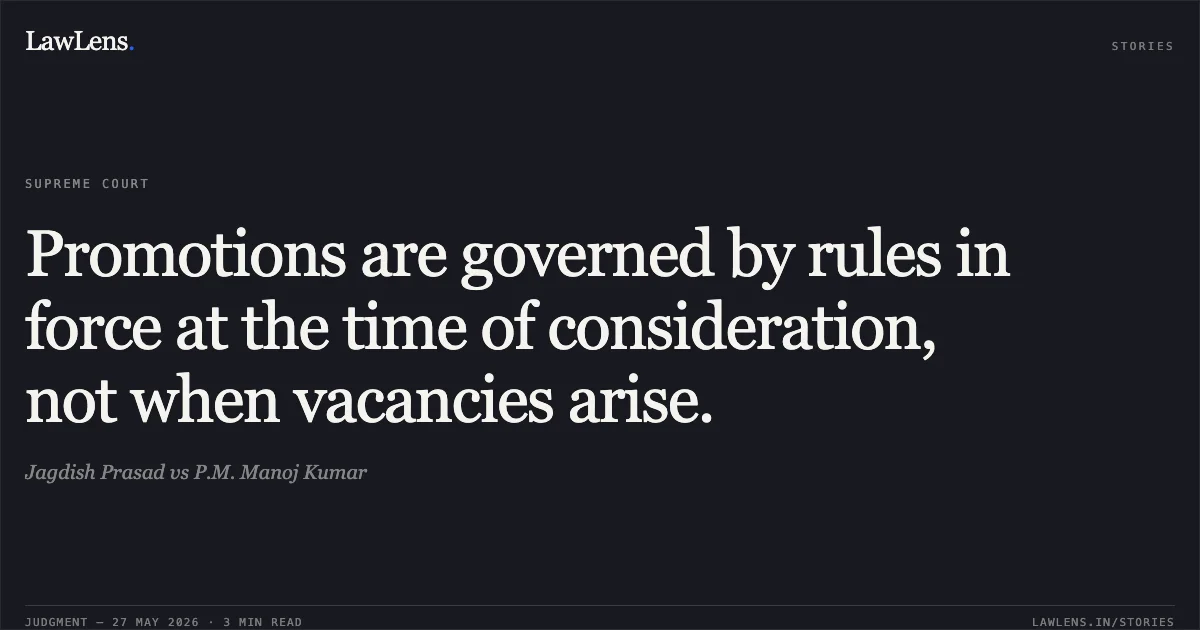
1. Whether promotions must be governed by the rules in force at the time the vacancy arises or by the rules in force at the time of consideration/selection.
Source reference: para. 232. Whether the ad hoc promotions granted under the 2010 Rules created a vested right in favor of the respondents that survives the 2016 amendment.
Source reference: para. 27-28Law Applied
The Court primarily applied the principle established in State of Himachal Pradesh v. Raj Kumar (2022), which explicitly overruled Y.V. Rangaiah v. J. Sreenivasa Rao (1983), holding that there is no universal rule that vacancies must be filled based on the law existing on the date they arose; rather, the right to promotion is governed by the rules in force at the time of actual consideration
Source reference: para. 24It further relied on Gottumukkala Venkata Krishamraju v. Union of India (2019) regarding the doctrine of "substitution," where replacing an old rule with a new one effectively deletes the former from the statute book unless intended otherwise
Source reference: para. 29The Court also highlighted that ad hoc promotions subject to litigation do not confer vested rights as per State of Odisha v. Sreepati Ranjan Dash (2026)
Source reference: para. 25Reasoning
The Court reasoned that the High Court erred by applying the overruled Rangaiah principle via Marripati Nagaraja, which wrongly tied promotion eligibility to the date of vacancy accrual
Source reference: para. 26Applying Raj Kumar, the Court held that since the 2016 Rules were in force when the final selection was to be concluded, those rules—which favor seniority-cum-fitness—must govern all pending promotions
Source reference: para. 30Regarding the Respondents' claims to "vested rights" under the 2010 Rules, the Court observed that their promotions in 2014 were "purely ad-hoc" and expressly subject to the outcome of the pending O.A.
Source reference: para. 28Consequently, those promotions were not "completed acts" or "past and closed transactions" protected from the 2016 amendment
Source reference: para. 29-30Because the 2016 Rules "substituted" the previous framework, the 2010 Rules ceased to exist, and the Administration was bound to follow the current statutory mandate
Source reference: para. 29Holding
The Supreme Court allowed the appeal and set aside the High Court's judgment
It held that the 2016 Rules, which restored the requirement of seniority-cum-fitness for 100% of the posts, are the only valid rules for considering promotions to the rank of ASI-Executive
Source reference: para. 31The Court directed the Administration to fill all existing vacancies of ASI-Executive strictly under the 2016 Rules within two months
Source reference: para. 31The ad hoc promotions granted under the old rules do not grant any seniority rights and are subject to the new recruitment process
Source reference: para. 28, 30Acts & Sections Cited
1 provisions across 1 statute referred to in this judgment. Each provision opens on LawLens.
General Clauses Act, 18971
Original Court PDF
Jagdish PrasadvsP.M. Manoj Kumar
Click to open original judgment
Original judgment, available to read, download and summarize on LawLens.in


