Facts
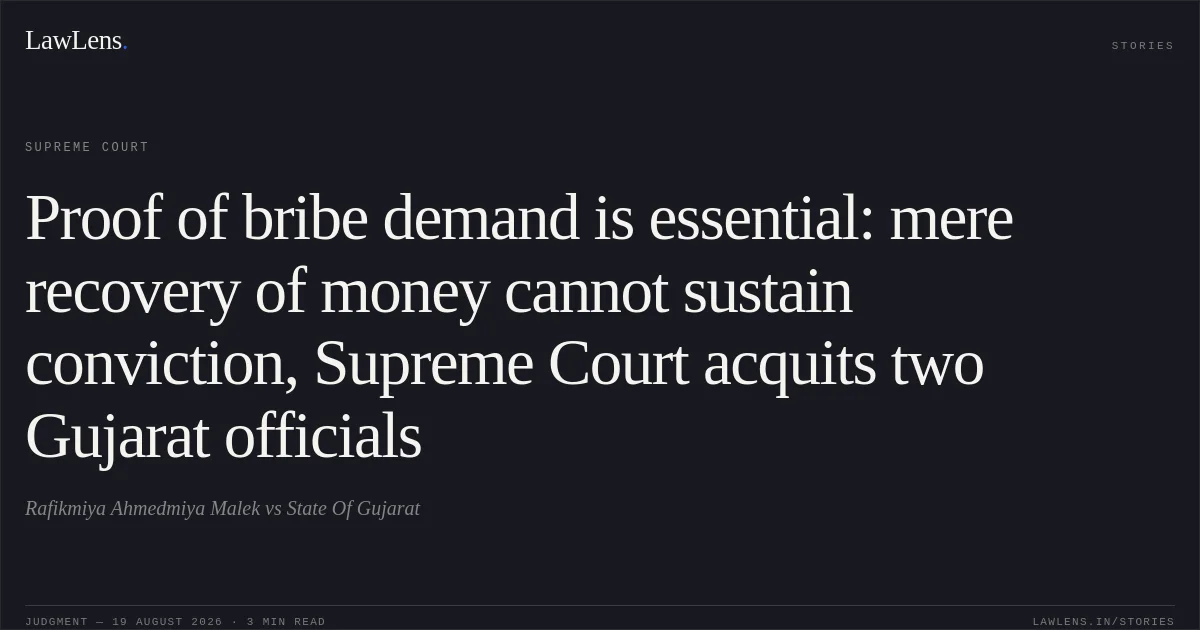
The complainant applied for an Income Certificate and alleged that A1, a Talati-cum-Mantri, demanded ₹120—₹100 for himself and ₹20 for A2, a Gram Panchayat peon—for processing the certificate.
Source reference: pp. 2–4, paras. 2–3After repeated interactions, the complainant approached the Anti-Corruption Bureau, which organised a trap on 19 February 1996.
Source reference: pp. 2–4, paras. 2–3The complainant received the Income Certificate from A1 and gave a ₹20 currency note to A2; no amount was paid to or recovered from A1.
Source reference: pp. 2–4, paras. 2–3The trial court convicted both appellants under Sections 7 and 13(1)(d) of the Prevention of Corruption Act, 1988, but acquitted them of criminal conspiracy under Section 120-B IPC.
Source reference: pp. 4–5, para. 4The High Court affirmed the convictions and dismissed the State’s appeal for enhancement of sentence.
Source reference: pp. 4–5, para. 5Issues
Whether the prosecution proved beyond reasonable doubt that A1 demanded ₹120 as illegal gratification and that the payment of ₹20 to A2 established the alleged bribery offence against either appellant?
Source reference: pp. 10–17, paras. 9–16Whether the presumption under Section 20 of the Prevention of Corruption Act, 1988, could be drawn merely from the recovery of ₹20 from A2 when demand had not been proved?
Source reference: pp. 16–17, para. 15Whether the sanction for prosecuting A1 was invalid because it was granted by the Deputy District Development Officer rather than the authority competent to remove him from service?
Source reference: pp. 18–19, para. 17Law Applied
The Court applied Sections 7 and 13(1)(d) of the Prevention of Corruption Act, 1988, which require proof of the essential ingredients of demand and acceptance or obtaining of illegal gratification; mere recovery or possession of currency is insufficient without proof connecting it to a corrupt demand.
Source reference: pp. 16–20, paras. 15–18Section 20 creates a statutory presumption only after the prosecution first proves the foundational fact of demand and acceptance beyond reasonable doubt; it cannot arise solely from recovery of money.
Source reference: pp. 7–8, 16–17, paras. 6(b), 15The Court relied on N. Vijayakumar v. State of Tamil Nadu, 2021 INSC 60, for this principle.
Source reference: pp. 7–8, 16–17, paras. 6(b), 15It also relied on State of Lokayuktha Police, Davanagere v. C.B. Nagaraj, 2025 INSC 736, for the proposition that payment made after the public duty has been performed does not ipso facto establish that it was pursuant to a prior demand.
Source reference: pp. 7–8, 17–18, paras. 6(b), 16Under Section 19(1)(c), sanction must be granted by the authority competent to remove the public servant from office; an order issued by an incompetent authority is invalid.
Source reference: pp. 18–19, para. 17Reasoning
The Court found material doubt in the complainant’s version of demand.
Source reference: pp. 11–12, para. 10His testimony in the present case differed from his earlier deposition, in which he stated that A1 had initially demanded ₹200 and that ₹120 was later agreed as a settlement.
Source reference: pp. 11–12, para. 10Although the complainant had been instructed to hand over the entire ₹120 upon demand, he gave only ₹20 to A2.
Source reference: pp. 12–14, paras. 11–12A2 did not ask why he was receiving ₹20 when A1 had allegedly directed payment of ₹120, and A2 himself was found not to have made any demand.
Source reference: pp. 12–14, paras. 11–12The certificate had already been prepared and handed over before the payment was made, further weakening the prosecution’s claim that the money was paid pursuant to an illegal demand.
Source reference: p. 17, para. 16The Court therefore held that demand by A1 was not proved beyond reasonable doubt and that recovery of the ₹20 note from A2 could not independently sustain the convictions or trigger Section 20’s presumption.
Source reference: pp. 14–17, paras. 13–15It additionally held that A1’s sanction was invalid because the prosecution failed to establish that the Deputy District Development Officer was competent to remove a Talati-cum-Mantri; that power lay with the District Development Officer.
Source reference: pp. 18–19, para. 17However, the Court expressly stated that it was not setting aside the conviction solely on the sanction ground, since the evidence independently failed to prove the charges.
Source reference: p. 19, para. 17Holding
The Supreme Court answered the issues in favour of the appellants.
It held that the prosecution failed to prove the foundational demand of illegal gratification by A1, that no demand by A2 was established, and that recovery of ₹20 from A2 neither proved the offences nor attracted the presumption under Section 20.
Source reference: pp. 16–20, paras. 15–18The sanction for A1’s prosecution was also held invalid under Section 19(1)(c).
Source reference: pp. 18–19, para. 17The convictions and sentences imposed by the trial court and affirmed by the High Court were set aside, and both appellants were acquitted of the offences under Sections 7, 12 and 13(1)(d) of the Prevention of Corruption Act, 1988.
Source reference: p. 20, para. 19Their appeals were allowed and their bail bonds were cancelled.
Source reference: p. 20, para. 19Acts & Sections Cited
5 provisions across 1 statute referred to in this judgment. Each provision opens on LawLens.
Prevention of Corruption Act, 19885
Original Court PDF
Rafikmiya Ahmedmiya MalekvsState Of Gujarat
Click to open original judgment
Original judgment, available to read, download and summarize on LawLens.in