Facts
The Plaintiff (Appellant) entered into a Sale Agreement (Ex.A1) with the 1st Defendant on 24.07.2010 to purchase 1.18 acres of land at Rs. 30,750/- per cent, totaling Rs. 36,28,500/-. An advance of Rs. 1,00,000/- was paid
Source reference: p. 2-3The agreement stipulated a three-month performance period, contingent upon the 1st Defendant surveying the property
Source reference: p. 3The Plaintiff alleged readiness and willingness but claimed the 1st Defendant evaded execution and settled the property on his son (2nd Defendant)
Source reference: p. 3The Trial Court found the agreement valid but denied specific performance, granting only a refund of the advance
Source reference: p. 5During the appeal, the Plaintiff sought to implead new parties and submit additional evidence regarding further settlement deeds executed by the 1st Defendant in 2023
Source reference: p. 5-6Issues
1. Whether the petitions to implead proposed parties and receive additional documents regarding subsequent alienations are maintainable?
Source reference: p. 8 / para. 112. Whether the Plaintiff proved continuous readiness and willingness to perform his part of the contract?
Source reference: p. 8 / para. 113. Whether the Plaintiff is entitled to the discretionary relief of specific performance?
Source reference: p. 8 / para. 11Law Applied
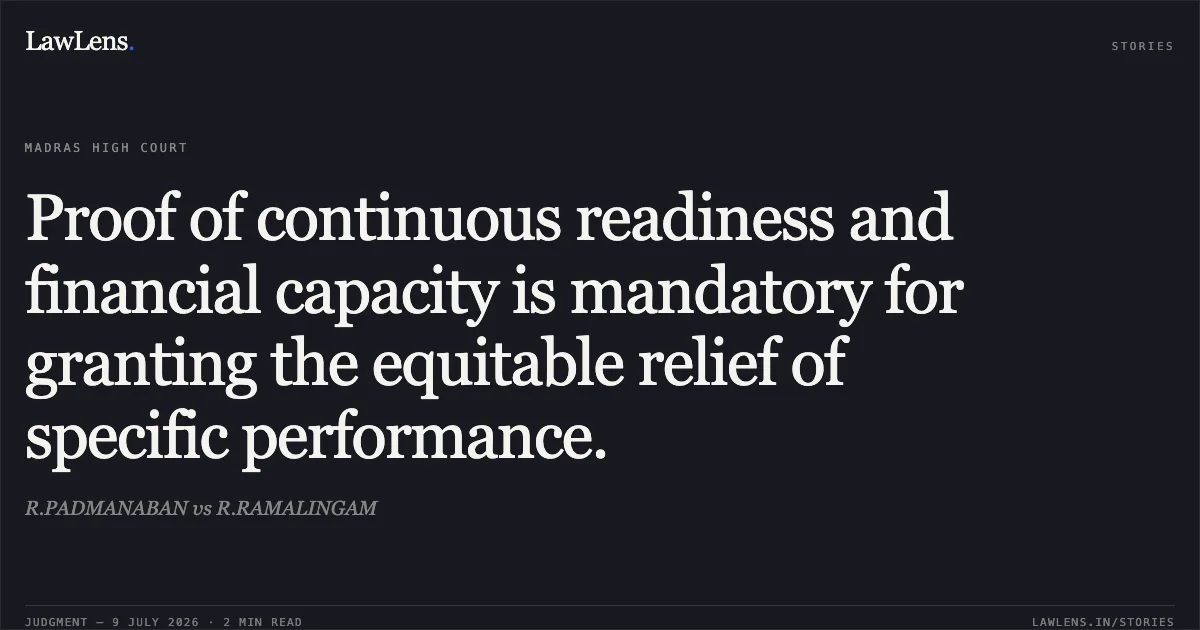
The Court applied Section 16(c) of the Specific Relief Act, 1963, which mandates that a plaintiff must aver and prove continuous readiness and willingness to perform the contract
Source reference: p. 12It relied on the distinction between "readiness" (financial capacity) and "willingness" (conduct) as settled in R. Sharma Naik v. G. Srinivasiah and Man Kaur v. Arthar Singh Sangha, which holds that even if a defendant breaches the contract, the plaintiff must still prove they had the capacity to pay the balance
Source reference: p. 12-13The Court followed U.N. Krishnamurthy v. A.M. Krishnamurthy, emphasizing that mere statements in a plaint are insufficient and readiness must be proven through evidence like bank statements
Source reference: p. 14Order 41 Rule 27 of the CPC was applied regarding the strict conditions for admitting additional evidence at the appellate stage
Source reference: p. 10Reasoning
The Court observed that while the 1st Defendant admitted to the execution of the agreement and receipt of the advance, the Plaintiff failed the test of "readiness and willingness."
Source reference: p. 11Despite the contract fixing a three-month period, the Plaintiff issued a legal notice only after seven months and filed the suit two years later
Source reference: p. 11, 15The Plaintiff produced no documentary evidence, such as bank statements, to prove he possessed the balance consideration of approximately Rs. 35.28 lakhs at the relevant time
Source reference: p. 15The Court found the payment of a "meagre" advance of Rs. 1,00,000/- against a total of Rs. 36,28,500/- necessitated higher scrutiny of financial capacity
Source reference: p. 15Regarding the additional documents (CMP Nos. 29638 29640 of 2024), the Court held they were irrelevant to the core issue of the Plaintiff's prior readiness and did not meet the requirements of Order 41 Rule 27 CPC
Source reference: p. 10Holding
The Court answered the issues in the negative, holding that the Plaintiff failed to establish continuous readiness and willingness
The petitions to implead new parties and receive additional evidence were dismissed as they had no bearing on the determination of the appeal
Source reference: p. 10The High Court confirmed the Trial Court’s judgment, dismissing the appeal and upholding the decree limited to the refund of the advance amount without the relief of specific performance
Source reference: p. 16Acts & Sections Cited
4 provisions across 3 statutes referred to in this judgment. Each provision opens on LawLens.
Code of Civil Procedure, 19082
Transfer of Property Act, 18821
Specific Relief Act, 19631
Original Court PDF
R.PADMANABANvsR.RAMALINGAM
Click to open original judgment
Original judgment, available to read, download and summarize on LawLens.in