Facts
The Accused, a Police Constable at Songadh Police Station, was alleged to have demanded ₹1,000 (settled at ₹800) from the complainant, Manjibhai Savjibhai Rehwar, as illegal gratification for "petrol expenses" related to a criminal case involving the complainant's father
Source reference: p.2, 3On 12.09.2005, a trap was arranged by the ACB; the complainant handed over tainted currency notes to the Accused at a tea stall in Shihor
Source reference: p.5The amount was recovered from the Accused at a Government Rest House
Source reference: p.6The Trial Court acquitted the respondent on 31.03.2010, citing a lack of evidence regarding the "demand" and accepting the defense's explanation that the money was a repayment of a loan
Source reference: p.7, 8The State appealed this acquittal.
Source reference: no citationIssues
1. Whether the prosecution proved the foundational facts of "demand" and "acceptance" of illegal gratification beyond reasonable doubt
Source reference: p.15, 172. Whether the Trial Court’s acquittal was perverse or based on a misreading of material evidence, warranting interference by the Appellate Court
Source reference: p.13, 25Law Applied
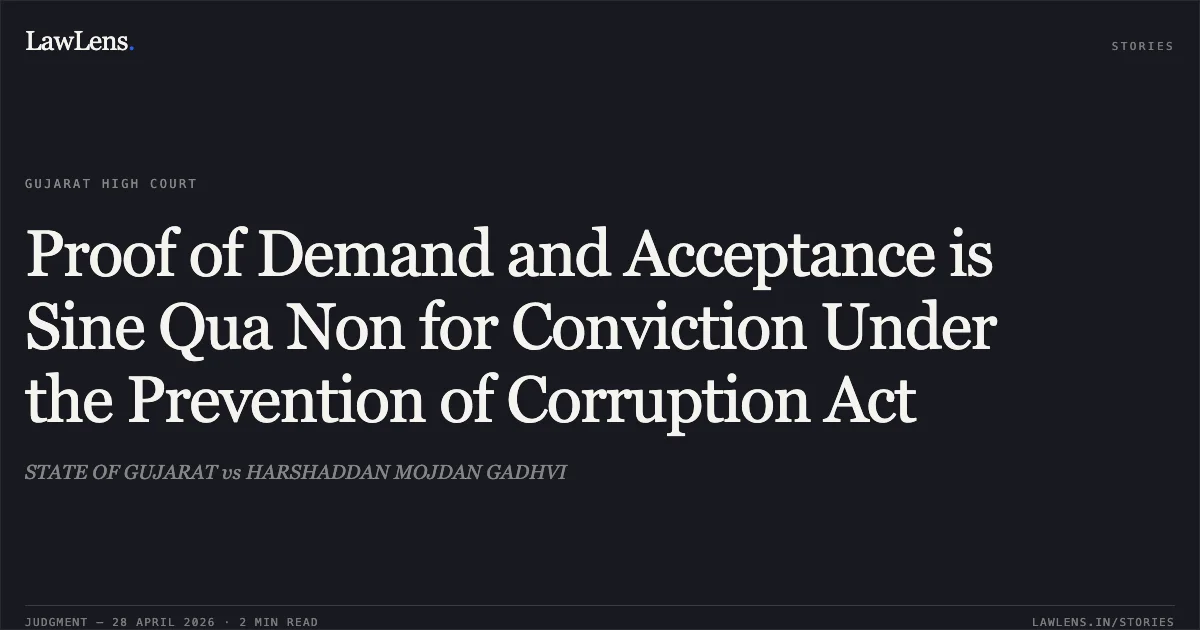
The court primarily applied Sections 7, 13(1)(d), and 13(2) of the Prevention of Corruption Act, 1988, which require proof of demand and acceptance as a sine qua non for conviction
Source reference: p.15It relied on the principles from Neeraj Dutta v. State (Govt. of N.C.T. of Delhi) regarding the necessity of proving foundational facts before invoking the presumption under Section 20 of the Act
Source reference: p.15-17Further, the court followed Chandrappa & Ors. v. State of Karnataka and P. Somaraju v. State of Andhra Pradesh, which establish that in appeals against acquittal, the "double presumption" of innocence must be respected, and if two reasonable views are possible, the view favoring the accused should prevail
Source reference: p.12, 13Reasoning
The High Court observed that the prosecution failed to provide details of the underlying criminal case that purportedly motivated the bribe
Source reference: p.21Crucially, the complainant's father—the primary target of the initial demand—was not examined
Source reference: p.22Regarding the trap, the shadow witness could not hear the phone conversation between the complainant and the Accused, failing to corroborate the "demand"
Source reference: p.22Additionally, the court noted the defense's plausible explanation supported by a medical certificate: the complainant’s mother was hospitalized during the period the Accused allegedly lent money to the family
Source reference: p.24-25As the foundational fact of "demand" remained unproven, the presumption under Section 20 of the PC Act could not be triggered
Source reference: p.24The High Court found the Trial Court's view to be a "possible and reasonable" interpretation of the evidence
Source reference: p.25Holding
The High Court dismissed the State's appeal and confirmed the judgment of acquittal
It held that the prosecution failed to establish the essential ingredients of demand and voluntary acceptance beyond reasonable doubt, and the defense had successfully offered a probable explanation through the "loan repayment" theory
Source reference: p.25The bail bond of the Accused was cancelled
Source reference: p.26Acts & Sections Cited
7 provisions across 2 statutes referred to in this judgment. Each provision opens on LawLens.
Code of Criminal Procedure, 19734
Prevention of Corruption Act, 19883
Original Court PDF
STATE OF GUJARATvsHARSHADDAN MOJDAN GADHVI
Click to open original judgment
Original judgment, available to read, download and summarize on LawLens.in