Facts
The respondent, a Talati-cum-Mantri (Public Servant), was accused of demanding a bribe of ₹4,000 from the complainant to certify a rejected land mutation entry
Source reference: p. 2-3It was alleged that on 23.02.2004, the respondent accepted ₹2,000 as illegal gratification near a pond in village Kansari and was caught red-handed in an ACB trap
Source reference: p. 4-5The Trial Court (11th Fast Track Court, Kheda) acquitted the respondent on 14.03.2006, observing failures in proving demand and acceptance. The State appealed this acquittal under Section 378(1)(3) of the CrPC
Source reference: p. 1-2Issues
1. Whether the prosecution proved the foundational facts of "demand" and "acceptance" of illegal gratification beyond reasonable doubt to sustain a conviction under the Prevention of Corruption Act
Source reference: p. 14, para. 112. Whether the judgment of acquittal by the Trial Court was perverse or based on a misreading of evidence justifying interference by the Appellate Court
Source reference: p. 29, para. 11Law Applied
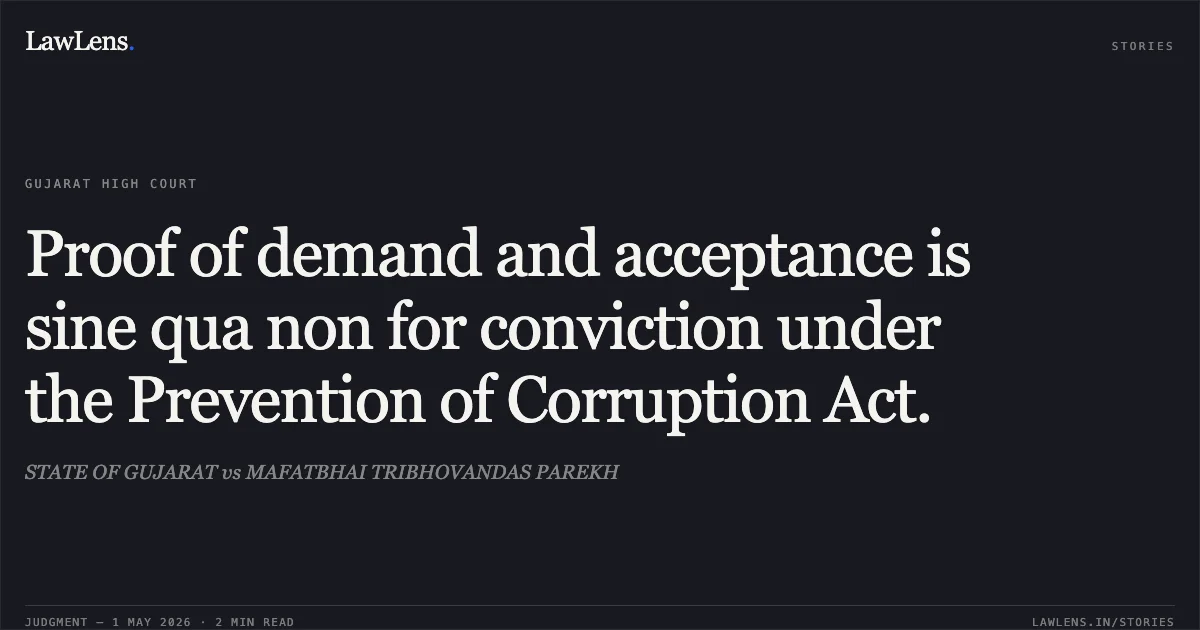
The Court primarily applied Sections 7, 13(1)(d), and 13(2) of the Prevention of Corruption Act, 1988 (P.C. Act), noting that proof of demand and acceptance is a sine qua non for establishing guilt
Source reference: p. 12, para. 9It relied on Neeraj Dutta v. State (Govt. of N.C.T. of Delhi) regarding the necessity of proving foundational facts before raising legal presumptions
Source reference: p. 12Furthermore, the court adhered to the principles governing appeals against acquittal as reiterated in Surendra Singh v. State of Uttarakhand and Babu Sahebagouda Rudragoudar v. State of Karnataka, emphasizing that if two reasonable views are possible, the view favoring acquittal must prevail
Source reference: p. 8-10, para. 7, p. 11, para. 8Reasoning
The Court found the prosecution's case fundamentally flawed due to several contradictions. First, documentary evidence (Daily Diary at Exh. 34) proved the respondent was in Khambhat on 19.02.2004, contradicting the complainant’s claim of an initial bribe demand at Kansari on that date
Source reference: p. 25Second, a plausible defense existed that the money was for outstanding government conversion tax, as the complainant admitted his previous tax cheque had been dishonored for "insufficient funds"
Source reference: p. 25-26Third, procedural lapses in the trap were noted: the recovery was not conducted at the spot but at a distant Rest House, and the chain of custody for the chemical samples (muddamal) was not established
Source reference: p. 27-28Finally, the sanction for prosecution was found invalid as the Sanctioning Authority (PW-3) admitted to merely filling in blanks on a draft provided by the ACB, indicating a lack of independent application of mind
Source reference: p. 21, 29Holding
The High Court dismissed the State's appeal and confirmed the judgment of acquittal. It held that the prosecution failed to prove demand, acceptance, and recovery beyond reasonable doubt
The Court concluded that the Trial Court’s view was a possible and reasonable one, the sanction was mechanical, and the investigation suffered from material omissions regarding the respondent's presence and the complainant's tax liabilities. All bail bonds were ordered cancelled
Source reference: p. 30, para. 12, p. 30Acts & Sections Cited
6 provisions across 2 statutes referred to in this judgment. Each provision opens on LawLens.
Code of Criminal Procedure, 19733
Prevention of Corruption Act, 19883
Original Court PDF
STATE OF GUJARATvsMAFATBHAI TRIBHOVANDAS PAREKH
Click to open original judgment
Original judgment, available to read, download and summarize on LawLens.in