Facts
The State appealed against the acquittal of Accused No. 1 (Executive Engineer) and Accused No. 2 (a private contractor) for offenses under Sections 7, 12, and 13 of the Prevention of Corruption Act (PC Act).
Source reference: no citationThe complainant alleged that Accused No. 1 demanded a 3% bribe (approx. Rs. 4,000) to pass an outstanding construction bill.
Source reference: p. 2-3During the trap on 15-07-2006, Accused No. 1 allegedly instructed the complainant to give the money to Accused No. 2, who was sitting in the chamber.
Source reference: p. 4-5Accused No. 2 allegedly accepted the money and placed it in a handbag on the table.
Source reference: p. 4-5Accused No. 1 died during the pendency of the appeal, and the case proceeded only against Accused No. 2.
Source reference: p. 2Issues
1. Whether the prosecution proved the essential ingredients of demand and acceptance of illegal gratification against Accused No. 2 beyond a reasonable doubt
Source reference: p. 112. Whether the presence and actions of Accused No. 2 (a private person) established a conspiracy or abetment under the PC Act
Source reference: p. 17-18Law Applied
The Court primarily applied Sections 7, 13(1)(d), and 13(2) of the PC Act regarding the bribery of public servants.
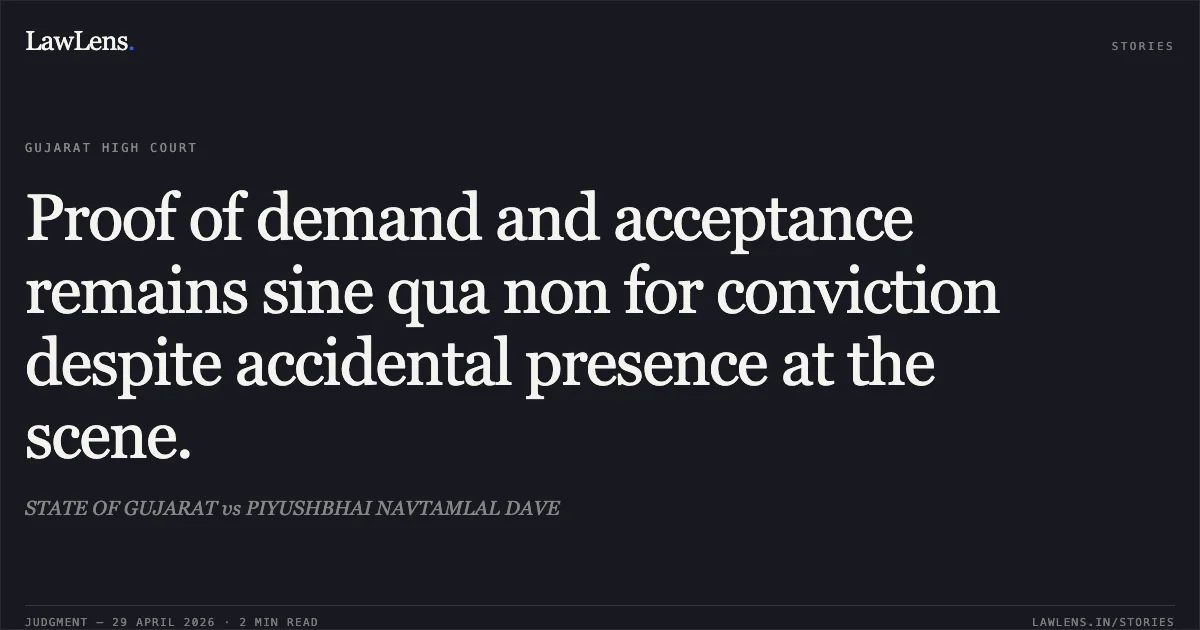
Source reference: p. 1-2Neeraj Dutta v. State (Govt. of N.C.T. of Delhi), which held that proof of "demand and acceptance" is a sine qua non for conviction, and while it can be proved by circumstantial evidence, the foundational facts must be established.
Source reference: p. 11-13The Court applied the standards for interfering with acquittals as laid down in Chandrappa v. State of Karnataka and P. Somaraju v. State of Andhra Pradesh, emphasizing the "double presumption of innocence" and the rule that if two reasonable views are possible, the appellate court must not disturb an acquittal.
Source reference: p. 9-10Reasoning
The Court found that the prosecution failed to establish a nexus between Accused No. 1 and Accused No. 2. Both the Trap Laying Officer (PW-3) and the Investigating Officer (PW-5) admitted that Accused No. 2’s presence in the chamber was "accidental" and not anticipated during the planning of the trap.
Source reference: p. 16-18The complainant (PW-1) admitted he saw Accused No. 2 for the first time on the day of the trap and that Accused No. 2 had no role in the prior demand or the processing of the bill.
Source reference: p. 13-14The Court noted that the handbag where the money was placed was never seized, creating a gap in the evidence regarding "conscious possession".
Source reference: p. 14, 20Since there was no evidence that Accused No. 2 knew the money was a bribe or had conspired with the deceased public servant, the foundational fact of "demand" as against him was missing.
Source reference: p. 19-20Holding
The Court answered the issues in the negative, holding that the prosecution failed to prove the charges beyond a reasonable doubt.
The appeal was dismissed, and the judgment of acquittal dated 28-02-2014 was confirmed.
Source reference: p. 21Acts & Sections Cited
8 provisions across 2 statutes referred to in this judgment. Each provision opens on LawLens.
Code of Criminal Procedure, 19734
Prevention of Corruption Act, 19884
Original Court PDF
STATE OF GUJARATvsPIYUSHBHAI NAVTAMLAL DAVE
Click to open original judgment
Original judgment, available to read, download and summarize on LawLens.in