Facts
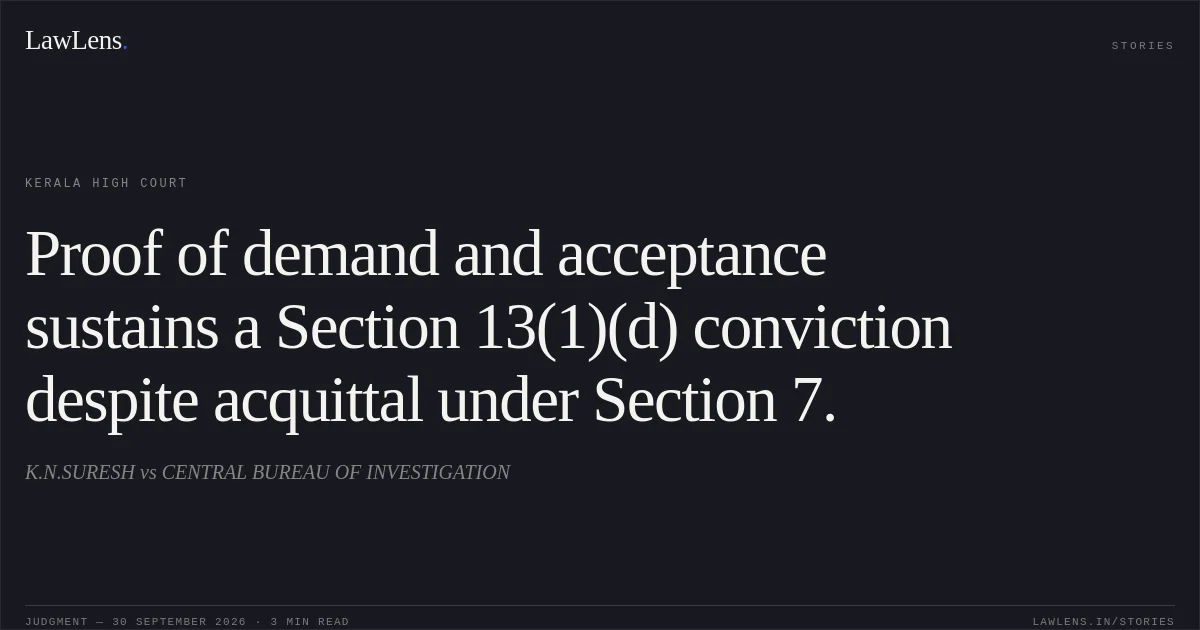
The appellant, a Customs Havildar at Calicut International Airport, was accused of demanding and accepting 150 UAE Dirhams from passenger PW4 to release a used LED television brought from Sharjah.
Source reference: paras. 3–6The Special Court acquitted him of the charges under Sections 7 and 13(1)(a) read with Section 13(2) of the Prevention of Corruption Act, 1988, but convicted him under Section 13(1)(d) read with Section 13(2) and sentenced him to four years’ simple imprisonment and a fine of ₹10,000.
Source reference: paras. 3–6The appellant challenged the conviction, disputing the complainant’s evidence, the recovery of the currency, and the identification evidence; he also argued that acquittal under Section 7 was inconsistent with conviction under Section 13(1)(d).
Source reference: paras. 7–8Issues
Whether the prosecution proved that the appellant committed an offence punishable under Section 13(1)(d) read with Section 13(2) of the PC Act
Source reference: para. 12(i)Whether the Special Court’s judgment and sentence required interference in light of the challenges to the evidence and the appellant’s acquittal under Section 7
Source reference: para. 12(ii)Law Applied
Sections 7 and 13(1)(d)(i) and (ii) read with Section 13(2) of the PC Act were considered.
Source reference: no citationUnder Neeraj Dutta v. State, proof of demand and acceptance or obtainment of illegal gratification is essential to establish the relevant offences; those facts may be proved by direct or circumstantial evidence, and a court may draw a discretionary inference from proved foundational facts.
Source reference: para. 28Section 20’s mandatory presumption applies to Section 7, but not to Section 13(1)(d)(i) and (ii).
Source reference: para. 28Under Section 27 of the Evidence Act, information leading to discovery may be proved when given in police custody, which includes custodial surveillance or restraint and is not limited to formal arrest; the Court relied on Dharam Deo Yadav v. State of U.P. and Rohit Jangde v. State of Chhattisgarh.
Source reference: paras. 10–11, 25Reasoning
The Court accepted PW4’s consistent testimony that the appellant demanded 250 Dirhams, accepted the 150 Dirhams PW4 had, and released the television without issuing a receipt.
Source reference: paras. 13, 24–25It found the recovery of the same currency pursuant to the appellant’s disclosure reliable, supported by the investigating officer and other witnesses; PW2’s inconsistent, hostile evidence did not establish that recovery occurred before the appellant was in custody.
Source reference: paras. 13, 24–25The Court also held that the discrepancy about whether the appellant was in uniform or civilian clothes at identification did not undermine PW4’s identification, given their interaction at the airport and the supporting evidence.
Source reference: para. 26It concluded that demand and acceptance were proved and that the Special Court’s acquittal under Section 7 rested on an erroneous view of the evidence; however, no prosecution appeal had been filed against that acquittal. The error did not displace the separately established offence under Section 13(1)(d).
Source reference: para. 31Holding
The High Court held that the prosecution proved the appellant’s demand and acceptance of illegal gratification and upheld his conviction under Section 13(1)(d) read with Section 13(2) of the PC Act.
Finding no reason to interfere with the sentence, it dismissed the appeal, vacated the suspension of sentence and bail order, and directed the appellant to appear before the Special Court to serve the sentence; failing that, the Special Court was directed to execute it.
Source reference: para. 32Acts & Sections Cited
6 provisions across 2 statutes referred to in this judgment. Each provision opens on LawLens.
Prevention of Corruption Act, 19884
Code of Criminal Procedure, 19732
Original Court PDF
K.N.SURESHvsCENTRAL BUREAU OF INVESTIGATION
Click to open original judgment
Original judgment, available to read, download and summarize on LawLens.in