Facts
The State appealed an acquittal judgment dated 19.09.2013
Source reference: p.1The prosecution alleged that the accused, a Patwari, demanded a bribe of ₹3,000 from Nazakat Ali (PW-1) to enter a land mutation in favor of his mother, Jivnee
Source reference: p.2A trap was laid on 07.01.2012, during which the informant placed money on the accused's table
Source reference: p.4While the accused's hand-wash turned pink, demonstrating he handled the currency, the money was found on a file, not on his person
Source reference: p.5The accused contended that the mutation was already sanctioned on 23.12.2011—weeks before the alleged demand—and that he was asked by police to count the notes only after the trap, explaining the chemical reaction on his hands
Source reference: p.7-8Issues
1. Whether the prosecution proved the essential ingredients of "demand and acceptance" of illegal gratification beyond a reasonable doubt
Source reference: p.15-162. Whether the findings of the Trial Court were perverse or based on a misreading of evidence justifying interference in an appeal against acquittal
Source reference: p.10-143. Whether the presumption under Section 20 of the PC Act can be triggered in the absence of proof of demand
Source reference: p.20-21Law Applied
Sections 7, 13(1)(d), and 13(2) of the Prevention of Corruption Act (PC Act), 1988
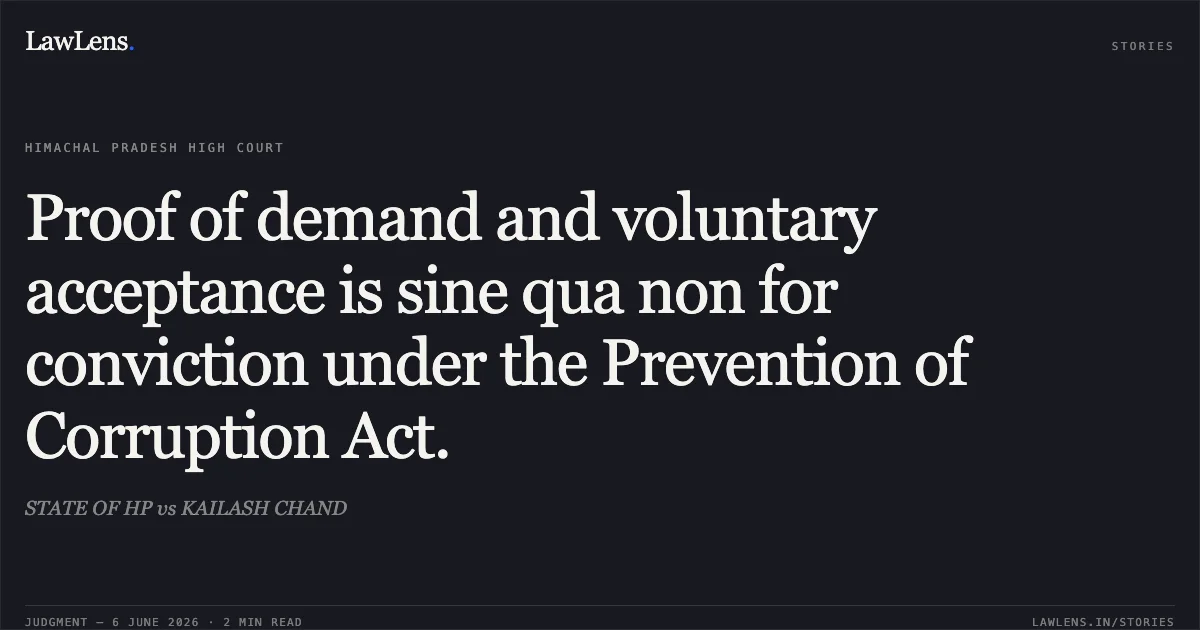
Source reference: p.2Neeraj Dutta v. State (NCT of Delhi) and P. Satyanarayana Murthy v. State of A.P., which establish that the demand for a bribe is the sine qua non for an offence, and mere recovery of money is insufficient without proof of such demand
Source reference: p.17-19Surendra Singh v. State of Uttarakhand and Tulasareddi v. State of Karnataka, holding that acquittal should not be disturbed if the Trial Court's view is "possible" and not "patently perverse"
Source reference: p.10-13Paritala Sudhakar v. State of Telangana, ruling that the statutory presumption under Section 20 of the PC Act does not apply if the foundational fact of "demand" is unproven
Source reference: p.20-21Reasoning
The Court observed that the informant (PW-1), shadow witness (PW-2), and recovery witnesses (PW-4 & PW-5) all turned hostile or admitted that the accused was not at his seat when the money was placed on the table
Source reference: p.14-15Crucially, revenue records (Ext. PW-13/J) revealed that the mutation work was already completed on 23.12.2011, establishing that no work was pending with the accused at the time of the alleged demand on 07.01.2012
Source reference: p.22-23Applying the principle from Suryabhan v. State of Maharashtra, the Court reasoned that a demand for a bribe for a task already performed is highly improbable
Source reference: p.24-25Furthermore, the witnesses consistently stated that the police directed the accused to count the recovered notes after the trap, which provided a logical explanation for his pink hand-wash
Source reference: p.31-32Consequently, the prosecution failed to establish the "demand" necessary to complete the chain of circumstances
Source reference: p.29Holding
The High Court dismissed the appeal and upheld the acquittal
It held that the Trial Court had taken a reasonable and possible view based on the evidence
Source reference: p.33It ruled that in the absence of a proven demand, the recovery of currency and the result of the chemical test were insufficient for conviction
Source reference: p.20-21The respondent was directed to furnish bail bonds under Section 437-A of the Cr.P.C.
Source reference: p.35Acts & Sections Cited
7 provisions across 4 statutes referred to in this judgment. Each provision opens on LawLens.
Prevention of Corruption Act, 19883
Indian Penal Code, 18601
Code of Criminal Procedure, 19732
Bharatiya Nagarik Suraksha Sanhita, 20231
Original Court PDF
STATE OF HPvsKAILASH CHAND
Click to open original judgment
Original judgment, available to read, download and summarize on LawLens.in


