01Facts
PW.1 (Shivanna) ran Mahadeshwara Steels and Hardware and applied for a TIN at the Commercial Tax Office, Ramanagara.
¶ 2Accused No.1 (D. Rajanna), a Commercial Tax Officer, allegedly demanded Rs.3,000/- as illegal gratification.
¶ 2Accused No.2, a 'D' Group employee, allegedly received the amount on 31.03.2011 on Accused No.1's behalf.
¶ 2Both were apprehended, a case was registered, and a chargesheet was filed.
¶ 2The Trial Court (Special Case No.16/2012) convicted both under Sections 7 and 13(1)(d) r/w 13(2) of the Prevention of Corruption Act, 1988 by judgment dated 06.01.2020 and sentenced them on 14.01.2020.
¶ 1 · p. 2The prosecution examined 11 witnesses and marked 54 exhibits.
¶ 3PW.1 deposed that he paid Rs.4,800/- as a fee, denied paying any illegal gratification, and was declared hostile.
¶ 11(i)PW.2, the shadow witness, stated that PW.1 paid the amount to Accused No.2 as the prescribed fee for the TIN, not as illegal gratification.
¶ 11(ii)PW.3 did not witness the receipt of money.
¶ 11(iii)PW.4 (Typist) deposed to raising bills of Rs.3,500/- + Rs.25/- and receipts for Rs.3,525/- in the firm's name.
¶ 11(iv), 12Sanctions were granted by PW.6 (for Accused No.1) and PW.7 (for Accused No.2).
¶ 11(vi)–(vii)02Issues
i.1. Whether the prosecution proved the demand and acceptance of illegal gratification beyond reasonable doubt, so as to sustain convictions under Sections 7 and 13(1)(d) r/w 13(2) of the PC Act, where the complainant and the shadow witness turned hostile.
¶ 9 · ¶ 10 · ¶ 13ii.2. Whether recovery of the amount from Accused No.2 is, by itself, sufficient to convict in the absence of proof of demand.
¶ 9 · ¶ 1303Law Applied
Sections 7 and 13(1)(d) r/w 13(2) of the Prevention of Corruption Act, 1988, under which demand and acceptance of illegal gratification must be proved.
¶ 9Neeraj Dutta v. State (Govt. of NCT of Delhi), (2023) 4 SCC 731, cited by the Special PP, holds that demand may be proved through circumstantial evidence, other witnesses, or documents, and that proof of demand is a sine qua non of the offence, so mere acceptance or recovery without demand is insufficient.
¶ 8State of U.P. v. A.K. Gaba, 2026 SCC OnLine SC 967, holds that demand and acceptance must be proved beyond reasonable doubt and that recovery alone does not establish guilt unless demand is proved.
¶ 9Once demand and acceptance are established, a statutory presumption arises, and the accused must then rebut it with cogent evidence.
¶ 10Provisions in the judgment · 4 · Linked ones open on LawLens
Code of Criminal Procedure, 1973 Section 374
Prevention of Corruption Act, 1988 Section 7Section 13Section 2
04Reasoning
The Court first applied the foundational requirement that demand and acceptance be proved.
¶ 10The core prosecution witnesses did not support the case. PW.1 denied paying any illegal gratification, and PW.2 admitted in cross-examination that the payment was a prescribed fee.
¶ 11(i)–(ii), 12PW.4's evidence that receipts were issued for the TIN fee further supported the defence version.
¶ 12Because demand was not proved, the statutory presumption could not arise, and the recovery of money from Accused No.2 could not by itself sustain the charge.
¶ 9, 10, 13The Trial Court had misappreciated the evidence.
¶ 1305Holding
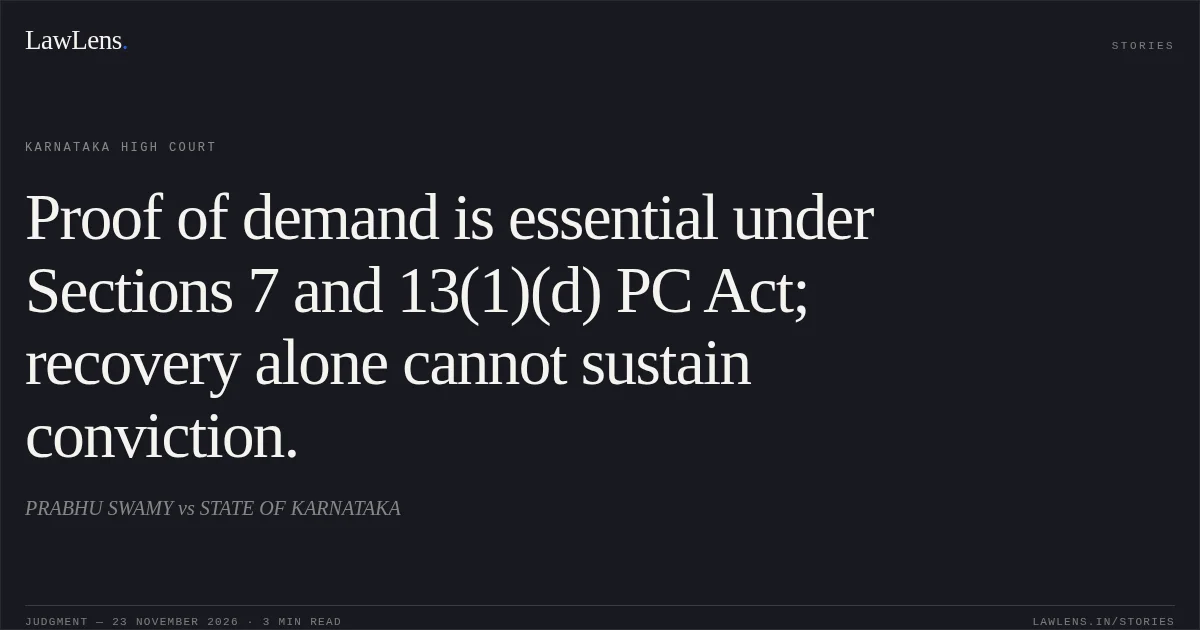
Demand and acceptance of illegal gratification were not proved beyond reasonable doubt, and recovery alone does not sustain conviction under Sections 7 and 13(1)(d) r/w 13(2) of the PC Act.
¶ 9, 13Both appeals are allowed. The Trial Court's judgment of conviction and order on sentence dated 06.01.2020 and 14.01.2020 in Special Case No.16/2012 are set aside. Accused Nos.1 (D. Rajanna) and 2 (Prabhu Swamy) are acquitted of all charges under Sections 7 and 13(1)(d) r/w 13(2) of the PC Act.
¶ 14(i) · ¶ 14(ii) · ¶ 14(iii)Original Court PDF
PRABHU SWAMYvsSTATE OF KARNATAKA
Click to open original judgment
Original judgment, available to read, download and summarize on LawLens.in