Facts
The Appellants, V.K. Datta (A1, Assistant Engineer) and Dinesh Garg (A2, Junior Engineer) of the Flood Control Department, were convicted by the Special Judge, Delhi, for offences under Sections 7 and 13(1)(d) read with 13(2) of the Prevention of Corruption Act, 1988 (PC Act).
Source reference: p. 2-5The prosecution alleged that on 20.09.1991, the Appellants demanded and accepted ₹900/- each from PW1 (a power of attorney holder for a contractor) to facilitate the release of pending bills.
Source reference: p. 2PW1 lodged a complaint with the Anti-Corruption Branch (ACB), leading to a trap where the tainted money was allegedly recovered from A1’s desk drawer and A2’s shirt pocket.
Source reference: p. 18-19The Appellants contended that the case was a malicious fabrication because A2 had previously reported PW1 for poor work quality and cement pilferage (Ext. PW8/DA).
Source reference: p. 5-6They further argued that no bills were pending for payment at the time of the alleged demand.
Source reference: p. 9Issues
1. Whether the prosecution established the foundational facts of demand and acceptance of illegal gratification beyond a reasonable doubt to sustain a conviction under the PC Act.
Source reference: p. 14, para 15; p. 32, para 232. Whether the statutory presumption under Section 20 of the PC Act can be invoked in the absence of proof regarding the demand for a bribe.
Source reference: p. 46, para 33Law Applied
The court primarily applied Sections 7 and 13 of the PC Act regarding the bribery of public servants and criminal misconduct.
Source reference: p. 2It relied on the Supreme Court precedent in Neeraj Dutta v. State (NCT of Delhi) (2023), which mandates that proof of demand is a sine qua non for conviction, and mere recovery of money is insufficient.
Source reference: p. 32-33, para 23Furthermore, the court invoked Section 114, Illustration (g) of the Indian Evidence Act, 1872, regarding the drawing of an adverse inference when the prosecution withholds material witnesses.
Source reference: p. 46, para 32Reasoning
The Court found the prosecution's narrative riddled with irreconcilable contradictions.
Source reference: no citationFirst, while PW1 alleged a demand at 10:15 AM at the Shastri Nagar office, the defense produced muster rolls (Ext. D1 and D2) showing the Appellants were on-site for inspections at that time, a fact not successfully disputed by the prosecution.
Source reference: p. 34-35, para 25-26Second, the timeline of the FIR (registered at 11:15 AM) was deemed "practically impossible" given the distance PW1 had to travel and the administrative procedures required at the CBI office.
Source reference: p. 10-11, para 12.1; p. 38, para 27Third, the testimony of the recovery witness (PW3) contradicted PW1 and the shadow witness (PW4) regarding the location of the accused during the raid and the sequence of recovery.
Source reference: p. 41, para 29Crucially, the Executive Engineer (PW5) testified that no payments were actually due to the contractor at the time of the trap, and for one project, the contractor actually owed the department money (a "minus bill"), thereby negating any motive for a bribe.
Source reference: p. 29, para 20.1; p. 43-44, para 31Finally, the Court drew an adverse inference against the prosecution for failing to examine 14 witnesses, including the actual contractor (CW14) and the officers who physically apprehended the accused.
Source reference: p. 45-46, para 32Holding
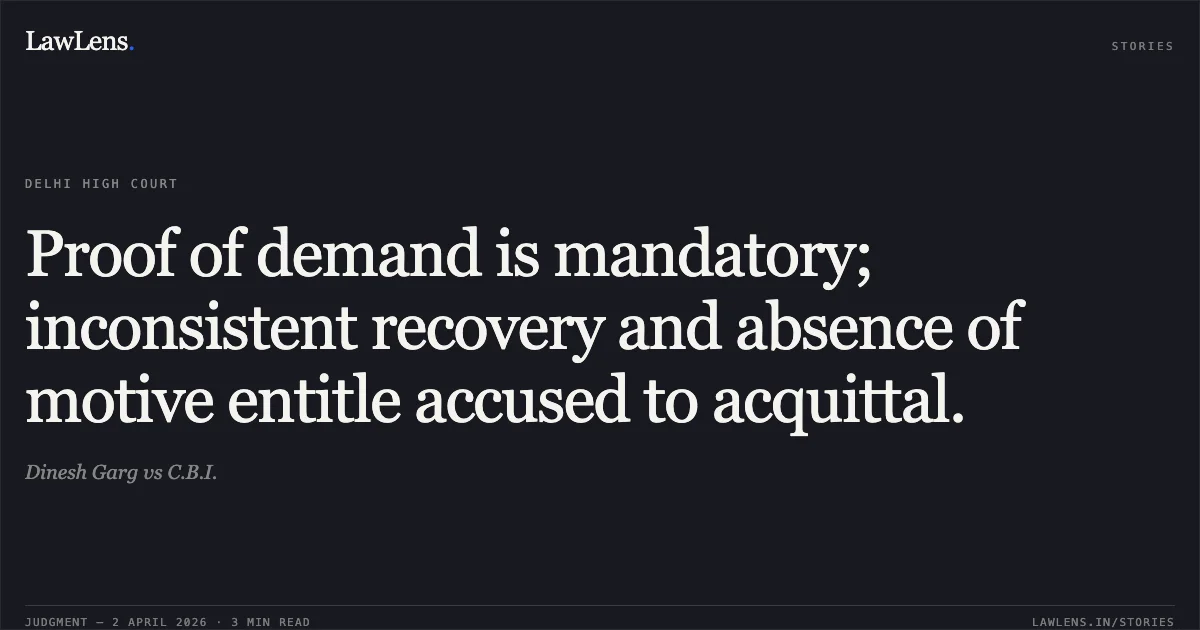
The Court held that the prosecution failed to prove the foundational fact of "demand," rendering the statutory presumption under Section 20 of the PC Act inapplicable.
Finding that the evidence was unsatisfactory and the trial court’s reliance upon it was erroneous, the High Court allowed the appeals.
Source reference: p. 47, para 34-35The conviction and sentence were set aside, and both Appellants were acquitted of all charges.
Source reference: p. 47, para 35Acts & Sections Cited
8 provisions across 2 statutes referred to in this judgment. Each provision opens on LawLens.
Code of Criminal Procedure, 19734
Prevention of Corruption Act, 19884
Original Court PDF
Dinesh GargvsC.B.I.
Click to open original judgment
Original judgment, available to read, download and summarize on LawLens.in