Facts
The Appellant, a Helper in the Gujarat Electricity Board (GEB), was accused of demanding and accepting a bribe of ₹500 from the complainant, Ratilal Sonani, for shifting residential electric wires from one pole to another.
Source reference: p.2-3The complainant alleged that the Appellant visited his house on 10.03.2004 with equipment to start work and requested the bribe at his residence later that evening.
Source reference: p.4A trap was laid by the Anti-Corruption Bureau (ACB) at the Appellant's house, where the tainted currency was recovered from his trouser pocket.
Source reference: p.6-7The Trial Court convicted the Appellant under Sections 7, 13(1)(d), and 13(2) of the Prevention of Corruption Act, 1988 (PC Act), sentencing him to three years' rigorous imprisonment.
Source reference: p.1, 8-9Issues
1. Whether the prosecution proved the demand and voluntary acceptance of illegal gratification beyond reasonable doubt, which is a sine qua non for an offence under the PC Act?
Source reference: p.30, 412. Whether the recovery of tainted notes and the presence of phenolphthalein powder on the Appellant’s hands are sufficient for conviction in the absence of a corroborated demand?
Source reference: p.41-433. Whether the procedural irregularities in the Panchnama and the non-examination of material witnesses vitiated the trial?
Source reference: p.38, 42Law Applied
The Court relied on Section 7 (Public servant taking gratification) and Section 13 (Criminal misconduct) of the PC Act.
Source reference: no citationIt applied the standard of "proof beyond reasonable doubt" as established in Ramakant Rai v. Madan Rai.
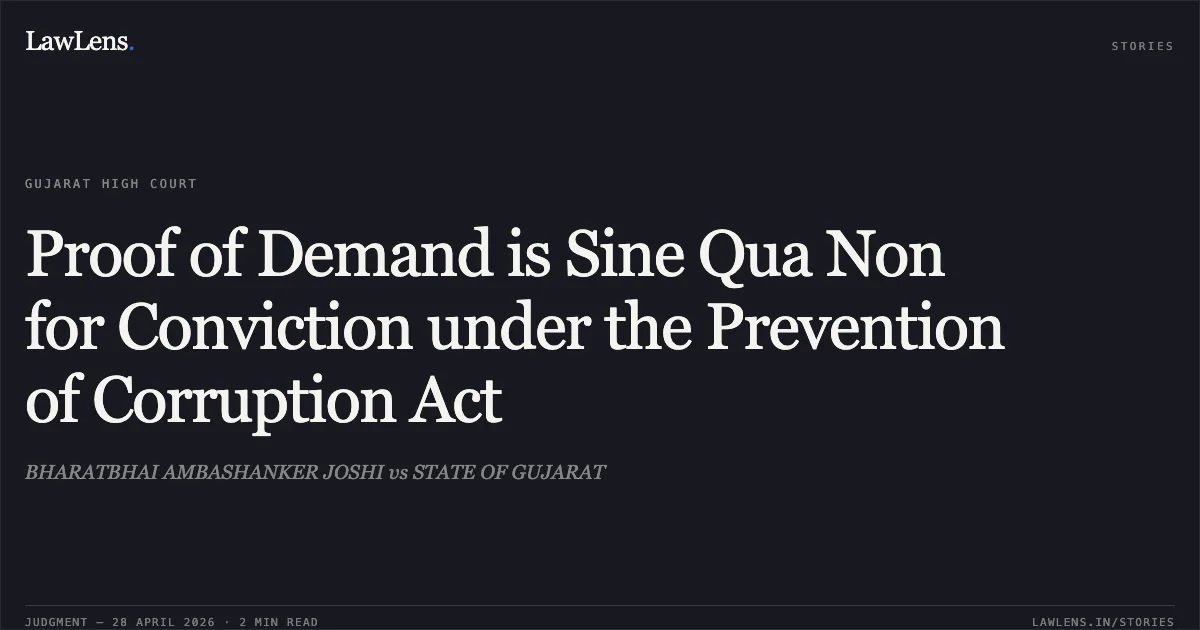
Source reference: p.20Precedents Neeraj Dutta v. State (NCT of Delhi) and P. Satyanarayana Murthy v. State of A.P. establish that proof of demand is the gravamen of the offence; mere recovery of money dehors proof of demand is insufficient for conviction.
Source reference: p.26-28The court also noted the limits of the presumption under Section 20 of the PC Act, which only arises after proof of acceptance is established.
Source reference: p.28-29Reasoning
The High Court found that the prosecution failed to establish the initial demand, noting that the ₹2,000 discussed was for legitimate material costs and the alleged bribe of ₹500 was not clearly distinguished as illegal gratification.
Source reference: p.41The Court highlighted critical contradictions: the complainant denied visiting the ACB office on 09.03.2004, whereas the Trap Officer claimed telephonic contact.
Source reference: p.33, 38Furthermore, material witnesses—the neighbor Virjibhai and the complainant’s niece (who was present during the transaction)—were not examined, creating a gap in the narrative.
Source reference: p.42The Panchnama lacked mention of the Appellant rubbing his hands together, an "afterthought" introduced in oral testimony to explain why both hands showed powder traces despite the claim of acceptance by only the right hand.
Source reference: p.43-44Procedural lapses, such as the failure to seal currency notes and the FSL officer not personally conducting the tests, further weakened the case.
Source reference: p.38-40Holding
The Court held that the prosecution failed to prove the essential ingredients of demand and acceptance beyond reasonable doubt.
The High Court allowed the appeal, quashed the conviction, and acquitted the Appellant.
Source reference: p.46It ordered the cancellation of bail bonds and the refund of fines.
Source reference: p.46Acts & Sections Cited
8 provisions across 2 statutes referred to in this judgment. Each provision opens on LawLens.
Code of Criminal Procedure, 19733
Prevention of Corruption Act, 19885
Original Court PDF
BHARATBHAI AMBASHANKER JOSHIvsSTATE OF GUJARAT
Click to open original judgment
Original judgment, available to read, download and summarize on LawLens.in