Facts
The appellant, an Assistant Grade-III (Reader) in the office of the Sub-Divisional Officer (SDO) (Revenue), was accused of demanding a bribe of ₹1,500 (₹500 for himself and ₹1,000 for the SDO) from the complainant, Rizvwanul Haq, to process a land diversion application
Source reference: para 2, 11The complainant filed a grievance with the Anti-Corruption Bureau (ACB), which provided a tape recorder to capture the demand
Source reference: para 2A trap was laid on December 23, 2004. During the trap, the appellant allegedly refused the money initially but later accepted it when presented in an envelope
Source reference: para 2, 11The trap team apprehended the appellant, and a phenolphthalein test on his fingers turned pink, indicating contact with tainted currency
Source reference: para 2The Trial Court convicted the appellant under Sections 7 and 13(1)(d) read with 13(2) of the Prevention of Corruption (PC) Act, 1988
Source reference: para 1The appellant challenged the conviction, arguing that the demand was never proved and that no work was pending in his office at the time of the trap
Source reference: para 5Issues
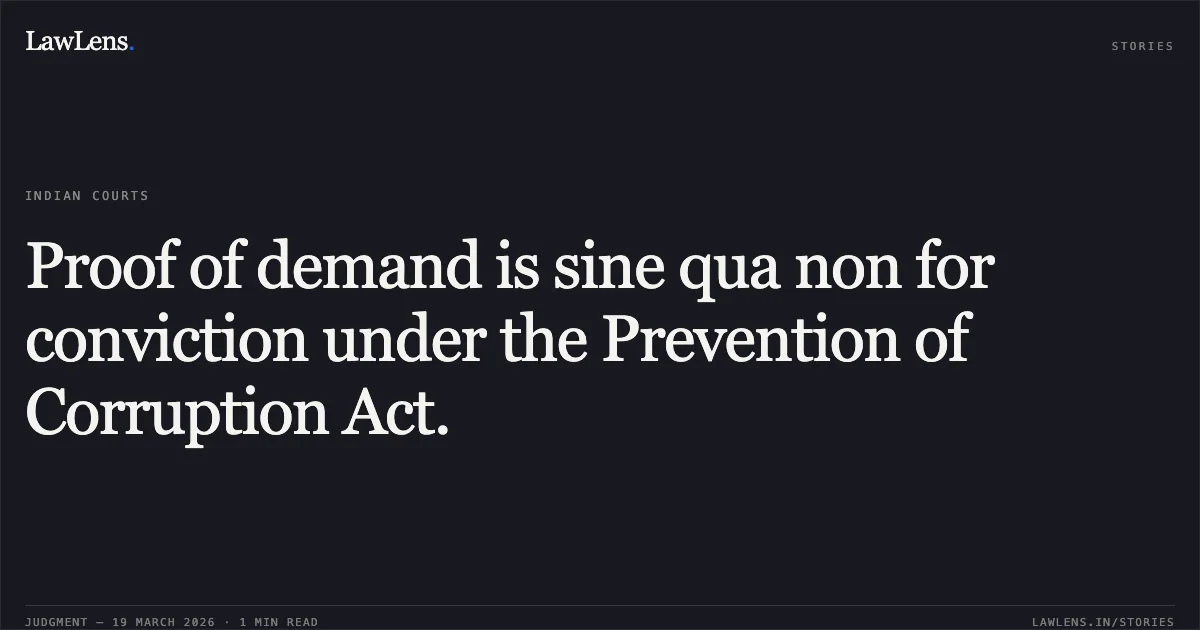
1. Whether the prosecution proved the foundational fact of "demand" of illegal gratification beyond a reasonable doubt as a prerequisite for conviction under the PC Act
Source reference: para 24, 302. Whether the recovery of tainted currency and a positive chemical test are sufficient to sustain a conviction in the absence of reliable evidence of demand and acceptance
Source reference: para 24, 303. Whether the electronic evidence (tape-recorded conversation) met the legal standards for admissibility and reliability
Source reference: para 26-27Law Applied
Section 7 and Section 13 of the Prevention of Corruption Act, 1988, regarding the bribery of public servants
Source reference: para 1The principle established in P. Somaraju v. State of Andhra Pradesh and Rajesh Gupta v. State, holding that the demand for illegal gratification is a sine qua non for the offence and mere recovery of money does not constitute guilt
Source reference: para 24The court further applied the statutory presumption under Section 20 of the PC Act, noting it only arises after foundational facts of demand are proven
Source reference: para 18, 30Voice identification must be clear and the possibility of tampering must be ruled out as per Ziyauddin Burhanuddin Bukhari v. Brijmohan Ramdas Mehra and Ram Singh v. Col. Ram Singh
Source reference: para 25-26Reasoning
The Court found the prosecution's case fundamentally flawed as the "demand," a mandatory ingredient, was not established. The complainant (PW-1) could not recall specific dates of the demand and admitted the appellant initially refused the money during the trap
Source reference: para 11Critically, the SDO (PW-6) testified that the complainant’s diversion file had been forwarded to another section months prior and was not pending with the appellant at the time of the incident
Source reference: para 15, 22The court noted that the tape-recorded transcript (Ex. P/15) was "unclear" in several vital parts and the voice was not independently verified by the Trial Court, rendering it unreliable
Source reference: para 18, 27Furthermore, the Court observed that despite the presence of other employees during the trap, no independent witnesses were examined to corroborate the transaction
Source reference: para 29The appellant’s defense—that the money was forcibly placed in his pocket—was deemed plausible given the complainant’s admission that he was directed by the ACB to use an envelope after the initial refusal
Source reference: para 11, 31Holding
The High Court allowed the appeal, setting aside the judgment of the Trial Court and acquitting the appellant of all charges
The Court held that mere recovery of tainted money is insufficient to fasten guilt when the substantive evidence regarding the demand is unreliable or missing
Source reference: para 30-31The Court directed the appellant to furnish a personal bond under Section 481 of the BNSS (formerly Section 437A CrPC) to ensure appearance in case of further legal challenges
Source reference: para 33Acts & Sections Cited
7 provisions across 3 statutes referred to in this judgment. Each provision opens on LawLens.
Code of Criminal Procedure, 19732
Prevention of Corruption Act, 19884
Bharatiya Nagarik Suraksha Sanhita, 20231
Original Court PDF
VIJAY KUMAR AHIRvsSTATE OF CHHATTISGARH
Click to open original judgment
Original judgment, available to read, download and summarize on LawLens.in