Facts
The deceased, Smt. Kunti Bai, married respondent Jagdeep Lonia approximately two years prior to her death on June 23, 2014
Source reference: para. 3, 8The complainant (the deceased's father) was informed that his daughter died of an electric shock
Source reference: para. 3Upon arrival at her matrimonial home, he observed burns on her face, mouth, and limbs and alleged murder
Source reference: para. 3The prosecution charged the respondents under Sections 302/34, 304-B, and 201 of the IPC
Source reference: para. 2Medical evidence from Dr. Jitendra Paikra (PW-11) attributed death to extensive thermal burns but remained inconclusive as to whether the death was homicidal, suicidal, or accidental
Source reference: para. 9The FSL and viscera reports found no flammable substances or chemical poisons
Source reference: para. 9The Trial Court acquitted the respondents on August 21, 2017, leading to these concurrent appeals by the complainant and the State
Source reference: para. 1-2Issues
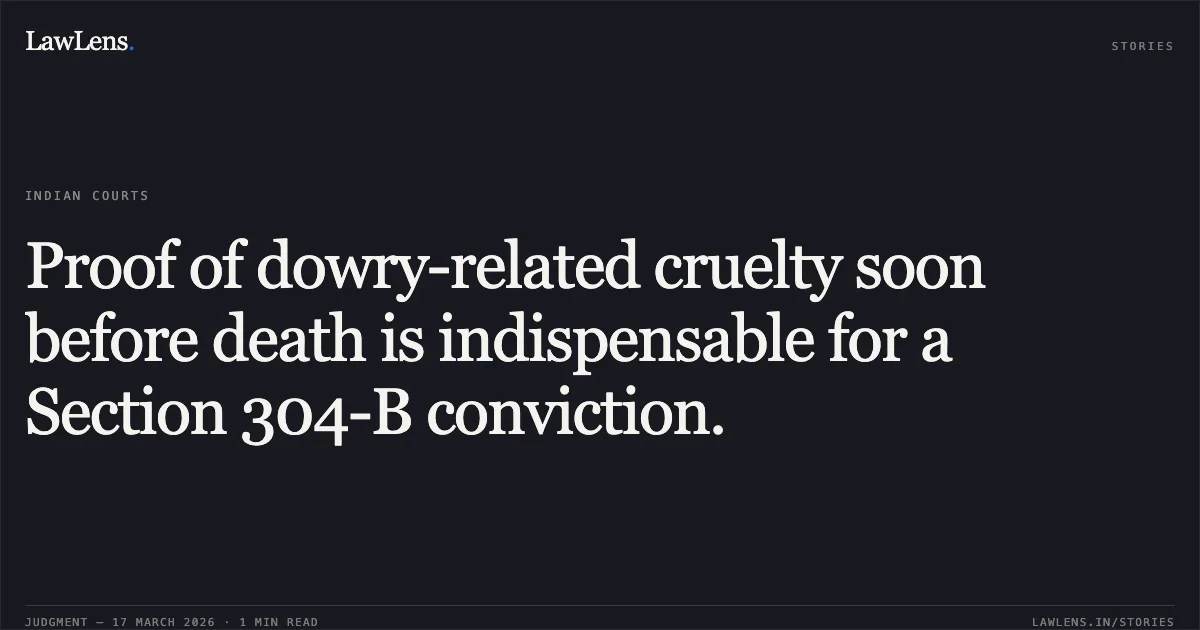
1. Whether the prosecution proved the ingredients of "dowry death" under Section 304-B of the IPC, specifically regarding cruelty or harassment in connection with dowry demands soon before death
Source reference: para. 7, 102. Whether the nature of death was established as homicidal to sustain a conviction under Section 302 IPC
Source reference: para. 9-103. Whether the appellate court should interfere with a judgment of acquittal where the Trial Court's view is plausible
Source reference: para. 16-17Law Applied
The court applied Section 304-B (Dowry Death) and Section 302 (Murder) of the IPC.
Source reference: no citationIt relied on Section 113-B of the Evidence Act regarding the presumption of dowry death, noting that such presumption only arises after the prosecution proves all essential ingredients of the offence beyond reasonable doubt
Source reference: para. 13The court cited Charan Singh @ Charanjit Singh v. The State of Uttarakhand (2023) regarding the definitions of "cruelty" and "dowry"
Source reference: para. 12The court cited Shoor Singh v. State of Uttarakhand (2024) regarding the necessity of proving harassment "soon before death"
Source reference: para. 13Finally, it applied the principles from Mallappa v. State of Karnataka (2024) regarding the limited scope of appellate interference in acquittals
Source reference: para. 16Reasoning
The Court observed that the prosecution failed to establish the foundational facts for dowry death or murder.
Source reference: no citationRegarding cruelty, only PW-2 (the deceased's brother) alleged a single instance of a slap for dowry; no other evidence suggested persistent harassment
Source reference: para. 11Conversely, the deceased’s father (PW-1) admitted in cross-examination that his daughter had a history of attempted suicide by poisoning and was "short-tempered"
Source reference: para. 14, 15Crucially, medical evidence was ambiguous; the doctor (PW-11) admitted injuries could have resulted from an electric shock and could not confirm the death was homicidal
Source reference: para. 9, 15The Trial Court found the room where the deceased was found was locked from the inside, weighing against a theory of murder
Source reference: para. 15The High Court determined that the prosecution failed to prove any cruelty related to dowry demands "soon before death"
Source reference: para. 14Holding
The High Court held that the prosecution failed to prove its case beyond reasonable doubt
It concluded that the Trial Court's view was plausible and supported by the evidence on record, specifically noting the lack of medical certainty regarding the nature of death and the deceased’s prior suicidal tendencies
Source reference: para. 15, 17Following the principle that an appellate court should not reverse an acquittal merely because a contrary view is possible, the Court found no patent illegality or perversity in the original judgment
Source reference: para. 16-17Both appeals were dismissed, and the acquittal of the respondents was upheld
Source reference: para. 18Acts & Sections Cited
4 provisions across 2 statutes referred to in this judgment. Each provision opens on LawLens.
Indian Penal Code, 18603
Dowry Prohibition Act, 19611
Original Court PDF
STATE OF CHHATTISGARHvsJAGDEEP JAIKI LONIA
Click to open original judgment
Original judgment, available to read, download and summarize on LawLens.in