Facts
The appellants (plaintiffs) entered into a sale agreement with the deceased first respondent (defendant) on 23.10.1996 to purchase the suit property for ₹2,10,000/-
Source reference: para. 4The plaintiffs paid a total of ₹60,000/- in installments and a prior mortgage of ₹10,000/- existed in their favor
Source reference: para. 4, 5The deadline for execution was 30.06.1997. The plaintiffs issued a legal notice on 25.06.1997 and a telegram on 30.06.1997, and were present at the Sub-Registrar’s Office on the final date; however, the defendant failed to appear
Source reference: para. 14, 15The Trial Court decreed specific performance in favor of the plaintiffs
Source reference: para. 9The First Appellate Court reversed this, holding that time was of the essence and that the plaintiffs failed to prove readiness and willingness
Source reference: para. 10, 18Issues
1. Whether the Lower Appellate Court was right in holding that time was the essence of the contract in a sale of immovable property
Source reference: para. 112. Whether the appellants had sufficiently established their readiness and willingness to perform their part of the contract under Section 16(c) of the Specific Relief Act
Source reference: para. 11, 233. Whether the Lower Appellate Court erred in failing to provide reasons for its conclusions as mandated under Order 41 Rule 31 of the C.P.C.
Source reference: para. 11Law Applied
The court applied Section 16(c) of the Specific Relief Act, 1963, which requires a plaintiff to aver and prove continuous readiness and willingness to perform the contract
Source reference: para. 23It relied on the legal principle that in contracts for the sale of immovable property, there is no inherent presumption that time is the essence of the contract (referencing AIR 1993 SC 1942)
Source reference: para. 11The court also applied Section 55 of the Indian Contract Act, 1872 regarding the effect of failure to perform at a fixed time
Source reference: para. 18Order 41 Rule 31 of the Code of Civil Procedure, 1908, governing the contents of an appellate judgment
Source reference: para. 11Reasoning
The High Court found that the First Appellate Court erroneously focused on the time stipulation without considering the plaintiffs' proactive conduct
Source reference: para. 18, 19The evidence established that the plaintiffs paid significant advance amounts leading up to the deadline, issued prompt legal notices, purchased stamp papers, and were physically present at the Sub-Registrar’s office
Source reference: para. 15, 20, 24Regarding financial capacity, the Court noted that under Section 16(c), a plaintiff need not physically "jingle coins" or carry cash, provided they demonstrate the means to pay
Source reference: para. 23The plaintiffs proved their capacity through Exhibit A12 (bank passbook) showing a balance of ₹95,150/- and evidence of other cash deposits and mortgage credits
Source reference: para. 21, 22Conversely, the defendant’s delay in replying and admitted intention to sell to third parties indicated a lack of bona fides
Source reference: para. 25Holding
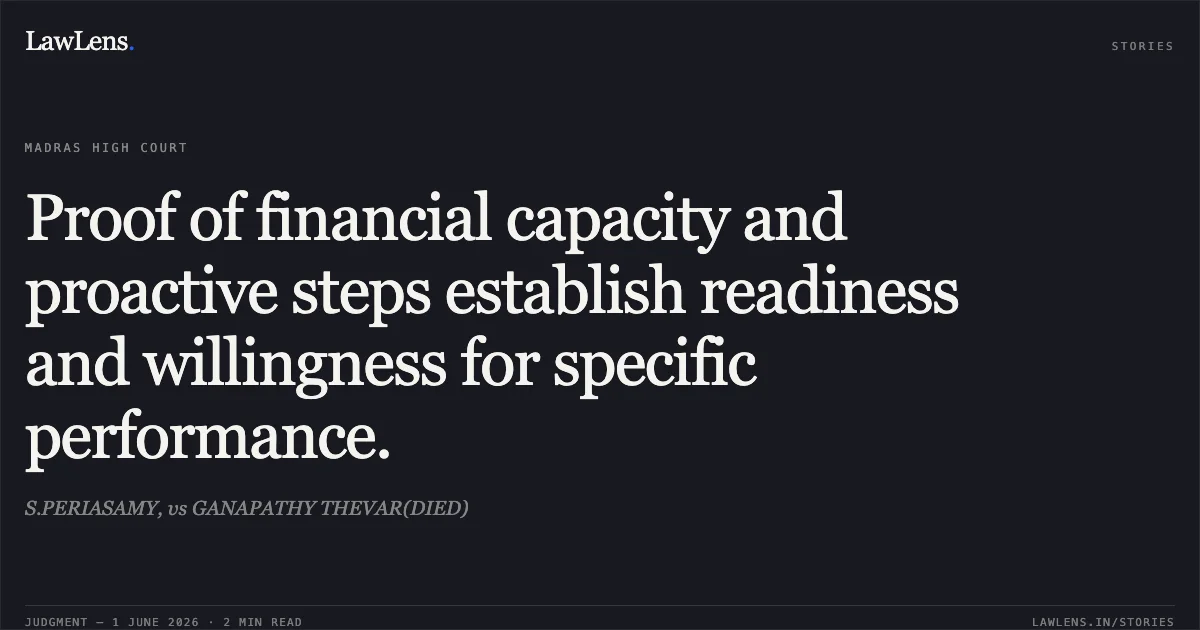
The Court held that the plaintiffs successfully proved their readiness and willingness, and the First Appellate Court had misappreciated the evidence regarding financial capacity and the essence of time
The High Court allowed the appeal and set aside the judgment of the First Appellate Court, restoring the Trial Court’s decree for specific performance. The respondents (legal heirs of the defendant) were directed to execute the sale deed upon receipt of the balance consideration
Source reference: para. 26, 27Acts & Sections Cited
4 provisions across 3 statutes referred to in this judgment. Each provision opens on LawLens.
Code of Civil Procedure, 19082
Indian Contract Act, 18721
Specific Relief Act, 19631
Original Court PDF
S.PERIASAMY,vsGANAPATHY THEVAR(DIED)
Click to open original judgment
Original judgment, available to read, download and summarize on LawLens.in