01Facts
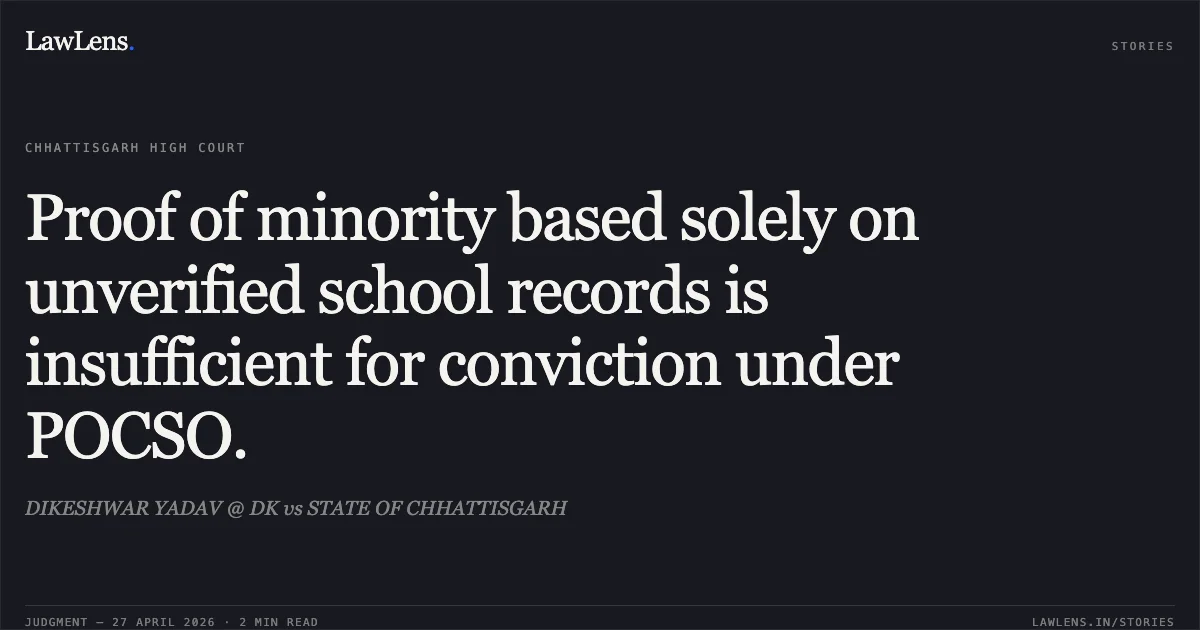
The appellant was convicted by the Trial Court on March 6, 2025, for offenses under Section 313 of the IPC and Sections 4(2) and 6 of the POCSO Act.
¶ 4The prosecution alleged that between 2017 and 2019, the appellant established a sexual relationship with the victim under the pretext of marriage while she was a minor, eventually resulting in a forced miscarriage in March 2019.
¶ 5The victim (PW-1) later filed a complaint in 2020 after the appellant refused to marry her.
¶ 5, 21The appellant challenged the conviction, contending that the relationship was consensual and that the prosecution failed to prove the victim was a minor at the time of the incident.
¶ 1202Issues
i.1. Whether the prosecution proved beyond reasonable doubt that the victim was a minor on the date of the incident.
¶ 15ii.2. Whether the sexual relationship between the appellant and the victim was consensual or constituted rape/aggravated penetrative sexual assault under the IPC and POCSO Act.
¶ 21-2203Law Applied
Section 94 of the Juvenile Justice (Care and Protection of Children) Act, 2015, read with Rule 12 of the Juvenile Justice Rules, 2007, which establishes a hierarchy of evidence for age determination, prioritizing matriculation certificates and school records over medical opinions.
¶ 24, 27, 28Jarnail Singh v. State of Haryana [(2013) 7 SCC 263], which mandates using the statutory basis for determining the age of victims.
¶ 24The principle from Birad Mal Singhvi v. Anand Purohit [1988 (Supp) SCC 604] and Alamelu v. State [(2011) 2 SCC 385], holding that school register entries have no evidentiary value under Section 35 of the Indian Evidence Act unless the source of the initial entry is examined or corroborated by material evidence.
¶ 25-26Provisions in the judgment · 15 · Linked ones open on LawLens
Bharatiya Nagarik Suraksha Sanhita, 2023 Section 415Section 481
Indian Penal Code, 1860 Section 313Section 363Section 366Section 376
Protection of Children from Sexual Offences Act, 2012 Section 4Section 5Section 6
Code of Criminal Procedure, 1973 Section 161Section 164Section 313Section 437
Juvenile Justice (Care and Protection of Children) Act, 2015. Section 9Section 94
04Reasoning
The court found the evidence regarding the victim's age insufficient to sustain a conviction under the POCSO Act. It noted that the victim (PW-1) and her mother (PW-2) admitted that the date of birth in the school register was recorded based on mere assumption/assumption of the father, without supporting documents like a birth certificate.
¶ 16-17The Headmaster (PW-3) could not verify the basis of the entry, and the medical officer (PW-4) estimated the victim's age at 18 years. Even the FIR and written complaint mentioned the victim's age as 18.
¶ 18-20The court observed that the relationship lasted over two years and the victim admitted to being in love with the appellant. The court determined the relationship was consensual, as the victim never protested or sought help despite having frequent opportunities, and only filed a complaint after the appellant decided to marry another woman.
¶ 21, 22, 3005Holding
The court answered both issues in the negative, holding that the prosecution failed to provide "clinching and legally admissible evidence" to prove the victim was a minor and failed to prove the lack of consent.
¶ 23, 30-31The High Court allowed the appeal, set aside the judgment of conviction and order of sentence dated March 6, 2025, and acquitted the appellant of all charges. The court ordered the appellant's immediate release subject to the fulfillment of a personal bond under Section 437-A of the Cr.P.C.
¶ 31-33Original Court PDF
DIKESHWAR YADAV @ DKvsSTATE OF CHHATTISGARH
Click to open original judgment
Original judgment, available to read, download and summarize on LawLens.in