Facts
The Appellant’s services were terminated by the Respondent on 27.09.1988 on grounds of misconduct, specifically insubordination and refusal to collect payments from customers
Source reference: p. 1-2The Appellant challenged the termination before the Labour Court-01, Karkardooma, alleging violation of natural justice as no domestic inquiry was held prior to the dismissal
Source reference: p. 2The Labour Court allowed the Respondent to prove the charges by leading evidence; after examining witnesses and cross-examination, the Labour Court found the charges proved and upheld the termination
Source reference: p. 2-3The Appellant filed a writ petition challenging the Award, which was dismissed by a learned Single Judge on 02.04.2013
Source reference: p. 2This intra-court appeal seeks to set aside that dismissal
Source reference: p. 1Issues
1. Whether the termination of service was vitiated by a violation of the principles of natural justice given that no domestic inquiry was conducted prior to dismissal
Source reference: p. 8 / para. 72. Whether the punishment of dismissal was disproportionate to the proved charge of refusing to follow instructions
Source reference: p. 9 / para. 93. Whether a workman is entitled to back wages from the date of termination until the date of the award if the misconduct is proved for the first time before the Labour Court
Source reference: p. 9 / para. 10Law Applied
The Court applied the principle that an employer may justify a dismissal without a prior inquiry by leading evidence before the Industrial Tribunal/Labour Court
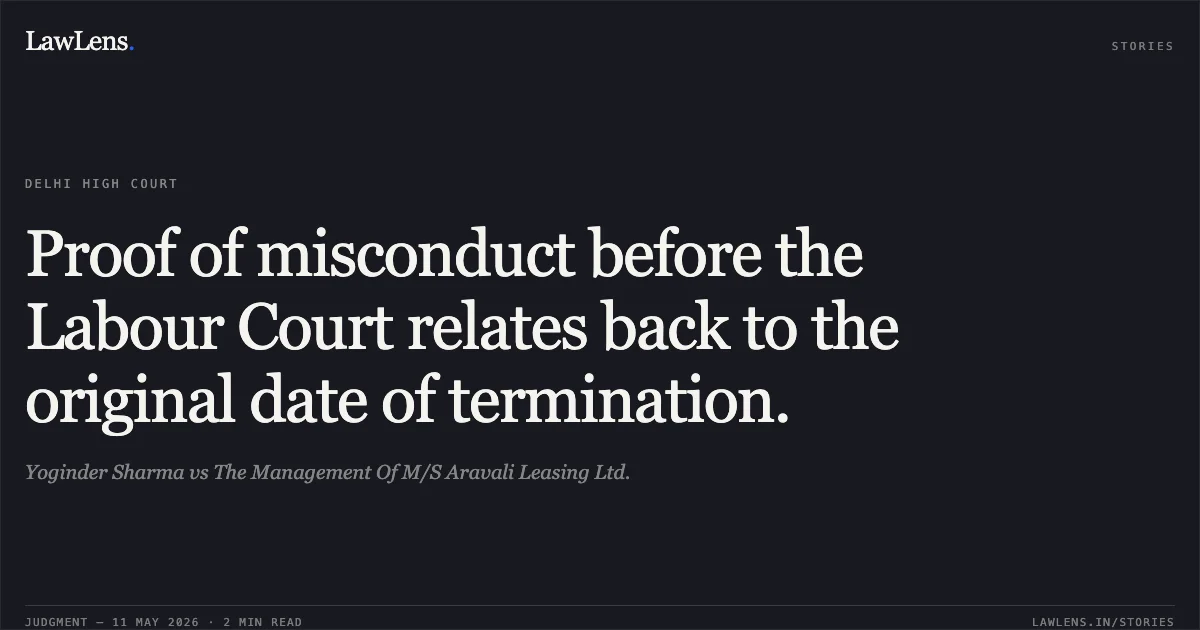
Source reference: p. 7 / para. 30It relied on the Constitution Bench decision in P.H. Kalyani v. Air France [1964], which established the "relation back" doctrine, holding that if a dismissal is justified before a Labour Court, the approval relates back to the original date of termination
Source reference: p. 9-10 / para. 11It further followed R. Thiruvirkolam v. Presiding Officer [(1997) 1 SCC 9], which affirmed the Kalyani precedent and declared the contrary view in Gujarat Steel Tubes Ltd. v. Gujarat Steel Tubes Mazdoor Sabha to be per incuriam
Source reference: p. 10 / para. 11Reasoning
The Court reasoned that once the Management established the charges of misconduct before the Labour Court through witness testimony and cross-examination, any initial defect in natural justice was cured as the Appellant received a full hearing before an independent judicial officer
Source reference: p. 8 / para. 8On proportionality, the Court held that refusal to obey lawful instructions (collecting deposits) strikes at the root of the employer-employee relationship and constitutes serious insubordination justifying dismissal
Source reference: p. 9 / para. 9Regarding back wages, the Court rejected the Appellant’s claim that termination should take effect only from the date of the Award; citing Thiruvirkolam, the Court held that when a termination is upheld based on evidence before the Labour Court, the order operates from the original date of dismissal (18.11.1981 in the cited precedent; 27.09.1988 herein)
Source reference: p. 10-11 / para. 11Holding
The termination was valid as charges were proved via the legal process before the Labour Court; Dismissal was not disproportionate for insubordination; and The Appellant is not entitled to back wages up to the date of the award
The Division Bench upheld the Single Judge's order and dismissed the appeal as being without merit
Source reference: p. 11 / para. 13Acts & Sections Cited
1 provisions across 1 statute referred to in this judgment. Linked provisions open on LawLens.
Industrial Disputes Act, 19471
Original Court PDF
Yoginder SharmavsThe Management Of M/S Aravali Leasing Ltd.
Click to open original judgment
Original judgment, available to read, download and summarize on LawLens.in