Facts
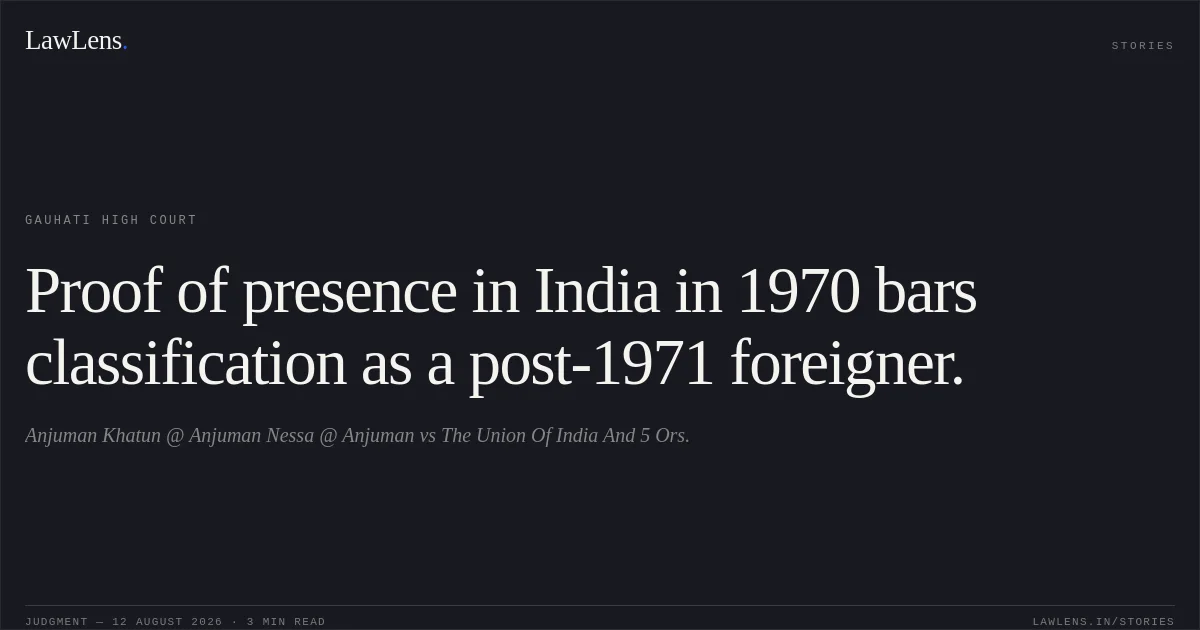
The petitioner challenged an opinion dated 11 October 2019 of the Foreigners Tribunal–XI, Barpeta, declaring her to be a foreigner who entered India after 1971.
Source reference: p.2, para.1Before the Tribunal, she examined herself and her brother and relied principally on voters’ lists of 1966, 1970 and 1985. The 1966 voters’ list contained the names of her parents, brother and sister-in-law, but not the petitioner; the 1970 voters’ list contained her name along with her husband and in-laws, while the 1985 voters’ list also recorded her name with her husband.
Source reference: p.2, para.4; p.3, paras.9–10The petitioner contended that the 1970 voters’ list established her presence in India before the relevant cut-off period and that the Tribunal had ignored material evidence. The State disputed the existence of documentary linkage between the petitioner and her parents and argued that the 1970 entry did not establish her continuous residence thereafter.
Source reference: p.3, paras.5–7Issues
Whether the Foreigners Tribunal erred in declaring the petitioner a foreigner who entered India after 1971 despite the 1970 voters’ list containing her name?
Source reference: p.3, paras.5–7; p.4, paras.9–12Whether the evidence established that the petitioner was present in India before 1966, so as to avoid a declaration in the 1966–1971 stream?
Source reference: p.4, paras.11–13Whether the petitioner discharged the burden of proof imposed by Section 9 of the Foreigners Act, 1946?
Source reference: p.3, para.8; p.4, paras.9–11Law Applied
The Court applied Section 9 of the Foreigners Act, 1946, under which the burden of proving that a person is not a foreigner lies upon that person, notwithstanding anything contained in the Indian Evidence Act, 1872.
Source reference: p.3, para.8The Court reiterated that this burden remains on the proceedee and does not shift.
Source reference: p.3, para.8It further applied the principle that a voters’ list contemporaneously recording a proceedee’s name may constitute relevant documentary evidence of the person’s presence in India, although oral testimony of a projected relative cannot, by itself, ordinarily establish citizenship.
Source reference: p.4, paras.9–10Reasoning
The Court accepted that the 1966 voters’ list did not directly establish the petitioner’s presence in India because it contained only the names of her parents and other relatives, and there was no documentary linkage connecting her to them.
Source reference: p.4, paras.9, 11However, the 1970 voters’ list directly recorded the petitioner’s name with her husband and in-laws, thereby establishing her presence in India in 1970.
Source reference: p.4, paras.9–10In light of that documentary evidence, the Tribunal could not reasonably classify her as a post-1971 foreigner.
Source reference: p.4, paras.11–13At the same time, because the petitioner failed to produce documentary or otherwise acceptable evidence proving her presence in India before 1966, the Court did not treat the 1970 entry as establishing pre-1966 presence. The appropriate classification was therefore the 1966–1971 stream.
Source reference: p.4, paras.11–13Holding
The Gauhati High Court held that the Foreigners Tribunal’s opinion was unsustainable insofar as it declared the petitioner a foreigner who entered India after 1971 and accordingly set aside that part of the opinion.
However, the Court held that the petitioner had not established her presence in India before 1966 and directed that her declaration as a foreigner would fall within the 1966–1971 stream.
Source reference: p.4, para.13The writ petition was allowed with those observations; the petitioner was directed to take the consequential steps prescribed by law, and the records were ordered to be returned to the Foreigners Tribunal.
Source reference: p.4, paras.14–16Acts & Sections Cited
1 provisions across 1 statute referred to in this judgment. Linked provisions open on LawLens.
Foreigners Act, 19461
Original Court PDF
Anjuman Khatun @ Anjuman Nessa @ AnjumanvsThe Union Of India And 5 Ors.
Click to open original judgment
Original judgment, available to read, download and summarize on LawLens.in