Facts
The appellant/husband married the deceased, Radha Devi, in 2015. It was alleged that after marriage, the appellant subjected the deceased to continuous cruelty and harassment regarding dowry demands.
Source reference: p.2On 26.11.2019, the appellant allegedly assaulted the deceased and set her on fire by pouring kerosene.
Source reference: p.2She succumbed to her injuries on 12.12.2019 at PMCH, Patna.
Source reference: p.2A fardbeyan was recorded by the deceased's mother (PW-4), leading to a trial where the appellant was convicted under Section 304B of the IPC and sentenced to 10 years rigorous imprisonment, while being acquitted of Section 302 and 498A charges.
Source reference: p.2/6The appellant challenged the conviction, claiming the death was an accidental kitchen fire.
Source reference: p.12Issues
1. Whether the prosecution successfully established the essential ingredients of "dowry death" under Section 304B IPC, specifically the element of cruelty "soon before death".
Source reference: p.6 / para. 14-152. Whether the defense of accidental death and the delay in lodging the FIR were sufficient to rebut the statutory presumption against the appellant.
Source reference: p.12 / para. 21; p.15 / para. 23Law Applied
The court applied Section 304B of the Indian Penal Code (IPC), which defines dowry death as a death caused by burns or bodily injury under abnormal circumstances within seven years of marriage, where it is shown that "soon before" death the woman was subjected to cruelty by her husband or relatives in connection with dowry.
Source reference: p.6-7The court also applied evidentiary principles regarding the "proximate and live link" required between cruelty and death.
Source reference: p.11-12It recognized the admissibility of oral dying declarations made to family members as corroborative evidence.
Source reference: p.14-15Reasoning
The court found that two ingredients—death within seven years and death by burns—were undisputed.
Source reference: p.7To satisfy the "soon before death" requirement, the court analyzed testimony from the deceased’s brother, mother, and father (PW-1, PW-4, PW-5), noting a continuous pattern of harassment from 2015 until the fatal incident in 2019.
Source reference: p.8-11The court held that "soon before" is a relative term requiring a "proximate and live link" rather than a specific timeframe, which was established by the sequence of assault followed immediately by the burning.
Source reference: p.11-12The court rejected the defense of an accidental kitchen fire, noting the appellant’s suspicious absence from the hospital despite claims of trying to save her, and dismissed the testimony of neighboring witnesses (PW-2, PW-6, PW-7) as interested and contradictory.
Source reference: p.13-14The court further held that while the police caused a delay in formal FIR registration, the family's delay was natural as their priority was medical treatment.
Source reference: p.15-16Holding
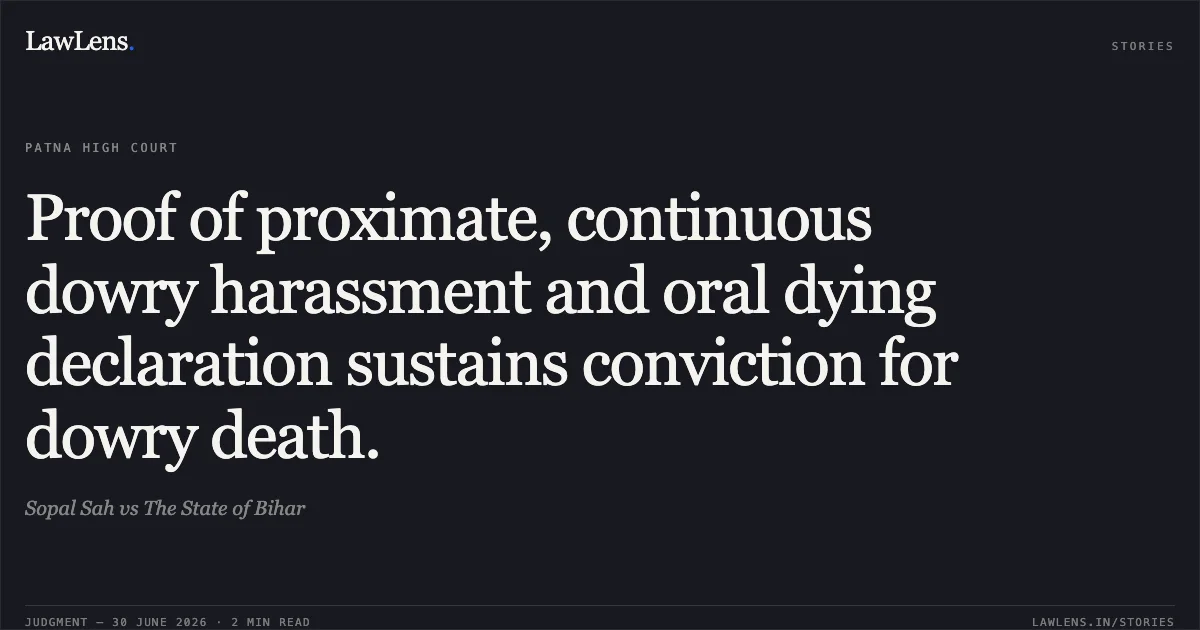
The court answered the issues in the affirmative for the prosecution, upholding the conviction. It held that the prosecution proved all ingredients of Section 304B IPC and that the oral dying declaration made to the mother served as vital corroboration.
The appeal was dismissed, the judgment of conviction dated 19.06.2024 and the sentence dated 26.06.2024 were affirmed, and the trial court was directed to take necessary action for compliance.
Source reference: p.16-17Acts & Sections Cited
5 provisions across 3 statutes referred to in this judgment. Each provision opens on LawLens.
Indian Penal Code, 18602
Code of Criminal Procedure, 19731
Original Court PDF
Sopal SahvsThe State of Bihar
Click to open original judgment
Original judgment, available to read, download and summarize on LawLens.in


