Facts
On April 12, 2016, at approximately 6:15 p.m., police officials raided a spot at village Tikarikhar based on an informer's tip regarding a group assembled to commit dacoity.
Source reference: para 2The appellant was arrested alongside seven co-accused, and an iron sword (talwar) was allegedly seized from his possession.
Source reference: para 2, 11The Trial Court, in Session Trial No. 76/2016, acquitted all accused of charges under Sections 399 and 402 of the IPC (preparation for dacoity).
Source reference: para 5However, the appellant was convicted under Section 25(1-B)(b) of the Arms Act and sentenced to three years of rigorous imprisonment.
Source reference: para 1, 5The appellant challenged this conviction on the grounds that no independent witnesses were joined in the recovery and the mandatory statutory notification was not produced.
Source reference: para 6Issues
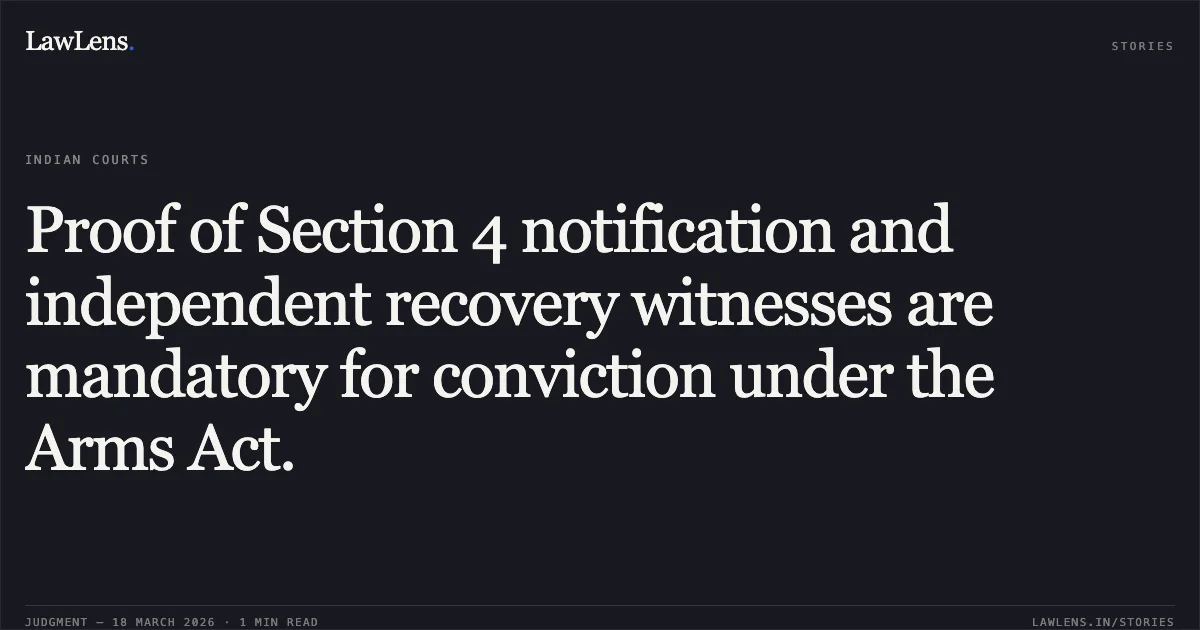
1. Whether the prosecution’s failure to produce the Official Gazette notification required under Section 4 of the Arms Act, 1959, is fatal to the conviction.
Source reference: para 9, 152. Whether a conviction under the Arms Act can be sustained solely on the testimony of police witnesses when independent public witnesses were available but not joined.
Source reference: para 10, 17-18Law Applied
The Court primarily applied Section 4 of the Arms Act, 1959, which stipulates that the possession of arms other than firearms is only regulated in specific areas if the Central Government directs so via a notification in the Official Gazette.
Source reference: para 9The Court further relied on the Supreme Court principle from Sans Pal Singh v. State of Delhi (AIR 1999 SC 49), which holds that maintaining a conviction is unsafe when recoveries are supported only by police officials despite the availability of public witnesses who were not associated with the search.
Source reference: para 10, 17Reasoning
The Court found that the prosecution failed to prove or even produce the mandatory notification under Section 4 of the Arms Act, which is essential to establish that the possession of a sword was prohibited in that specific area.
Source reference: para 15Regarding the recovery, the Court noted that the seizure witness (PW-2) was a police driver, not an independent witness, and he subsequently turned hostile.
Source reference: para 11-12, 14The Court emphasized that the seizure occurred near a liquor shop at 6:15 p.m., a time and place where independent witnesses would ordinarily be available.
Source reference: para 18Following the precedent in Sans Pal Singh, the Court reasoned that the police’s failure to join public witnesses without a valid explanation rendered the recovery unreliable.
Source reference: para 17-18Since the conviction rested exclusively on the uncorroborated testimony of police officials and a procedurally deficient seizure, it was deemed unsustainable in law.
Source reference: para 13, 19Holding
The High Court allowed the appeal and set aside the impugned judgment dated February 16, 2017.
The Court held that the appellant's conviction under Section 25(1-B)(b) of the Arms Act was legally untenable due to the absence of the requisite Section 4 notification and the lack of independent evidence for the seizure.
Source reference: para 15, 19The appellant was acquitted, and the Court ordered the trial court to take immediate action for compliance.
Source reference: para 20-21Acts & Sections Cited
4 provisions across 2 statutes referred to in this judgment. Each provision opens on LawLens.
Arms Act, 19592
Indian Penal Code, 18602
Original Court PDF
Lallan Singh(Out Jail)vsState Of Chhattisgarh
Click to open original judgment
Original judgment, available to read, download and summarize on LawLens.in