Facts
The complainant alleged that the accused borrowed ₹2,50,000 on 8 August 2017 and issued a cheque dated 1 February 2018 towards repayment. The cheque was dishonoured with the endorsement “payment stopped by drawer”; after notice and non-payment, the complainant filed a complaint under Section 138 of the Negotiable Instruments Act, 1881 (NI Act).
Source reference: pp. 3–4, paras. 4–5The trial court convicted the accused and imposed a fine of ₹5,00,000, including ₹4,90,000 as compensation; the appellate court affirmed the conviction.
Source reference: p. 5, paras. 7–9In revision, the accused maintained that the complainant lacked the financial capacity to lend the amount and that the cheque was among signed cheques allegedly misplaced from the accused’s home. She relied, among other things, on a stop-payment letter given to the bank on 12 January 2018.
Source reference: pp. 6–8, 17, paras. 12, 26, 37Issues
Whether the concurrent judgments of conviction were perverse, grossly erroneous, or otherwise within the limited grounds for interference in revisional jurisdiction
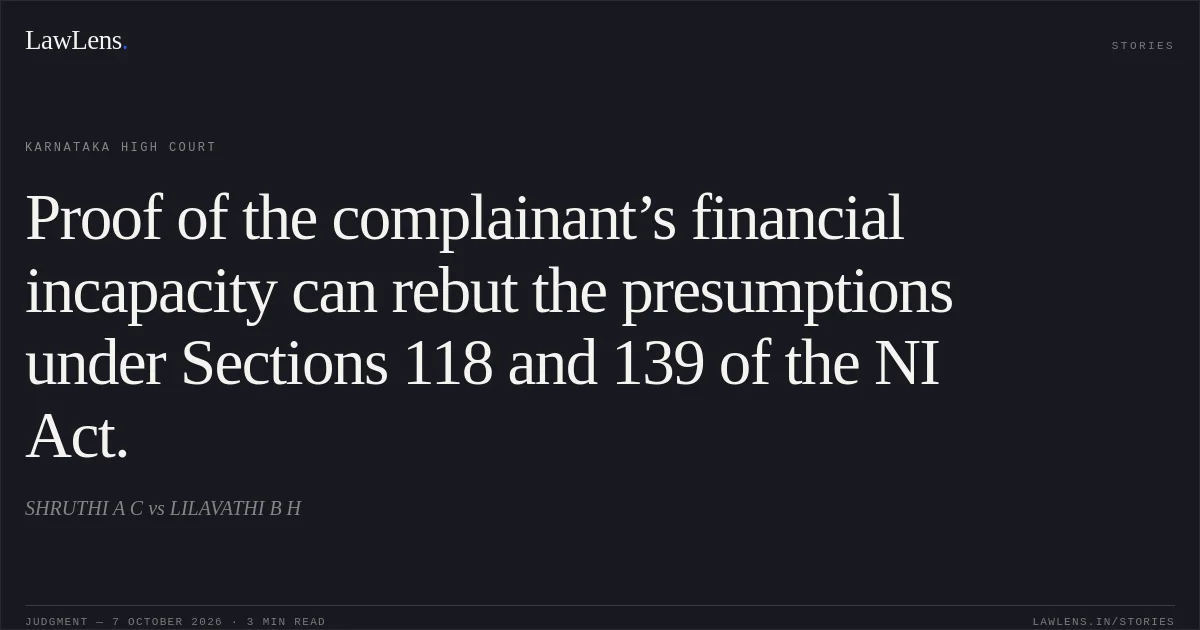
Source reference: p. 10, para. 15Whether the accused rebutted the statutory presumptions under Sections 118 and 139 of the NI Act by raising a probable defence concerning the complainant’s financial capacity and the circumstances of the stop-payment instruction
Source reference: pp. 14–15, 17–18, 20–28, paras. 20–21, 25–42Law Applied
Section 138 of the NI Act penalises dishonour of a cheque issued for discharge of a legally enforceable debt or liability, subject to the statutory requirements of presentation, demand notice and failure to pay. Sections 118 and 139 create rebuttable presumptions that a cheque was drawn for consideration and received towards a legally enforceable debt; the accused may rebut them on a preponderance of probabilities, after which the complainant must prove the debt.
Source reference: pp. 14–15, paras. 19–20Dishonour due to a stop-payment instruction may still attract Section 138, but the accused may show that the instruction was issued for a valid reason, including the absence of an existing debt (*M.M.T.C. Ltd. v. Medical Chemicals & Pharma (P) Ltd.*, (2002) 1 SCC 234, relying on *Modi Cements Ltd. v. Kuchil Kumar Nandi*, (1998) 3 SCC 249).
Source reference: pp. 28–30, para. 43Revisional jurisdiction is supervisory, not a second appeal; interference is warranted where findings are perverse, grossly erroneous or unreasonable, based on irrelevant or no material, or reached through arbitrary or capricious exercise of discretion (*Kuntegowda v. Thurubaiah*, 2026 SCC OnLine SC 1485; *State of Kerala v. Puttumana Illath Jathavedan Namboodiri*, (1999) 2 SCC 452).
Source reference: pp. 10–13, paras. 17–18Reasoning
The High Court found that the complainant’s admissions and the Grameen Koota records showed that she had no independent income and remained indebted around the time of the alleged loan; her claimed source of funds—a gift from her father—was unsupported by documents. The court also found PW.2’s account of repaying ₹2,50,000 to the complainant unreliable.
Source reference: pp. 18–22, 26–28, paras. 27–33, 41–42Further, the accused had given the bank a stop-payment instruction before the cheque’s date, stating that several signed cheques had been misplaced. The High Court considered this evidence sufficient to raise a probable defence and rebut the presumptions.
Source reference: pp. 23–25, 28–32, paras. 34–40, 42–48It held that the trial and appellate courts had overlooked material evidence and misappreciated the record, providing grounds for revision despite the concurrent findings.
Source reference: pp. 23–25, 28–32, paras. 34–40, 42–48Holding
The High Court answered the revisional issue in the affirmative, allowed the revision and set aside the conviction and sentence imposed by the trial court and affirmed by the appellate court.
The accused was acquitted of the offence under Section 138 of the NI Act, and the amount in deposit was ordered to be refunded to her upon proper identification.
Source reference: pp. 32–33, paras. 47–49Acts & Sections Cited
8 provisions across 2 statutes referred to in this judgment. Each provision opens on LawLens.
Code of Criminal Procedure, 19734
Negotiable Instruments Act, 18814
Original Court PDF
SHRUTHI A CvsLILAVATHI B H
Click to open original judgment
Original judgment, available to read, download and summarize on LawLens.in