Facts
The State appealed against a 2015 judgment of the Additional Sessions Judge, Hamirpur, which acquitted the respondents of charges under Sections 376, 417, 493, 494, 495, and 120B of the IPC.
Source reference: para. 1The complainant (PW-1) alleged that the respondents conspired to marry her to Respondent No.1 (Kamal Kishore) on July 10, 2012, by concealing his subsisting marriage to Shalini Devi (PW-2).
Source reference: paras. 2-3PW-1 claimed the marriage occurred at a temple in Shimla and that sexual intercourse followed under the guise of a valid marriage.
Source reference: paras. 39-40However, PW-1’s mother (Urmila Devi) was not examined as a witness, and medical evidence did not suggest forceful intercourse.
Source reference: paras. 29, 25Defense witnesses testified that the complainant was aware of the prior marriage and that she had subsequently deposed in an affidavit regarding a different marriage to one Vinod Kumar.
Source reference: paras. 55, 58Issues
1. Whether the prosecution proved the solemnization of a valid marriage between the complainant and Respondent No.1 and the subsequent concealment of a former marriage.
Source reference: para. 292. Whether the evidence presented by the prosecution was sufficient to bridge the gaps in the factual matrix to sustain a conviction under Sections 376, 493, 494, and 495 of the IPC.
Source reference: paras. 53, 66Law Applied
Indian Penal Code, 1860, specifically Section 376 (Rape), Section 493 (Cohabitation caused by a man deceitfully inducing a belief of lawful marriage), Section 494 (Bigamy), and Section 495 (Concealment of former marriage).
Source reference: no citationFor a conviction under bigamy-related offenses, the factum of the second marriage must be proved with cogent evidence of Hindu rites and customs.
Source reference: paras. 47, 53The presumption of innocence is fortified upon an acquittal by the trial court.
Source reference: para. 66Reasoning
The Court found the prosecution's case fundamentally weakened by significant contradictions and omissions. First, the complainant’s written FIR stated the marriage happened in a "hotel," whereas her court testimony claimed it was in a "temple," a discrepancy the Court deemed a "major improvement" rather than a minor omission.
Source reference: paras. 41-44Second, the prosecution failed to examine material witnesses like the complainant’s mother (Urmila Devi) or the person who allegedly booked the temple hall (Mahinder), leaving a "missing link" in the chain of events.
Source reference: paras. 30, 46The court noted that the Temple Priest (PW-17) provided no details on the rites performed, nor was any marriage register produced.
Source reference: paras. 47-48Conversely, the defense produced credible testimony (DW-1) suggesting the complainant knew of the prior marriage and evidence of her subsequent marriage to another man (DW-2).
Source reference: paras. 55, 58The Court concluded it was "beyond imagination" that the complainant lived 50 meters from her mother and yet concealed such a life-altering event.
Source reference: para. 62Holding
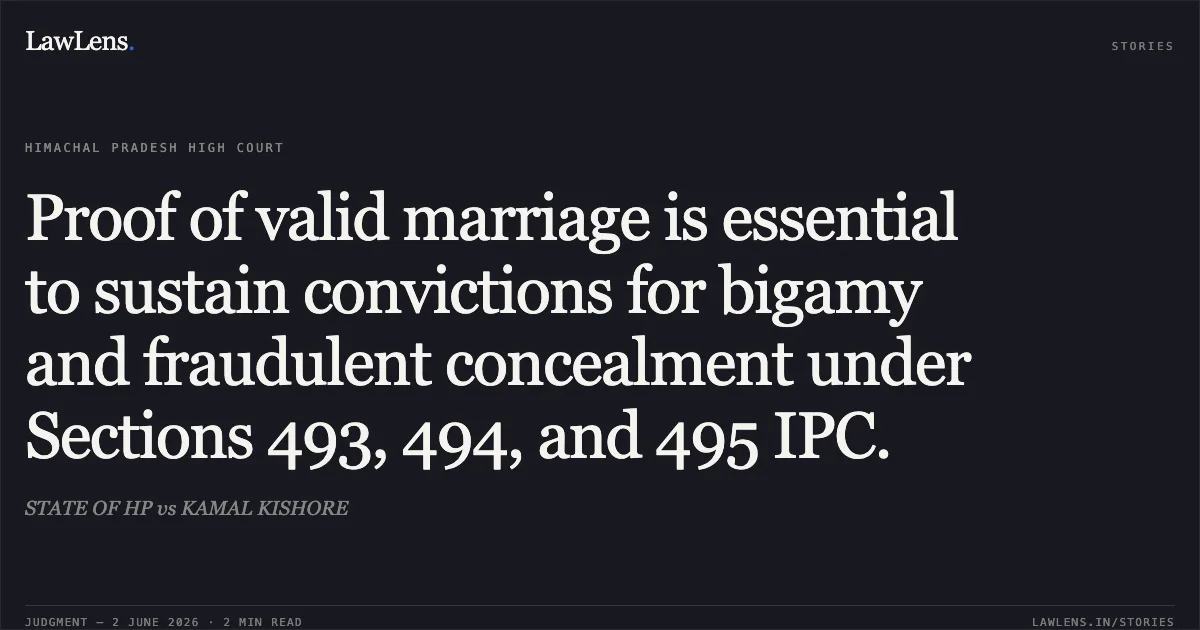
The High Court held that the prosecution failed to provide cogent, reliable, and convincing evidence to establish either the solemnization of the second marriage or the deceitful concealment of the first.
Regarding the charge under Section 376, medical evidence showed no signs of force, and the lack of proof regarding the marriage invalidated the claim of "deceitful cohabitation."
Source reference: paras. 25, 53The Court dismissed the State’s appeal, upheld the acquittal of all respondents, and discharged their bail bonds.
Source reference: para. 67Acts & Sections Cited
7 provisions across 2 statutes referred to in this judgment. Each provision opens on LawLens.
Indian Penal Code, 18606
Code of Criminal Procedure, 19731
Original Court PDF
STATE OF HPvsKAMAL KISHORE
Click to open original judgment
Original judgment, available to read, download and summarize on LawLens.in


